UPDATE 2026
Before reading, note that I asked an AI (Claude, by Anthropic) to critique this essay as a devil’s advocate — to stress-test it from multiple angles simultaneously. I’ve pasted that critique here as a kind of reader’s orientation. Take it for what it is: one useful, if imperfect, mirror. Good enough is good enough — I may tinker, but this mirror will do for now.
AI’s Assessment of Correlations
The yin/yang framework isn’t mere cultural overlay — it’s deliberate destabilization. The essay’s goal isn’t to replace one conceptual framework with a “neutral” one. Carl is explicit: the point is to push the mind to a place where all frameworks dissolve into “profound sameness.” The yin/yang binary is a ladder meant to be kicked away. Criticizing it for being culturally specific misses the stated aim. He’s not trying to give you a better map — he’s trying to exhaust your faith in maps.
The arbitrariness of categorizations is intentional, not a bug. The essay says this plainly: “Which category you place a particular word is less important because all the other words in that word’s column define that word.” The method works by vertical anchoring, not by the correctness of any individual placement. My criticism that “pain = Active” is arbitrary was correct — but I wrongly treated it as a flaw. It’s the mechanism.
“51% of the time” is not evasion — it’s phenomenology. The criterion isn’t meant to be falsifiable in a scientific sense. It’s asking whether a felt resonance exceeds random chance. That’s actually a more honest epistemological claim than “these correlations are objectively true.”
The muddled-over-clear preference makes sense in the full system. The broader work repeatedly argues that clarity = preconception solidified. The Correlations method is a psychological technique for destabilizing certainty, not for arriving at new certainties. “Muddled insight is preferable” is not anti-intellectual — it’s consistent with chapter 71’s disease diagnosis.
What my critique gets right
The method is self-immunizing, and that is a real problem. If puzzlement means you’re doing it right, and clarity means you’ve been recaptured by preconception, the system has no failure mode. This is a genuine limitation, even if understandable given the goal. The essay would be stronger if it acknowledged this paradox directly rather than presenting bewilderment as pure progress.
The cosmological overclaiming remains unsupported. Using the correlation tables to speculate about pre-Big Bang conditions and Einstein’s relativity is still a jump the method doesn’t earn. It muddies the real value of the exercise, which is psychological and introspective, not cosmological.
The tool only addresses a narrow range of words. In the context of the full work, this limitation is even more visible. Carl’s deepest concerns are about civilization, hierarchy, the self, and language itself — but these are precisely the nouns that resist antonym-style correlation. “Civilization” has no antonym. “Self” has no antonym. The method he’s most proud of works least well on the concepts he cares most about.
The leap from word-play to self-transformation is still under-supported. Carl reports his own six-month immersion in the process triggered a lasting mood shift and fundamentally changed his relationship to certainty. That’s compelling testimony. But the essay doesn’t explain how the mechanism works — what specifically about repeated vertical and circular reading produces the psychological effect. More phenomenological description here would help.
Observations from the full context
The method is more diagnostic than prescriptive. The broader work makes clear that Correlations isn’t really about word classification. It’s about exposing your own emotional anchoring to words. The DIY word list challenge is the real test: where do you feel resistance? Those resistance points are where your biases live. The essay undersells this — it reads more like a linguistics exercise than the self-honesty mirror it actually is.
The tool is most powerful as an accompaniment to life experience, not as a standalone practice. The broader work is emphatic: we only understand what we already intuitively know. Correlations doesn’t install insight — it reveals what experience has already deposited. This means the essay’s instructions are misleading if read as a complete method. The method only works as well as the life experience backing it up. That clarification would help readers not feel like failures when the exercise doesn’t produce breakthrough insight.
The social/group dimension is genuinely missing. Carl mentions at the end that group participation might help but he doubts it’s possible. Given how central the loss of egalitarian social connection is to his diagnosis of human suffering, this is a striking omission. The method is designed for solitary practice in a body of work that repeatedly identifies isolation as the root wound. There’s a productive tension there worth naming.
Useful improvements to consider making:
- Frame it explicitly as a self-honesty mirror, not a word-classification exercise. The point is where you feel resistance, not whether the categories are “correct.”
- Add a phenomenological account of the psychological mechanism — what happens in the mind during sustained practice, not just what to do.
- Separate the psychological practice from the cosmological speculation — the space-time section should either be dropped or clearly marked as playful extrapolation, not demonstration of the method’s power.
- Acknowledge the self-immunizing structure honestly — the fact that bewilderment signals progress and clarity signals capture is paradoxical, and naming that paradox would actually deepen the reader’s trust.
- Note the dependence on lived experience — the method amplifies what life has already taught; it doesn’t substitute for it. This sets appropriate expectations.
- Consider adding contrast exercises using politically or socially charged word pairs — where the emotional stakes are higher, the self-revealing function is clearest. That’s where the “bias-busting” claim gets its real test.
UPDATE 2023
Here may be a more straightforward way to introduce this method. Essentially, Taoist thought rests on three interconnecting pillars, doing without doing, impartiality, and profound sameness. As the Tao Te Ching observes…
#3… Doing without doing, following without exception rules.
#16… Impartial therefore whole, whole therefore natural,
#56… Knowing not speak; speaking not know. Squeeze exchange, shut the gates, Subdue its sharpness, untie its tangles, Soften its brightness, be the same as dust, This is called profound sameness.
The principle obstacle to Taoist thought is our disease which chapter 71 succinctly points out: Realizing I don’t know is better; not knowing this knowing is disease. Most importantly, this disease is an obstacle to life balance—sanity—overall.
The Correlation method covered here is a tool that tackles this disease directly. The first task will be to parse word difference and similarity. For this, you gather up words that share similar qualities and place them in column ‘A’. In column ‘B’, you place the antonyms for all the words you placed in column ‘A’. As a result, you end up with two known baskets that share close similarity with their fellow basket words, yet also share profound difference with the other basket of words. In other words, words in column ‘A’ are similar and words in column ‘B’ are similar. At the same time, the two columns ‘A’ and ‘B’ are also profoundly different.
In a sense, you have begun to break language down into opposing fundamentals… a kind of on vs. off, yin vs. yang, negative vs. positive, yes vs, no, etc. Now we might as well parse this last group of words: on≈yang≈positive≈yes in column ‘A’, and off≈yin≈negative≈no in column ‘B’. Can you feel how the words in ‘A’ share similarity with each other and share difference with ‘B’, and vice versa?
Importantly, this method only works for words that have antonym-like opposites, which means adjectives and verbs mostly. Once you’ve assembled columns ‘A’ and ‘B’ consisting of a few hundred of the words you commonly use, you’ll be ready to begin the next step.
The next step is a little more mysterious. In a way, you began doing this step to a degree when you began parsing difference and similarity. I feel this heightened focus on differences is similar to bringing a boil to a head… Out of extreme opposites pops profound sameness, if you like. This mental ‘pop’ is not unlike the ‘answer’ to a Zen koan. Chapter 36 hints how this plays out overall … In desiring to inhale, one must first open up. In desiring weakness, one must first strive. In desiring to let go, one must first begin. In desiring to get, one must first give. Naturally this transition is intuitive and quite beyond your thought or control. So, until your mind ‘arrives’, the journey will likely feel illogical and impossible.
In summary: This method uses language to more deeply sense the co-generating Active (Yang) and Passive (Yin) dynamics of Nature. I view the Correlations in particular as a psychological technique that disassembles the mind’s dipolar process, which then lets the mind reassemble itself with profound sameness and impartiality occupying more of its space.
Correlations
Our path to language
Initially, our ancestors, like all animals, simply pursued what felt good and avoided what didn’t—the biology of basic survival. As our brain evolved, we developed conceptual counterparts to this sensory experience. For instance, we translate the textures of Nature we perceive into contrasting words such as rough vs. smooth, pungent vs. mild, bitter vs. sweet, loud vs. soft, bright vs. dim, etc. As such, words are efficient generalizations of Nature, allowing us to categorize and organize information. All of this helps us exploit Nature and survive par excellence. One adverse consequence of this lies in how our connection with Nature loses intimacy and spontaneity as our words and ideas bias experience. This augments the awareness of a separate self as we go through life judging reality… love vs. hate, good vs. bad, beautiful vs. ugly, superior vs. inferior, intelligent vs. stupid, etc. All of this sets us apart from the constant unity of Nature. As chapter 32 reminds, The way constant is without name.
Eden Lost
We all acquire our collection of names and words as we grow through infancy into adulthood. Our words rapidly become the threads with which we weave our preconceptions. This causes a few problems:.
Problem #1: Preconceptions overly-civilize our primordial nature. The ideas and beliefs we hold can quickly suppress curiosity and our sense of awe. We easily become preoccupied with thinking how life should be, and this hinders appreciating life as it is. This leaves us feeling disconnected from Nature, which provokes further idealized thinking, and so on. We end up feeling more disconnected—Eden lost. Ironically, we then try to return ‘home’ via whatever set of learned beliefs and ideals we hold dear.
Problem #2: Preconceptions throw us off balance. Naked experience clothed in preconceptions evokes past memories and expectations, and with that, another round of thinking begins, often coloring subsequent experiences. This often influences our desires and worries negatively. The ensuing emotions then prompt future expectations. This vicious circle makes contentment even more short-lived.
Problem #3: Preconceptions mislead us. Our judgments are never impartial since we can’t untangle our beliefs from our likes and dislikes— our primal emotions. This tangled mess impedes all attempts to understand life, regardless of our beliefs to the contrary. Oblivious to our own ignorance, we jump to conclusions and go to extremes in our attempt to cope with life.
Fortunately, just acknowledging that thought is deeply flawed helps avoid the worst of this. As chapter 71 notes, Realizing I don’t know is better; not knowing this knowing is disease. Fortunately, this becomes less difficult as the years go by and we mature. Plunging deeper however, requires deliberate learning — or rather unlearning. Perhaps these tools of Taoist thought can help. These and the Tao Te Ching compel you to reconsider your preconceptions, depending on your curiosity and interest of course.
Couplets and the Co-generating Principle
The Couplets may be the easier place to begin. Each Couplet first focuses on one of life’s polar extremes; extremes that soon become too much of a good thing. Next, that Couplet offers a balancing axiom that shows what to aim for to moderate those particular extremes.
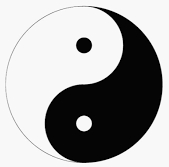
The ancient Chinese symbol (right) is the “great pole” pictogram (太极图 tàijítú). It depicts the dynamics of Yin and Yang. White corresponds to Active (Yang), and black to Passive (Yin). It says visually what each couplet says verbally. The benefit of Couplets lies in how they substitute Yin and Yang for two unique words and their complementary antonyms. These four words make a distinctive statement about the natural process depicted in the symbol, yet are chock full of specific meaning imparted to the couplet by the four words comprising it.
The first step in creating a Couplet is choosing four words from the Correlations table. We’ll make a Correlations table by placing basic nouns, adjectives, and verbs with their respective antonyms into complementary categories: Active (Yang) and Passive (Yin).
| Active (yang) | Active (yang) | Passive (yin) | Passive (yin) | |
| (nouns & adj.) | (verbs) | (antonyms) | (antonyms) | |
| activity | works | PASSIVITY | RESTS | |
| bold | advances | MEEK | RECEDES | |
| day | warms | NIGHT | COOLS |
Now we’ll make the first Couplet by taking a word from each column above and using it to make a statement that succinctly describes the natural process represented by the “great pole” pictogram.
Contemplate this first Couplet:
Activity evolves forth into PASSIVITY as it works, yet PASSIVITY revolves back to activity as it RESTS; hence, work within the PASSIVITY, yet REST within the activity.
The white-left side: Activity evolves forth into PASSIVITY as it works, yet…
The black-right side: PASSIVITY revolves back to activity as it RESTS; hence…
The lower-white dot: work within the PASSIVITY, yet…
The upper-black dot: REST within the activity.
Here now are two more Couplets formed from the other Correlations above. Mull them over to get the feel of this dynamic.
Bold evolves forth into MEEK as it advances, yet MEEK revolves back to bold as it RECEDES; hence, bold within the MEEK, yet RECEDE within the bold.
Day evolves forth into NIGHT as it warms, yet NIGHT revolves back to day as it COOLS; hence, warm within the NIGHT, yet COOL within the day.
Note how each couplet begins with an Active term. The first half can be a little obscure, especially if you’re not used to viewing reality as a circular phenomenon. Is the second half, beginning with “hence”, more easily understood? Let’s see.
Take the first couplet we did. How do you work within the PASSIVITY, yet REST within the activity? First, obviously activity plays a larger role in life than PASSIVITY (e.g., the heart and lungs are active until we die). Nevertheless, we occasionally fall into periods of PASSIVITY (laziness, depression, fatigue, failure. illness, sleep). Work within the PASSIVITY suggests that in those times we will feel better if we hold ourselves up a little so that our life doesn’t fall apart. REST within the activity suggests that we will feel better in all life’s activities if we bring a RESTFUL attitude to activity, or as the Tao Te Ching #56 puts it, Subdue its sharpness, untie its tangles, Soften its brightness, be the same as dust, This is called profound sameness.
Buddha’s Path: Right Comprehension; Right Resolution; Right Speech; Right Action; Right Living; Right Effort; Right Thought; Right State of Peaceful Mind parallels this approach. While this balancing process is easy to ponder, following its wisdom is another matter… or is it? Actually, simply realizing (a.k.a., Right Comprehension) the cycle of extremes and the pathway to balance can be sufficient. As realization deepens, balance gradually increases naturally. There is no need to work at it, or worry about it. Just watch and ponder. As chapter 16 says…
Obviously, this isn’t as easy as it sounds. Nature makes all living things pay for balance. Couplets just reveal the price Nature asks. To delve into the Couplets List first, see Tools of Taoist Thought: Couplets. Otherwise, continue on here with Correlations.
Before moving on to pop preconceptions
You’ll need to ponder how words correlate. For example, what do pleasure and pain correlate to? That’s a tricky one. Considering the experiences these words define can help. Scan your experience for instances that indicate whether or not pleasurable experiences tend to be more calming than painful ones. Next, how do pain and pleasure correspond to need and fear? Normally, fear is painful and need promises pleasure once satiated.
Yet, I have correlated pain and need as the complementary opposites of PLEASURE and FEAR. Pain and need both stir up a lot of energy—struggle and emotion. PLEASURE and FEAR are both more passive. Thus, on balance, I must correlate pain and need to Active (yang) and PLEASURE and FEAR to Passive (yin). Yet, this isn’t set in stone. Correlating these words differently would not be wrong as long as you’re diligent and honest. The real purpose of working with correlations is to put some emotional and cognitive distance between you and the words with which you think. As you become impartial concerning word meaning, your chances for truly thinking outside the box improve greatly. Put simply, you’re training yourself to distrust the words with which you think, and thus your thoughts as well. As the end of chapter 16 hints,
Correlations: Using Yin and Yang to Pop Preconceptions
We’ll begin by placing basic nouns, adjectives, and verbs with their respective antonyms into opposing categories: Active (Yang) and Passive (Yin). For example:
| Active | Passive | Active | Passive | Active | Passive |
| anxious | PATIENT | strong | WEAK | arrogant | HUMBLE |
| pain | PLEASURE | acquired | INNATE | juvenile | MATURE |
| desires | SATIATES | wins | LOSES | speaks | LISTENS |
| shallow | DEEP | urbane | RUSTIC | obvious | MYSTERIOUS |
| noise | SILENCE | analysis | SYNTHESIS | difference | SAMENESS |
| rises | SETTLES | clarifies | MUDDLES | leads | FOLLOWS |
First, carefully read each column vertically. Can you feel how the Active words correlate, i.e., how they share similar, if subtle, qualities? How about the Passive words? Note. It is important to remember that this method works through contemplating the words that correlate for you! Therefore, always set aside any pairs that don’t seem to do so. We will get to them later.
Next, it is time for DIY — do it yourself! Let me emphasize at the outset that the only way to understand this technique will be by actually doing it, and not just reading about it. Therefore, with pen and paper in hand, correlate the following word pairs. Assign one word of the pair as Active and the other word Passive: works – rests, peace – war, success – failure, agrees – argues, push – pull, anonymous – famous, brightens – dims, soft – hard, ancient – modern, part – whole, heaven – hell, delights – bores, white – black, go – stay, heavy – light, reality – illusion, male – female, dirty – clean, waste – conserve, conceal – expose, body – spirit.
Let’s ponder a few of these. Does work have more of an Active or Passive quality? That was probably easy. How about war and peace? War correlates better with work than rest, so whatever category work correlates to, war belongs there too. Fame associates more with success than failure, so it would fit in the same category as success. And what is more likely to bring success… work or rest? That is more subtle, but overall, which is more likely?
This sounds a little convoluted when put into words and read. In practice though, you simply let your mind scan and ponder opposites and let each word fall into its place. Most come quickly, some gradually, while others may take years to settle… no matter!
Active noun and verbs vs. their Passive antonyms
From here on we will pair Active (nouns & adjectives) with Active (verbs), followed by their antonyms, Passive (nouns & adjectives) with Passive (verbs). For example:
| Active | Active | Passive | Passive | |
| (nouns & adj.) | (verbs) | (antonyms) | (antonyms) | |
| conspicuous | wakes | SUBTLE | SLEEPS | |
| bold | advances | MEEK | RECEDES | |
| day | warms | NIGHT | COOLS |
It is best to read the columns vertically first, i.e., conspicuous, bold, day vs. SUBTLE, MEEK, NIGHT, then wakes, advances, warms, vs. SLEEPS, RECEDES, COOLS. Do the words in each column show a relationship; do they correlate?
This arrangement permits the pairs to make a contrasting statement when you read them horizontally, i.e., conspicuous wakes, SUBTLE SLEEPS; bold advances, MEEK RECEDES; day warms, NIGHT COOLS. Do these pairs show a relationship; do they correlate? Follow this same vertical and horizontal reading procedure for this next set.
| Active | Active | Passive | Passive | |
| (nouns & adj.) | (verbs) | (antonyms) | (antonyms) | |
| small | stirs | LARGE | STILLS | |
| hysterical | ignores | TRANQUIL | NOTICES | |
| child | takes | PARENT | GIVES | |
| abrupt | separates | GRADUAL | CONNECTS | |
| complex | excites | SIMPLE | CALMS | |
| something | fills | NOTHING | EMPTIES |
Now, play around a little with these two sets of three rows above. First, rotate the noun & adj. – verb matches. For example, child stirs; child ignores; child excites. Alternatively, complex stirs; complex ignores; complex excites. Some of the pairs make more intuitive sense than other ones. However, they will feel more as if they are on the same page if you compare them with their antonym pairs. For example, the antonym pairs for child and complex are: PARENT STILLS; PARENT NOTICES; PARENT CALMS and SIMPLE STILLS; SIMPLE NOTICES; SIMPLE CALMS.
While some of these pairs don’t make much sense at first glance, you may feel they share something deeper. This is called profound sameness, as chapter 56 puts it. For a hint to what that means, consider these synonyms: profound ≈ weighty ≈ insightful ≈ reflective ≈ deep.
Next, string all the verbs after only one of the words in the noun & adj. column. For example, child stirs, ignores, excites, takes, separates, and fills. Now the antonyms, PARENT STILLS, NOTICES, CALMS, GIVES, UNITES, and EMPTIES. Alternatively, string all the verbs up after complex… complex stirs, ignores, excites, takes, separates, and fills. Now the antonyms, SIMPLE STILLS, NOTICES, CALMS, GIVES, UNITES, and EMPTIES. Not every verb matches up equally well, but you should eventually feel most do share a degree of subtle agreement. It is intuitive!
Note: While these statements sound very BLACK and white, you must realize these statements represent possibility, not certainty! Obviously, child doesn’t always ignore; PARENT doesn’t always NOTICE. Frequently, it is just the opposite; there are always exceptions to the rule. You need to look between the lines for the trends. The statements correlate if child stirs, ignores, excites, takes, separates over 51% of the time, and PARENT STILLS, NOTICES, CALMS, GIVES, UNITES over 51% of the time.
Now we’ll string all the words in the noun & adj. column with only one of the verbs. For example, abrupt stirs; day stirs; complex stirs. Next, do the same with the associated antonyms. For example, GRADUAL STILLS; NIGHT STILLS; SIMPLE STILLS.
Next, we’ll string nouns and verbs together. For example, small child stirs, ignores, and takes. Now, do the antonyms: LARGE PARENT STILLS, NOTICES, and GIVES. Note, these two statements are not intended to be a definitive description of either children or parents. Think of them as describing an abstract archetype. As the saying goes, ‘there is a grain of truth in every myth’.
When you have played around enough with this set of correlations, pull correlations from the two other previous sets. Now you have five sets of three rows to work with all together… juggle!
Going full circle
The next major procedure involves reading the rows in a somewhat circular manner. For example, [ small stirs LARGE, LARGE STILLS small ] ; [ day warms NIGHT, NIGHT COOLS day ] ; [ conspicuous wakes SUBTLE, SUBTLE SLEEPS conspicuous ] and so on. Now, apply this circular reading to other rows in all previous sets.
It can help to add prepositions occasionally. For example, child takes (from) PARENT; bold advances (toward) MEEK.
Finally, use all the procedures covered so far for the following:
| Active | Active | Passive | Passive | |
| (nouns & adj.) | (verbs) | (antonyms) | (antonyms) | |
| young | works | OLD | RESTS | |
| life | evolves | DEATH | REVOLVES | |
| need | hurries | CONTENTMENT | DAWDLES | |
| struggle | competes | SURRENDER | COOPERATES | |
| unique | abhors | COMMON | LOVES | |
| answer | forgets | QUESTION | REMEMBERS |
Review and reflect
Try switching words around to produce different combinations. For example: anxious child ignores & forgets… PATIENT PARENT NOTICES & REMEMBERS, (or) complex analysis works & separates… SIMPLE SYNTHESIS RESTS & CONNECTS (or) obvious life clarifies & evolves… MYSTERIOUS DEATH MUDDLES & REVOLVES.
Now try the circular reading on these last three examples, e.g., anxious child ignores PATIENT PARENT, and so on. Note: Each word within a column helps define its column mates and vice versa. Take GIVES, for example. If the GIVING is bold, conspicuous and arises out of a needy ulterior motive such as wanting to be liked, it has more in common with taking. GIVES, as correlated here, is MEEK, SUBTLE and SETTLED with in CONTENTMENT.
Likewise, if a child NOTICES, REMEMBERS, COOPERATES, and GIVES, then that child has more in common with PARENT. Conversely, if a parent ignores, forgets, competes, and takes, then he has more in common with child. Whether or not one has a child does not make one a PARENT, as defined here. In addition, doesn’t that which applies to PARENT and GIVES also apply to LOVE?
Once again, word meaning depends on concurrent qualities. All the words sharing a vertical column, i.e., anxious, pain, complex, need, etc., and PATIENT, PLEASURE, SIMPLE, ENOUGH, etc., define each other! The correlations, read vertically and perceived as a whole, help establish the ‘Yin-ness’ or ‘Yang-ness’ of any particular word. In effect, you are consolidating the meaning of the contrasting words with which you think about life.
Momentarily returning words to their Active or Passive essence in this way helps return your mind to the primordial dawn of conceptual thought. Your mind’s on the brink of “MYSTERIOUS SAMENESS”. As mentioned earlier for chapter 56’s This is called profound sameness, profound » mysterious. You are allowing the mind to approach the event horizon of belief’s black hole, so to speak. Indeed, mysterious sameness exists outside the realm of belief. As chapter 1 puts it, The way possible to think, runs counter to the constant way.
Reading correlations can produce obscure results, as you probably have noticed by now. If in all of this you are somewhere between understanding and bewilderment, you are doing all this correctly. MUDDLED insight is actually preferable to clarity, i.e., preconceptions impart clarity. In fact, using the correlation process on what troubles or puzzles you deeply not only helps you learn this process, but can also help you resolve those issues, albeit, mysteriously.
Important: don’t consider any statements made by this process as TRUTH. If not taken too literally, such statements can become food for thought… even insight, depending on how patient, curious and open-minded you are.
| Active | Active | Passive | Passive | |
| (nouns & adj.) | (verbs) | (antonyms) | (antonyms) | |
| part | scatters | WHOLE | GATHERS | |
| contrast | divides | PARALLEL | UNITES | |
| illusion | promises | REALITY | DELIVERS | |
| arrogant | ignores | HUMBLE | NOTICES | |
| folly | argues | WISDOM | AGREES | |
| definite | floats | AMBIGUOUS | SINKS |
Now, mentally merge pervious correlations into the set above as you read its columns vertically. Proceed with the horizontal, and then the circular readings. Play around. Pull from previous correlations. For example, arrogant answer excites & promises… HUMBLE QUESTION CALMS & DELIVERS.
It is a little puzzling how the same word can correlate to both Active and Passive categories. This tricky issue was first tackled in “Before moving on to pop preconceptions” at the end of Couplets and the Co-generating Principle. If you have difficulty with this going forward, it may help to study or review that.
Take sound for example. Contrasted with music, SOUND is Passive, yet contrasted with SILENCE, sound is Active. Discord also contrasts enough with music to correlate, but in this case, MUSIC might now correlate to the Passive category. This is easier to contemplate in a correlation table, as follows:
| Active | Active | Passive | Passive | |
| (nouns & adj.) | (verbs) | (antonyms) | (antonyms) | |
| sound | stirs | SILENCE | STILLS | |
| music | divides | SOUND | UNITES | |
| discord | awakens | MUSIC | SLEEPS |
Did you read these vertically, horizontally and circularly? Did you rotate the noun – verb matches? For example, line discord up with stirs and then divides.
When a word has a true antonym, use it. Many words don’t have true antonyms. For example, there is no antonym for music. However, words often have a word whose qualities contrast enough to allow us to correlate, such as music vs. sound above, or audience vs. performer, eye vs. belly, fire vs. water, fruit vs. flower, chicken vs. egg, sex vs. love.
Speaking of chickens and eggs:
| Active | Active | Passive | Passive | |
| (nouns & adj.) | (verbs) | (antonyms) | (antonyms) | |
| chicken | emerges | EGG | RETURNS | |
| first | goes | LAST | WAITS | |
| secondary | effects | PRIMARY | CAUSES | |
| anxious | begins | PATIENT | ENDS | |
| angular | ends | CIRCULAR | CONTINUES | |
| recent | changes | ANCIENT | REMAINS |
Correlations enable you to consider problems and questions more deeply. Even better, correlations easily thwart your chances of finding a quick answer or solution. That’s not appealing if you need the psychological security that quick and easy answers offer.
Nevertheless, maybe we have been looking at our questions and problems too narrowly for the past 50,000+ years, and hastily seizing ostensibly obvious answers and solutions. Correlations can help you return to the PRIMARY QUESTION, out of which our journey to answers began. For example, let us return to our previous chicken and egg correlations as they might apply to the OLD QUESTION, “Which came first, the chicken or the egg?”
Reading those correlations can produce: first, anxious, angular, chicken > emerges, changes, goes & effects LAST, PATIENT, CIRCULAR, EGG. And of course,… LAST, PATIENT, CIRCULAR, EGG > RETURNS, REMAINS, WAITS & CAUSES first, anxious, angular, chicken. Now, play around; match the words up in other ways. Does the correlation table offer any insight into the question? Don’t look for a clear-cut answer!
When categorizing words, it is important initially to stick to words that have true antonyms. However, when you are pondering the correlations, you can substitute words within the category. For example, after you have correlated LOVE – hate, ACCEPTANCE – rejection, GRADUAL – abrupt, you can link corresponding words ACCEPTANCE, LOVE, GRADUAL in your mind while you contemplate. Furthermore, correlations give each word a whole list of ‘semi’ antonyms that further broaden each word’s meaning. For example, while LOVE vs. hate are true antonyms, LOVE vs. careless, LOVE vs. need, LOVE vs. sex, or LOVE vs. strife also contrast enough to regard them as pseudo or ‘almost’ antonyms — this even applies to LOVE vs. love, depending on how you correlate the word, i.e., love can correlate to either Active or Passive.
Ultimately, this process nibbles away at innate genetically based biases and contradictions. The contradictory, albeit subconscious, use of language allows you to deceive yourself. If you do correlations carefully, you just can’t help but become more cognitively honest. This simplifies life, which deepens your sense of serenity. Naturally, there is a cost; correlations whittle away cherished biases.
Interested? Again, you can only know this approach through doing and pondering correlations. While this mental undertaking requires focus, it also entails keeping mental focus fuzzy. It is analogous to downplaying what you see in front of you, to better sense what is behind you. You’re looking behind the foreground of specific thoughts to sense the BACKGROUND OF GENERAL CONSCIOUSNESS. True intuitive knowing requires awareness of both poles.
Do It Yourself Word List:
Are you ready to go to the next level in learning this technique? OK, but first you should agree with most of the Active – Passive classifications of the words covered so far. If you have wide disagreement, struggle to resolve this before proceeding. Carefully considering the following paragraph may help.
The critical part of this process is the anchoring of words to each other vertically under the Active/ Passive categories. Which category you place a particular word is less important because all the other words in that word’s column define that word. Thus, if you wanted to re-categorize dirty as Active instead of Passive, then dirty becomes synonymous with unique, success, transitory, shallow, illusion, famous, answer, angular, abrupt… and so on. You must now maintain that connotation for dirty.
Thus, dirty brightens, awakens, divides, exposes, floats, promises, pushes, separates, and wins. That means that CLEAN DULLS, SLEEPS, UNITES, CONCEALS, SINKS… and so on. Such anchoring of basic words helps you avoid subconscious duplicity that only complicates mental life by facilitating self-protective and egocentric rationalization. If you must re-categorize any word pair, do so carefully; the Correlation Sets have been under consideration for a long while.
With pencil in hand, consider each word/antonym pair from the following un-correlated list. Correlate each pair using the previous correlations and procedures (vertical, horizontal, circular reading, etc.) for guidance. Simply circle which word you think is Passive. Whenever you get stuck, set the word aside, let your sub-conscious ponder it, and continue on. Return in a few days to see if you’re still as stuck. (See centertao.org/essays/correlations/do-it-yourself/ to print out this exercise.)
You will use the words we have already correlated — the Correlations starter list — as a base to help you discern the classification of subsequent words (see Correlations Set #1 at the end of this Correlations essay). When you finish, compare your results with the completed word sheet — Correlation Set #2 — located after the Correlations Set #1.
| word & | antonym | word & | antonym | word & | antonym |
| agitate | sedates | hell | paradise | proceed | pauses |
| anger | fear | hesitates | acts | rejects | accepts |
| artificial | natural | hosts | visits | remembers | forgets |
| beauty | ugliness | human | animal | replies | asks |
| biases | balances | hunts | eludes | repulsion | attraction |
| black | white | I | that | restrains | abandons |
| bliss | anguish | ignorance | awareness | satiates | craves |
| blurs | defines | indulges | tempers | seclusion | fellowship |
| certainty | doubt | inferior | superior | shame | pride |
| civilized | primitive | innocence | guilt | sincerity | hypocrisy |
| clarifies | confounds | intensifies | mitigates | skepticism | religion |
| clouds | clears | joy | sorrow | slows | quickens |
| compels | coaxes | kindles | quells | soils | washes |
| complies | resists | knows | misunderstand | solidifies | liquifies |
| confronts | evades | liberal | strict | speaks | listens |
| constraint | spontaneity | local | universal | specific | general |
| contends | yields | loss | gain | spiritual | worldly |
| counterfeit | authentic | loves | hates | stabilizes | wobbles |
| cynicism | faith | master | slave | stagnates | grows |
| decides | deliberates | moderate | radical | teacher | student |
| detaches | adheres | moves | stops | tightens | loosens |
| deters | invites | naive | sophisticated | tip | base |
| diverges | converges | neutral | impassioned | transitory | perpetual |
| elite | riffraff | numbs | sharpens | truth | fiction |
| enough | need | objective | subjective | vanishes | appears |
| expert | novice | obscures | illuminates | vertical | horizontal |
| extreme | conservative | order | chaos | watches | shows |
| flows | ebbs | pains | pleases | widens | narrows |
| future | present | past | present | wishes | has |
| gobbles | tastes | plant | animal | worries | soothes |
Putting Correlations to Work:
Do you understand this process well enough to explore your worldview more effectively? Try it out. Select some word pairs from the Correlation Sets that pertain to a question, problem, or idea. It can be personal, political, scientific, religious… anything that you are curious or troubled about, and on which you would like deeper insight. Also, use these Correlation Sets for guidance in classifying any words you wish to correlate and, of course, to broaden perspective in general.
Initially, if you are trying to correlate new words, use only those that have true antonyms… use a thesaurus! If the word you are considering does not have an antonym, find a word/antonym pair that is close in meaning. Studying the Correlation Set lists vertically can point you in the right direction. For a list of 1600 correlated commonly used words go to centertao.org/correlationsallwords, or for the colorful version see centertao.org/essays/correlations/master-list/
Discoveries
Once you are familiar with using this technique, you can begin to apply it to some basic questions and perhaps get some insight into them.
The discoveries you make will often be hard to put into words. It is possible to discern things via the correlations which normal linear thought cannot grasp. Why? Correlations by themselves never reveal much of anything. The discoveries here originate from within you. Correlations are like a mirror through which you see yourself. They can serve as a path to self-understanding, not the understanding itself. Self-understanding helps you understand others, and the world around you, not the other way around. Consequently, turning much of what you find into coherent linear ideas to share with others can be challenging, if not impossible.
On the other hand, there are many ideas that can be represented in a straightforward way, i.e., day warms NIGHT… NIGHT COOLS day. Correlations can convey perceptions elegantly and simply, especially if you sense in them a process that may be universally applicable. Contemplate the following set of correlations to see what ideas they could express. Remember to play around. Match pairs with different pairs, string them together, and so forth as shown earlier. I will give some possibilities.
| Active | Active | Passive | Passive | |
| (nouns & adj.) | (verbs) | (antonyms) | (antonyms) | |
| energy | divides | TIME | UNITES | |
| straight | moves | CIRCULAR | STAYS | |
| far | effects | NEAR | CAUSES | |
| matter | works | SPACE | RESTS | |
| there | excites | HERE | CALMS | |
| illusion | fills | REALITY | EMPTIES |
♦ “The grass is always greener” parallels these correlation statements: … illusion fills REALITY,… REALITY EMPTIES illusion, or far excites NEAR,… NEAR CALMS (or BORES) far.
♦ Time, as measured by clocks, is really energy interacting in the PRESENT. You could say energy divides TIME. We conflate this ‘clock’ time with REAL TIME. Einstein’s relativity theory helped to correct this misconception. So, does TIME UNITES energy subtly describe something about the speed of a photon in SPACE?
♦ Reading from the correlations above gives: CIRCULAR SPACE TIME > STAYS, UNITES, & CAUSES, straight matter energy… and so on. This reading offers a possible pre – ‘Big Bang’ scenario; the ‘Big Bang’ REVOLVED out of CIRCULAR SPACE TIME REALITY.
Correlations can portray natural principles in a very simple way. The neat thing here is that you can apply these same principles to any consideration. This helps gather your disparate views into a more universal perspective. The correlations appear to depict a universal process that occurs in all things, at all levels, from the cosmic to the microscopic. As you become more aware of this, you will feel more at home in the universe. Take for example: beginning of creation vs. ending of creation, living vs. dying, success vs. failure, waking vs. sleeping, wanting vs. having. The following correlation table helps tie them together.
| Active | Active | Passive | Passive | |
| (nouns & adj.) | (verbs) | (antonyms) | (antonyms) | |
| beginning (universe) | warms | ENDING (universe) | COOLS | |
| transitory | peaks | CONSTANT | BOTTOMS | |
| mass/energy | effects | SPACE/TIME | CAUSES | |
| child | grows | ADULT | SHRINKS | |
| waking | excites | SLEEPING | CALMS | |
| wanting | promises | HAVING | DELIVERS | |
| struggle | assumes | SURRENDER | KNOWS | |
| success | leads | FAILURE | FOLLOWS | |
| living | competes | DYING | COOPERATES |
Death
Our instinctive dread of DEATH takes its form in many mundane ways. For example, we abhor FAILURE, LOSS, SURRENDER, MONOTONY, and even just WAITING. Correlations can help you see DEATH, and its associates (see Passive’s listed below) in a broader perspective.
Our problem with DEATH, and its correlates, arises from life’s survival instinct. The more we cling to life, the more the other side, DEATH, haunts us; we can’t escape the circular relationship of the Active and Passive sides. Thus the more important you regard life, the more separate and anxious you will inevitably feel. Once you realize this, you may begin to see past the survival instinct and GRADUALLY RECONNECT with DEATH and its ‘forms’. Ironically, this makes it easier to welcome and savor the PRESENT moments of life. Perhaps this is because you inevitably find yourself battling less with REALITY.
I will simplify the following set by limiting it to two columns, sorted on the Active words (nouns & adj.) As you read these correlations vertically, let the words in each column blend in your mind until you feel the essence of all those words. Next, try turning some of these pairs into contrasting statements to read horizontally. To make a statement, you’ll insert any of the Active and Passive verbs listed up to now (refer to Correlations Set #1 and Correlation Set #2 ). I’ll start this out using the first three pairs: Angular wakes, CIRCULAR SLEEPS; anxious advances, PATIENT RECEDES; commotion warms, TRANQUILITY COOLS.
| Active | Passive | Active | Passive | Active | Passive |
| angular | CIRCULAR | future | PRESENT/PAST | recent | ANCIENT |
| anxious | PATIENT | gain | LOSS | sound | SILENCE |
| commotion | TRANQUILITY | illusion | REALITY | straight | BENT |
| complex | SIMPLE | individual | COLLECTIVE | struggle | SURRENDER |
| diversity | MONOTONY | separate | CONNECTED | success | FAILURE |
| excitement | BOREDOM | life | DEATH | there | HERE |
| far | NEAR | busy | LAZY | transitory | CONSTANT |
| fast | SLOW | motion | STILLNESS | war | PEACE |
| fleeting | ETERNAL | need | CONTENT | work | REST |
Okay, time to nag just once more…
Have you actually tried your hand at this? As Buddha said, “verify through experience”. You can only verify this process through doing it with pen and paper… and deep pondering of course. Thus, return to the ‘Do It Yourself’ Word List’ challenge if you skipped it. Simply jot these words down according to how you feel they should correlate. Play around. Have you noticed how often I’ve suggested, “Play around”? Playing around is how children learn the most essential aspects of life — walking and talking. In the same way, playing around with correlations is the only way you’ll learn it. This is a subtle process, so if this feels too obscure, put it aside and attempt it again in 10+ years. This process requires as much life experience as you can muster. Put simply, We only understand what we already know, so aging is a real asset here.
Time
TIME correlates with DEATH, , at least Taoist time does. Part of the human problem is our disconnect from TIME. We feel separate from the PRESENT – the ETERNAL now (see correlations below). The unique human ability to create and sustain a perception of past and future competes for our attention. To the extent we are estranged from the PRESENT, we feel more isolated and insecure than we might otherwise feel.
Religion is a human endeavor whose noblest purpose is to re-CONNECT us to the ETERNAL WHOLE. Interestingly, when religion does not work, we turn to drugs, alcohol, sports, possessions, work, people, and/or ideals and doctrines all the more fervently, in the hope to feel more CONNECTED. Yet all we end up with are fleeting moments of pseudo CONNECTION.
Note: The more definite and analytical you need to explain your perceptions with this method, the more complex and illusionary they become. You will move further away from a complementary viewpoint and any sense of MYSTERIOUS SAMENESS. Be on the lookout for an INTUITIVE, FUZZY, and SHADOWY, KNOWING. When you sense it, savor it without nailing it down as the answer!
| Active | Active | Passive | Passive | |
| (nouns & adj.) | (verbs) | (antonyms) | (antonyms) | |
| past | effects | PRESENT | CAUSES | |
| future | evolves | PRESENT/PAST | REVOLVES | |
| fleeting | ends | ETERNAL | ENDURES | |
| complex | intensifies | SIMPLE | DIMINISHES | |
| isolated | leads | CONNECTED | FOLLOWS | |
| part | divides | WHOLE | UNITES | |
| boy | ignores | MOTHER | ACKNOWLEDGES | |
| individual | floats | COLLECTIVE | SINKS | |
| life | takes | DEATH | GIVES |
Life, Death, and ‘Enlightenment’
The development of this method began upon hearing the news of my younger brother’s death 50+ years ago. Until then, I had never personally known death. It plunged me into a deep quandary. Months later, while riding home from work on the bus, I suddenly realized that life and death, while apparently separate and opposite were, in reality, MYSTERIOUSLY CONNECTED and COMPLEMENTARY. This realization is similar to chapter 2’s, Hence existence and nothing give birth to one another.
The epiphany was so profound that I thought I had experienced Satori (Chinese 悟 wù = realize; awaken). Of Satori, D.T. Suzuki (a professor of Buddhist philosophy) says: “This acquiring of a new point of view in our dealings with life and the world is popularly called by Japanese Zen students ‘satori’. It is really another name for Enlightenment.”
To be sure, I’d acquired a “new point of view”, yet I was still experiencing all the emotional vicissitudes of life as before. I did seem to become more skeptical of everything. However, I suspect I was already a dormant skeptic. When my brother died, the latent skeptic within me awoke. I just couldn’t buy any of society’s views on the nature of life and death.
I was certain I experienced “Enlightenment”, I was just skeptical as to what Enlightenment truly was. I couldn’t buy the cultural myths and spiritual hype surrounding the word. Decades passed while the experience itself remained a puzzle and indescribable beyond my trite, ‘life and death are the same’.
Then, in the early 80’s, I dreamed up (literally) this Correlations process as a possible way to say something useful about the epiphany I’d had. This process also finally settled my skepticism on the idea of Enlightenment. The problem with anything that is especially pregnant with meaning as Enlightenment is that it essentially misses the point. We just can’t help making mountains out of molehills, can we? The Correlations can prove it, but chapter 1 of the Tao Te Ching sums up the situation perfectly.
This is why I call myself a ‘taoist’ with a small ‘t’. Again, the name possible to express runs counter to the constant name. One thing has become obvious to me: Our species is extremely insecure due to our knowledge of the unknown. I imagine that irony is a result of dialectic cognition — thought. Thought disconnects us from the spontaneous present, and that leaves us sensing an empty unknown. This drives us to always seek ways to fill this void. Having no clue as to what we are looking for, we make up stories to anchor consciousness… to believe… to pursue.
Ironically, Satori or Enlightenment is often used interchangeably with kenshō. Kenshō refers to the perception of the Buddha-Nature or emptiness. My symptom’s point of view tells me that we all experience this emptiness, unknown, void, all the time. This freaks us out and drives us to make up stories to hang on to. As Buddha so aptly put it, “The illusion of self originates and manifests itself in a cleaving to things”. The “illusion of self” is the smoke screen that shields us from full-blown emptiness. A double irony here is how the story of Enlightenment serves to shield us even further from the emptiness. Chapter 78’s Straight and honest words seem inside out comes to mind. You probably already see the mythical underbelly of the West; my purpose here is to point out the mythical underbelly of the East. Obviously, my skeptical view will not sit well with many; I belong to neither East nor West.
Correlations do convey the process of realization that so settled my mind back then. I offer it in the chance that it may serve others, even though I know it isn’t the easiest thing to wrap your head around! Well, nothing ventured, nothing gained. I also imagine that group participation might help grasp this process better. Alas, I don’t expect you could find enough interested people in one locality to make group exploration possible.
By the way, I view genuine Enlightenment as a life long process of realization, not unlike the initial process we all face when first learning to walk and talk. We stumble, fall, realize, and adjust repeatedly throughout life. As the years pass, humility increases and certainty of knowing decreases. We slowly cure ourselves of the disease, at least to some extent, as we acknowledge chapter’s 71’s caution, realizing I don’t’ know is better; not knowing this knowing is disease. Yet, even more fundamentally, we are no different from other animals, and even plants… biology hoodwinks us all. See also, Peeking in on Nature’s Hoodwink.
Correlations Starter List
This list includes all the correlations introduced on the first few pages, plus a few more. I sorted them on the Active nouns and verbs. Such an arbitrary arrangement can produce some cryptic horizontal and circular readings, which can lead you to unexpected insights. Add prepositions occasionally, e.g., with, to, from, on, by, for, and so on.
Remember, each word within a column helps define its column mates and vice versa. Here, no word stands alone. Meaning depends on concurrent qualities. You are using all the words sharing a vertical column to define each other, albeit, often elusively. Note: You can go to centertao.org/essays/correlations/starter-list/ to print out Set #1.
Correlation Set #1:
| Active | Active | Passive | Passive | |
| (nouns & adj.) | (verbs) | (antonyms) | (antonyms) | |
| abrupt | advances | GRADUAL | RECEDES | |
| analysis | argues | SYNTHESIS | AGREES | |
| angular | awakens | CIRCULAR | SLEEPS | |
| answer | begins | QUESTION | ENDS | |
| anxious | brightens | PATIENT | DULLS | |
| arrogant | changes | HUMBLE | REMAINS | |
| bold | cleans | MEEK | DIRTIES | |
| chicken | competes | EGG | COOPERATES | |
| child | detaches | PARENT | MERGES | |
| commotion | divides | TRANQUILITY | UNITES | |
| complex | effects | SIMPLE | CAUSES | |
| conspicuous | emerges | SUBTLE | RETURNS | |
| day | ends | NIGHT | CONTINUES | |
| definite | evolves | AMBIGUOUS | REVOLVES | |
| different | excites | SAME | CALMS | |
| discord | expands | HARMONY | CONTRACTS | |
| famous | exposes | ANONYMOUS | CONCEALS | |
| first | fills | LAST | EMPTIES | |
| folly | floats | WISDOM | SINKS | |
| future | goes | PAST | STAYS | |
| illusion | hardens | REALITY | SOFTENS | |
| life | hurries | DEATH | DAWDLES | |
| male | ignores | FEMALE | NOTICES | |
| modern | increases | ARCHAIC | DECREASES | |
| music | leads | SOUND | FOLLOWS | |
| need | progresses | CONTENTMENT | REVERTS | |
| noise | promises | QUIET | DELIVERS | |
| obvious | pushes | MYSTERIOUS | PULLS | |
| pain | rises | PLEASURE | SETTLES | |
| part | roughens | WHOLE | SMOOTHS | |
| recent | scatters | ANCIENT | GATHERS | |
| secondary | separates | PRIMARY | CONNECTS | |
| shallow | shifts | DEEP | MAINTAINS | |
| small | stimulates | LARGE | INHIBITS | |
| something | stirs | NOTHING | STILLS | |
| sound | straightens | SILENCE | CURVES | |
| strong | takes | WEAK | GIVES | |
| struggle | tells | SURRENDER | LISTENS | |
| success | warms | FAILURE | COOLS | |
| unique | wastes | COMMON | CONSERVES | |
| war | wins | PEACE | LOSES | |
| young | works | OLD | RESTS |
Correlated “Do It Yourself Word List”
You can go to centertao.org/essays/correlations/do-it-yourself/filled-out/ to print out Set #2. No peeking until you have struggled for a while to correlate the words in the “Do It Yourself Word List” word challenge.
Correlation Set #2:
| Active | Active | Passive | Passive | |
| (nouns & adj.) | (verbs) | (antonyms) | (antonyms) | |
| anger | abandons | FEAR | RESTRAINS | |
| anguish | acts | BLISS | HESITATES | |
| animal | agitates | PLANT | SEDATES | |
| artificial | appears | NATURAL | VANISHES | |
| certainty | biases | DOUBT | BALANCES | |
| chaos | clarifies | ORDER | CONFOUNDS | |
| civilized | clears | PRIMITIVE | CLOUDS | |
| counterfeit | compels | AUTHENTIC | COAXES | |
| cynicism | confronts | FAITH | EVADES | |
| elite | contends | RIFFRAFF | YIELDS | |
| expert | craves | NOVICE | SATIATES | |
| extreme | decides | CONSERVATIVE | DELIBERATES | |
| fiction | defines | TRUTH | BLURS | |
| future | detaches | PRESENT | ADHERES | |
| gain | deters | LOSS | INVITES | |
| hell | diverges | PARADISE | CONVERGES | |
| human | flows | ANIMAL | EBBS | |
| hypocrisy | forgets | SINCERITY | REMEMBERS | |
| I | gobbles | THAT | TASTES | |
| ignorance | grows | AWARENESS | STAGNATES | |
| impassioned | hates | NEUTRAL | LOVES | |
| innocence | hunts | GUILT | ELUDES | |
| liberal | illuminates | STRICT | OBSCURES | |
| local | indulges | UNIVERSAL | TEMPERS | |
| master | intensifies | SLAVE | MITIGATES | |
| need | kindles | ENOUGH | QUELLS | |
| objective | misunderstands | SUBJECTIVE | KNOWS | |
| present | moves | PAST | STOPS | |
| pride | narrows | SHAME | WIDENS | |
| radical | pains | MODERATE | PLEASES | |
| repulsion | proceeds | ATTRACTION | PAUSES | |
| seclusion | quickens | FELLOWSHIP | SLOWS | |
| skepticism | rejects | RELIGION | ACCEPTS | |
| sophisticated | replies | NAIVE | ASKS | |
| sorrow | resists | JOY | COMPLIES | |
| specific | sharpens | GENERAL | NUMBS | |
| spontaneity | shows | CONSTRAINT | WATCHES | |
| superior | liquifies | INFERIOR | SOLIDIFIES | |
| teacher | speaks | STUDENT | LISTENS | |
| tip | tightens | BASE | LOOSENS | |
| transitory | visits | PERPETUAL | HOSTS | |
| ugliness | washes | BEAUTY | SOILS | |
| vertical | wishes | HORIZONTAL | HAS | |
| white | wobbles | BLACK | STABILIZES | |
| worldly | worries | SPIRITUAL | SOOTHES |
For a different approach, go to Couplets and the Co-generating Principle.
(Click here for related posts on correlations)