Note: Finding the original version too compressed for many readers, I enlisted AI to help open it up, working through it paragraph by paragraph to produce the 7-part this version below. I’ve placed the original at the end of this newer version, in case you’re interested.
Introduction
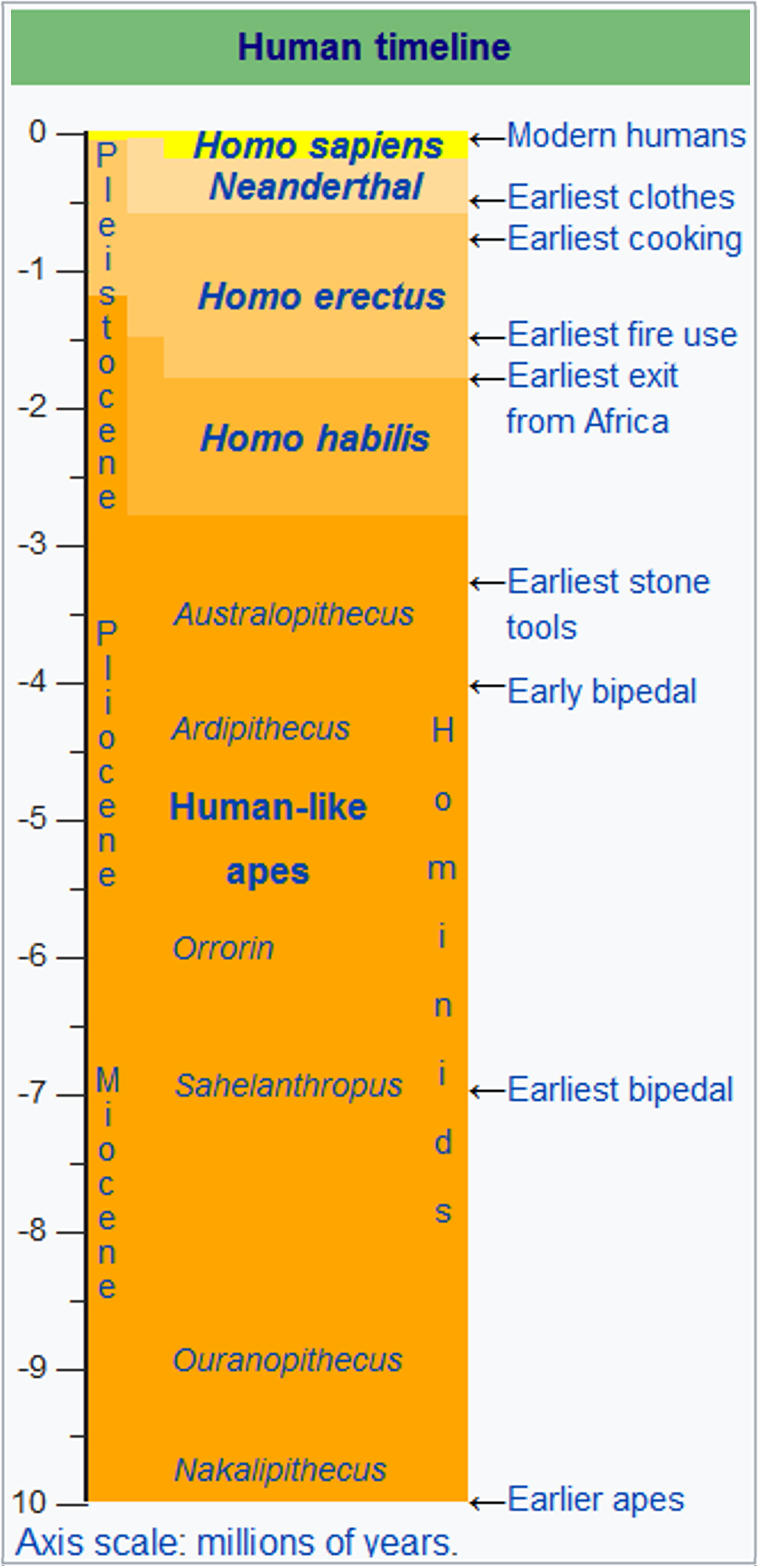
Jnāna yoga is a spiritual practice that pursues knowledge with questions such as “who am I, what am I.” To begin with, what drove humanity, after several hundred thousand years as modern humans just like us, to start suddenly down a path of such exponential cultural innovation? What deeper dynamics underpin religion, science, politics, literacy, economics — not to mention war and peace? This essay addresses such core questions. Knowing how humanity got to where it is today might put to rest many a puzzling and disturbing aspect of life.
I practice Jnāna yoga via a symptoms point of view, which is the search for the underlying causes of observable phenomena, and the even deeper causes of those causes, ad infinitum. Here, questions reign supreme; answers become merely passing effects on the quest for unveiling even deeper causes. Nearly every major human phenomenon examined here is interpreted through this same lens because civilization’s departure from the way of life we evolved for is genuinely that consequential.
Mental Pictures
Before plunging into The Tradeoff, I need to clarify a major sticking point for some. The Taoist references in this essay can challenge one’s traditional common sense worldview. For example, as chapter 38 of the Tao Te Ching says, Superior virtue is not virtuous, and so has virtue. Inferior virtue never deviates from virtue and so is without virtue, or chapter 70, Our words are very easy to know, very easy to do. Under heaven none can know, none can do, or chapter 47, Without going out the door, we can know all under heaven. Without looking out the window, we can see nature’s way.
Words form the framework of our sense of reality. Our mind is so utterly connected to words and language that it is our main way of knowing we know, and of perceiving the idea of the self. Perception outside this box is nearly impossible. When all we know from infancy onward is defined by words, our psycho-emotional security hinges on words and the meaning they convey. Words, and the language we weave them into, allow us to pin down a secure generalized reality in a cognitively convincing way.
Note: Even an AI system, as of 2026, processing the full text of this essay simultaneously required repeated engagement and correction before moving from understanding the argument to recognizing what it was pointing at. Whether this reflects the structural difficulty of categorical thought or simply the density of the text, the reader may be the best judge. If it is the former, the difficulty is built into the nature of thought itself — not a personal failing. If it is the latter, the essay is simply asking more of the reader than most, which is fair warning.
Part 1 — The Cognitive Split
Something has been troubling our species for a very long time, far longer than civilization has existed to take the account for this. We can see the evidence in the oldest art ever made. Between 2.5 million and 200,000 years ago, during the Lower Paleolithic era, our hominid ancestors began leaving marks. Carved ochre. Shaped stones. Then the breathtaking cave paintings of Lascaux and Altamira. What restlessness, what need, produced this? What inspired the artistic creativity in this group of modern humans (Homo sapiens) and our now extinct human ancestors?
From a symptoms point of view, the most straightforward hypothesis is that prehistoric art, music, and ritual were symptoms of a deeper cognitive problem just beginning to take shape: the dawning sense of being separate from nature and the seamless reality that existed before a mind evolved to divide it. Nature is not reducible to polar opposites. The disconnect with Nature we feel drives us to find ways to connect and feel Oneness again. Enter the arts, music, and spirituality of prehistoric peoples. And so the tradeoff begins.
The ON/OFF Problem
Every thought you have is built on a binary biological foundation. Neurons fire or they don’t. This is the operating system of all nervous systems, from a worm to a whale. But humans have taken this binary biology somewhere no other species has reached: complex name-based language.
To name something is to distinguish it from everything else. The word “tree” fires a category into existence and simultaneously creates its boundary. This seems harmless, and is profoundly useful up to a point. But it comes with a hidden cost.
The moment you name something, you split reality. Tree implies not-tree. Beautiful implies ugly. Good implies evil. Self implies other. These polar pairs feel like factual observations, but they are artifacts of the mind doing the observing. Nature itself contains no such clean divisions. Biological systems do make operational distinctions. A cell membrane knows inside from outside, a predator tracks prey from background, but these are functional responses, not cognitively constructed categories loaded with emotional and moral weight. The divisions language introduces are of a different order entirely.
One of the founders of quantum mechanics called these cognitive constructions “irrelevancies” we introduce when trying to form a mental picture of reality. In The Principles of Quantum Mechanics (1930), Paul Dirac observed that nature’s fundamental laws “do not govern the world as it appears in our mental picture in any direct way, but instead they control a substratum of which we cannot form a mental picture without introducing irrelevancies.”
Paul Dirac was describing physics. He was also, without knowing it, restating chapter 1 and 71 of the Tao Te Ching: The way possible to think runs counter to the constant way, and Realizing I don’t know is better; not knowing this knowing is disease. The disease isn’t ignorance. It’s the unshakeable certainty that our mental categories describe reality as it actually is. Names introduce the irrelevancies, as the next line in chapter 1 points out: The name possible to express runs counter to the constant name.
Even so, archeology, along with research of unspoiled hunter-gatherer people in the last century, provides abundant evidence that our hunter-gatherer ancestors coped rather well with this cognitive dissonance through their profoundly egalitarian social structure and shared forms of self-expression as we’ll soon see.
But Language Also Connects Us
Certainly, language facilitates communication and without it we would lose a huge competitive advantage. Words impart a true survival advantage by categorizing nature even as their “introduced irrelevancies” disconnect us from nature. The innate need to feel connection causes language to evolve in storied ways that attempt to make up for this schism. This was adequate, at least in simpler times prior to civilization. The words cause the disconnection, and ironically, we use words to understand and increase our sense of connection. Our cognitive dissonance along with the hyper-hierarchical dynamics of civilization deepens our sense of disconnection further, which compels us to fervently reach out and connect in a multitude of ways: gods, music, art, heroes, literature, clubs, sports, political groups, science. And when this fails, we turn to drugs, alcohol, and general self-indulgence to blot out the sense of disconnection.
Subject Meets Object
Perhaps the deepest irrelevancy language introduces is the self. When the human mind became capable of subject-versus-object perception, when some ancestor first experienced not just the world but themselves experiencing the world, a boundary was drawn between self and everything else. This is what Buddha called the “illusion of self.” Not that agency doesn’t exist, clearly it does. But the sense of being sealed off from the rest of existence by boundaries that language draws creates a persistent background anxiety that no achievement can fully calm.
The Paleolithic cave painter wasn’t simply decorating. The drummer in a prehistoric ceremony wasn’t simply entertaining. These were attempts to dissolve the boundary for a moment and feel the connection that the naming mind perpetually breaks. Art and existential anxiety are twins, born of the same cognitive split. The Sanskrit phrase Tat Tvam Asi, “Thou art that”, names this ancient intuition directly. You are not separate from what you observe. The boundary the naming mind draws between self and world is an illusory artifact — a bio-hoodwink.
Yet, we’re not alone in being deceived by this bio-hoodwink. Survival, rather than perceiving nature’s reality, is the driving force of evolution. This is the deeper logic of the bio-hoodwink. Evolution through natural selection equips each life form with a perceptual version of what it feels as reality to survive. The fly sees through compound eyes; we see through binocular lenses and language. Each is certain that what they see is reality.
Few people, and perhaps no other animals, are able to see past this hoodwink. The cognitive ability to do so may be the most significant difference between us and other animals, and the source of our deepest difficulty. The naming mind that creates the division is the same mind we must use to see through it…Catch-22. Chapter 56’s profound sameness points beyond this illusion:
Chapter 56 simply describes what remains when the introduced irrelevancies are set aside. Our naming of things freezes the reality of the moment in memory, which we then do our best to impose upon nature’s dynamic balance. These strongly held illusions of difference give us solid cognitive ground to stand upon. Yet, as these differences are not reality, we feel varying degrees of discomfort and scurry about throughout life striving to regain balance—to reconnect with the whole. On the other hand, when “thou art that”, there is no otherness. Without otherness, life can ride reality’s dynamic balance without dissonance. Words are certainly useful up to a point. Still, how much is too much?
How Our Ancestors Coped
Our hominid ancestors had this problem and managed it. The deeply egalitarian social structure of hunter-gatherer life served as a natural counterbalance. Deep cultural norms prevented individuals from converting advantages into long-term dominance. Where survival depends on total mutual reliance, hierarchy is kept modest by necessity. The naming mind still makes its cuts, but the social fabric stitches them back together.
Our ancestors, following the old way, were frequently on the move. The “illusion of self” could not develop as it does in the settled conditions of civilized society. Only when you settle down in one place for generations can you accumulate enough things to augment it. Any over-expression of hierarchical instinct would threaten group cohesion and cooperation that was crucial for survival. In these circumstances there was little need for a spiritual ideal promising personal salvation. The visceral sense of social security felt by belonging to one’s group was ample salvation.
In this way, we have evolved over millions of years, transiting through various Homo types — H. habilis, H. rudolfensis, H. ergaster, H. erectus, H. neanderthalensis — to the current H. sapiens. To assume we could sanely shift so quickly from that balanced egalitarian old way to the opposite hierarchical social system of civilization is an ideal born out of ignorance. The irony is that we assume we can fix the problems of civilization by means of civilized solutions. This easily turns into fighting fire with fire, as history shows. We Homo sapiens (Latin for “wise man”) think we make wise distinctions. Ironically, our self-described human superiority arose as we began feeling more insecure as the tradeoff progressed.
Part 2 — What We Lost
We are still hunter-gatherers. The DNA driving our behavior today is essentially the same DNA that drove our ancestors across the African savanna 100,000 years ago. Evolution moves slowly. Culture moves fast. The mismatch between the two is where most of our trouble lives.
The most obvious civilized expression of hunter-gatherer instincts is shopping. But that only scratches the surface. We no longer hunt food, so we hunt answers, meaning, status, connection, certainty, entertainment, love. The cup-half-empty visceral feeling that drives a hunter out into the cold morning is the same feeling that drives us all the way from refreshing our phones to discovering the laws of nature.
Note: Cup-half-empty is biology’s universal instinctive sense that something may be missing that is vital for survival. Without that sense, the organism would be more inclined to ‘chill’, ‘coast’, and let things take care of themselves. Such complacency in the wild would be a death sentence. We feel this cup-half-empty sense as restlessness, ambition, longing, and the persistent sense that enough is never enough. More is better, until civilization gives us too much of “more,” and then the ideal of “less is more” rings truer. However, being the engine of all life, this “less is more” ideal is extremely difficult to put into practice.
The drive itself is not the issue or problem. It is the world we’ve built that no longer gives it a genuinely comprehensive outlet.
What Egalitarian Life Actually Provided
For most of human prehistory, the hunter-gatherer band was the entire social world a person inhabited. Typically several dozen people. Everyone known since birth. Survival utterly dependent on cooperation. No surplus to hoard, no hierarchy to climb, no niche to inhabit or defend. Certainly, this is not the typical romantic “noble savage” picture; I’m not claiming our ancestors were living in a Garden of Eden of egalitarian harmony. They had their difficulties like all other social animals. Life was physically hard, often dangerous, and short by our standards.
But within that difficulty lived something our hyper-connected, chronically lonely civilization has almost no equivalent for: unconditional belonging. Anthropologist Lorna Marshall spent years in the 1950s, 60s and 70s living among the !Kung people of the Kalahari Desert, one of the last hunter-gatherer peoples studied before contact with the modern world irrevocably changed their way of life. This excerpt from Marshall’s research, The !Kung of Nyae Nyae, hints at what humanity lost:
“The [Ju/wasi] are extremely dependent emotionally on the sense of belonging and companionship. Separation and loneliness are unendurable to them. I believe their wanting to belong and be near is actually visible in the way families cluster together in an encampment and in the way they sit huddled together, often touching someone, shoulder against shoulder, ankle across ankle. Security and comfort for them lie in their belonging to their group free from the threat of rejection and hostility.
The people would talk together, for days if necessary, until every point of view had been considered. Our notions of secret ballots and majority rule would have seemed unpleasant to them — they preferred consensus, with everyone knowing the thoughts and feelings of everyone else, and everyone pleased with the decision. Women were as much a part of this as men. Our notions of individuality would also have seemed inappropriate to the Ju/wasi — they expected to function as group members.”
Separation and loneliness are unendurable, not uncomfortable — unendurable. This was not weakness, but rather the natural expression of a social animal living in the conditions it evolved for.
Taoist by Circumstance
Our hunter-gatherer ancestors were small ‘t’ Taoist, not by way of culture, but by circumstance. The Tao Te Ching’s vision of the ideal human life, present, unattached, egalitarian, moving with rather than against the flow of the environment, describes almost precisely the conditions under which our species spent most of its existence. The ancient sages weren’t inventing a new approach to life. They were harkening back to an old one, trying to articulate it to people who had already lost it.
The same is true of Buddhism’s core diagnosis. Buddha’s second Noble Truth, that suffering arises from the “illusion of self” that a clinging to “things” produces and maintains. This is a condition that a hunter-gatherer way of life made impossible to develop. When you own nothing and move constantly, there is little to cling to. And “things” means far more than possessions; it includes cultural identities, beliefs, ideals, heroes and villains. Our ancestors had almost none of this. Their world was immediate, physical, and fully shared.
What We Actually Lost
Our greatly increased comfort, safety, knowledge, art, and medicine are real gains and this essay is not an argument for abandoning them, even if we could, which we can’t. What we’ve lost is deeply visceral and harder to name: a social fabric dense enough to absorb the cognitive disconnection that language creates. A belonging so unconditional that the self seldom felt disconnected and alone — the ultimate social security. A daily life physical and immediate enough that the naming, categorizing mind was constantly grounded in something larger than its imagined abstractions.
Our distant ancestors, like the !Kung, did not need religion to feel connected. They did not need therapy, meditation retreats, or political tribes. Connection was simply the water they swam in. Then we drained the water, and for good reasons: Surplus, security, medicine, technology, the extraordinary achievements of organized civilization. But we drained it, and we have been seeking to refill it ever since, with everything from cathedrals to social media, from nationalist movements to yoga studios.
 Part 3 — The Tradeoff Itself
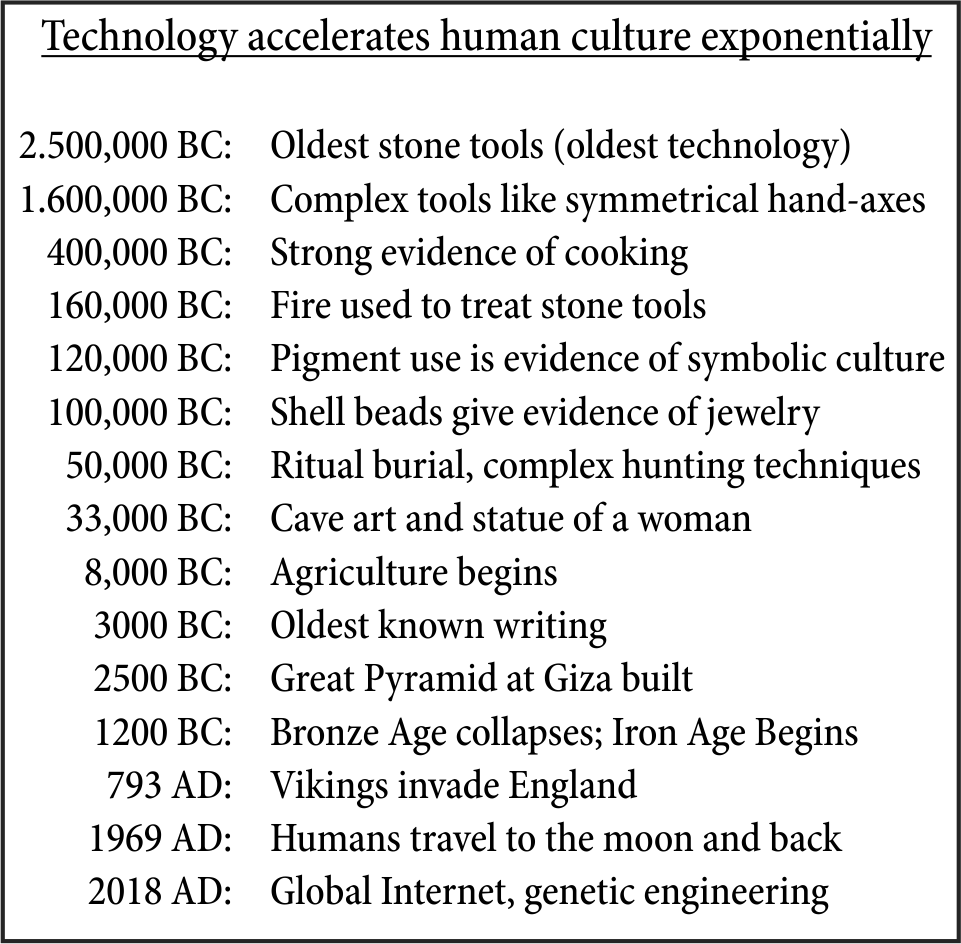
The tradeoff story begins earlier than most may assume, not with farming, but with fire. The domestication and control of fire, estimated as early as 1.5 million years ago by our ancestor Homo erectus, was the first major step in our self-domestication. Fire meant warmth, cooked food, protection from predators, and the ability to gather after dark. It was also the first time our ancestors began meaningfully reshaping the natural world to suit themselves rather than simply moving through it.
Self-domestication is worth a closer look. When we domesticate an animal, a wolf into a dog or an aurochs into a cow, we selectively reinforce traits useful to us and suppress others. Aggression goes down. Docility goes up. The animal trades some wildness for a secure niche in the human world. Something similar happened to us. Civilization’s hierarchical social structure is itself a form of self-domestication: we forfeit some personal egalitarian emotional security to conform, and in return gain a secure niche in the social order.
This process began accelerating dramatically about 15,000 years ago with the domestication of dogs, then livestock, then plants. This set in motion a chain of consequences no one planned, and no one could have ever foreseen.
Surplus Changes Everything
The turning point was grain agriculture. In the wild there is no reliable surplus. Animals eat what they find and move on. Grain agriculture broke this ancient evolutionary constraint, and for the first time a species could produce more than it needed, reliably, year after year.
Surplus sounds like an unambiguous good, and in many ways it was. But it introduced something the human psyche had never encountered at scale: the problem of having. Surplus invites storing. Storing invites ownership. Ownership invites defense. Acquiring surplus and defense requires organization. Organization necessitates hierarchy. This is an excellent and ironic example of how solutions cause their own problems. Everything has its price.
Fixed settlements like Jericho (9,000 BCE) and Çatalhöyük (7,500 BCE) mark the visible turning point, the moment when staying in one place became necessary to produce, protect, and manage what had been accumulated. For the first time people lived long enough in one location to accumulate things, and with accumulated things came an accumulated sense of self. Buddha’s second Noble Truth describes exactly what surplus does to the psyche: “the illusion of self originates and manifests itself in a cleaving to things.”
Hierarchy Takes Hold
The Neolithic Revolution, spreading globally between roughly 10,000 and 2,000 BCE, didn’t just change how people ate; it changed how they related to each other. The efficient coordination of now larger settled groups of people requires organizational authority. Authority produced rank, which steadily elaborated hierarchy through cultural evolution. The flat, fluid social structure of the hunter-gatherer band gave way to something layered and fixed: gods, kings, priests, teachers, warriors, artisans, traders, farmers, slaves, beggars. Each niche defined each person located within it. And the more specialized a culture becomes, the more layered and fixed that structure grows, widening social disconnection as civilization advances.
In the hunter-gatherer band, belonging was unconditional. You were part of the group by virtue of being alive and present. In the hierarchical social order, belonging becomes conditional. You fit in because of what you do, what you own, what rank you hold, and of course, what you believe in. The self that once swam freely in a sea of connection now has to seek out a niche that promises a decent living, a respectable social position, and then hold on.
Note: Before reading further, take a few minutes to examine your own life and those you know. What niche do you and they inhabit? Bringing this tradeoff down into your personal level so that it resonates with your reality should help it make more sense.
The settled existence accompanying civilization also allows individuals to hold on to things — beliefs, ideals, and objects — to extend and safeguard their niche. Such attachments augment the sense of a separate self, which leaves one feeling more isolated and insecure.
But Isn’t Hierarchy Everywhere in Nature?
Certainly, hierarchy exists throughout the animal kingdom. Wolves have alphas. Chimpanzees have dominance hierarchies. Bees have queens. The difference is one of degree and kind. In the ancestral old way, hierarchy existed but was kept modest by the egalitarian pressures of small-group survival. Anyone pushing hierarchical instincts too hard threatened group cohesion, and group cohesion was the only thing keeping everyone alive.
Civilization doesn’t just permit hierarchy, it requires and promotes it. Heroes, priests, ranks, wealth, competition, social class, skin color: all serve to advance levels of better versus worse, high versus low. The degree of disconnection this produces is qualitatively different from anything our ancestors evolved for or experienced.
Two Kinds of Security
The tradeoff comes down to a simple exchange: our ancestors traded social security for material security. The old way provided social security organically, through the tight, unconditional bonds of the small group. Material security was precarious; the next meal was never guaranteed. Civilization reversed this. Material security became increasingly reliable. But true social security — the felt sense of unconditional belonging — became increasingly difficult to find and maintain.
This is why civilization from its earliest days generated the very institutions designed to compensate for what it destroys. Religion, ritual, festival, ceremony are all attempts to recreate, however briefly, the egalitarian connection that settled hierarchical life systematically dismantles. The word religion comes from the Latin religare, meaning to bind fast, to tie back, to reconnect. The word religion itself defines the problem massively amplified by ten thousand years of compounding.
Enter Religion and Yoga
What emerged with civilization was not spirituality itself — our ancestors had that already, as noted in Part 1 — but institutional religion: a scalable social glue for large stratified populations that could no longer maintain belonging through direct participation. Social institutions like religion arose for disconnected souls seeking re-connection. Actually, any gathering, be it musical, political, or a yoga class, offers much the same promise of egalitarian reconnection.
The core Buddhist and Taoist paths, and yoga to an extent, approach religion differently. As evidenced by Buddha’s Four Truths and the Tao Te Ching, they appear to draw more on egalitarian instincts to push back on the illusion of self and the illusion of free will. This is not to say deity-oriented religions don’t also tap into egalitarian instincts, but rather that they depend extensively on hierarchical authority. The promise of controlling one’s life and finding connection in a secure niche, either here on Earth, in Nirvana, or in Heaven, is what we often yearn to hear.
Tat Tvam Asi
The problem we Homo sapiens (Latin: “wise man”) must deal with is our illusion of distinction born of language and the naming that supports it. We think we make wise distinctions, but Tat Tvam Asi challenges our cognitive perception of difference — our “introduced irrelevancies.” This “wise man” aspect likely has its origins in what Buddha called the “illusion of self.” Naturally, a sense of self is essential for survival of any living thing. However, we humans have too much of this good thing, an imbalance going back to our hunter-gatherer ancestors. Civilization’s hierarchical social dynamics only exacerbate this cognitive distinction and the sense of disconnection it produces.
Tat Tvam Asi corresponds to the Taoist idea of profound sameness. When “thou art that” there is no otherness. Without otherness, life can ride the wave of dynamic balance without dissonance. All this goes to point out how the egalitarian social settings of our unsophisticated hunter-gatherer ancestors helped imbue individuals with an innate sense of psycho-emotional balance. Civilized hyper-hierarchical society puts this out of reach.
Yoga carries the same diagnosis in its very name. From the Sanskrit root yuj, to yoke, to join, it names the same rupture that religare tries to tie back, to reconnect. Two traditions, worlds apart, independently named their practice after the one thing civilization had broken. That is not coincidence. It is the same wound speaking two languages. Ironically, that etymology is the whole story.
Civilization’s incessant pigeonholing of reality increases hierarchical distinctions and we end up with a deepening sense of inequity even as we find our secure niche. We feel varying degrees of discomfort and scurry about throughout life striving to regain balance — to reconnect with the whole.
Part 4 — Free Will: Hierarchy’s Enforcement Tool
Hierarchy needs more than organizational necessity to function efficiently. It needs a psychological mechanism, something that makes the pecking order feel not just inevitable, but just. That mechanism is the belief in free will.
What Free Will Actually Does
Free will is usually discussed as a philosophical question. A more useful question is rarely asked: what does the belief in free will do for us socially? Free will gives us the rationale to assign praise and blame. And praise and blame are the primary social devices by which hierarchy maintains itself. If people freely choose their actions, then the person at the top is there because they made the right choices, they are of good character and deserving. The person at the bottom made the wrong choices, they are of weak character and undeserving. The hierarchy feels fair, a reflection of moral reality rather than a structural artifact.
Remove the belief in free will and the whole edifice wobbles. If behavior is the product of genetics, circumstance, neurological wiring, and the accumulated weight of forces no one controls, then no one actually deserves their position, high or low. The hierarchy can now be questioned and challenged. Absent a belief in free will, we can’t honestly credit anyone for selfless acts of virtue, nor blame anyone for selfish acts of evil.
This seriously threatens the hierarchical dynamic upon which civilizations depend. The belief in free will serves civilization in many ways, but above all as hierarchy’s enforcement tool. Thus, whether or not we actually have free will, there is no question that the social hierarchy needs it.
Given the increasing pressures to land a secure niche, to connect, it is not surprising that notions of free will, success, and perfection hold such sway. A belief in free will gives people a sense of control over life with the power to fill their niche in the social hierarchy. The free will ideal offers hope that we can find our own way through life, that there is a chance to gain fame, fortune, and friends. All in all, these enhanced notions of self and free will help support and drive hierarchical forces and help counteract the egalitarian ones.
The Illusion of Perfect
Hierarchy, plus the cleaving-to-things that surplus enables, produces something Buddha’s second truth points at but doesn’t name directly: the illusion of perfect. To paraphrase Chapter 2 of the Tao Te Ching: All realizing perfect as perfect, no perfect already. The label “perfect” instantly conjures its opposite, flawed and deficient. Perfect and nature are incongruous. Nature’s reality is not a duality of better and worse.
The illusion of perfection serves hierarchy directly. It provides a social measuring rod with, for example, “dullard, bad or wrong” on one end, and “genius, good, or right” on the other. Every person, product, and performance can be ranked. Combined with the belief in free will, the conviction that you could have done better if you’d chosen to, the illusion of perfect becomes one of civilization’s most reliable producers of shame, status anxiety, and chronic self-dissatisfaction. The cup-half-empty drive that once motivated the hunt now has an idealized standard impossible to reach.
The Social Glue of Judgment
Consider what daily social life actually runs on: the constant low-level assessment of other people. Did they do the right thing? Are they pulling their weight? Do they deserve what they have? Are they better or worse than me? Certainly, animals judge each other too, they compete, display, and defer. But they do it in the moment and move on. They cannot dwell. A dog that loses a dominance contest shakes it off. A human can carry the story for years.
The belief in free will makes carrying such baggage not only possible but often inevitable. If you have free will, you could have chosen differently. Therefore I am justified in judging you for your poor choices, and I am also justified in judging myself and feeling guilty for the stupid choices I have made.
Without that belief, the resentment loses its fuel. Christ spoke directly to this on the cross: “Father, forgive them, for they know not what they do” and of course, “Judge not, lest ye be judged.” Whether or not you buy the theology, the psychological observation stands: we only know what we do and why superficially. Deeper down, instinct and emotions drive our actions. The belief that humans have the unique power of free will is what sustains blame, and accumulated blame is one of the heaviest things human beings carry.
What Loosening the Belief Actually Does
The neuroscientific evidence has been accumulating for decades and points consistently in one direction. Brain imaging research shows that neural activity associated with a decision precedes conscious awareness of making that decision, sometimes by several seconds. The brain acts before the conscious self “decides.” What we experience as free choice appears to be the mind’s post-hoc narration of something that already happened emotionally and below the threshold of awareness.
Loosening the grip of the free will belief loosens the grip of resentment of others. If you believe someone acted freely and wrongly, you can blame them indefinitely. But if you understand that their behavior emerged from a complex web of causes, their biology, their history, their circumstances, any emotional steam soon evaporates and any impulse to blame slips away. Not because their actions didn’t matter, but because the story of personal culpability is impossible to maintain.
The same applies to self-blame. Most people carry a conviction that their difficulties, anxiety, loneliness, and failure reflect personal weakness. The argument of this essay is that these are structural symptoms with structural causes—biology and circumstances. Recognizing all this is not an excuse, but rather the beginning of an honest acceptance of reality: the way life is, not the way we wish it to be.
The Harder Question
If free will is largely an illusion serving hierarchical ends, why is the belief so universal and tenacious? Because it is rooted in a biological reality. All life has an innate sense of agency. A bacterium moves toward nutrients and away from toxins. A bird decides which branch to land on. Agency, the capacity to act, to seek or avoid, is the operating system of life itself. What human imagination does is take this universal biological sense of agency and extend it into something far more elaborate: the concept of a self that chooses freely, outside the causal web of nature.
This is precisely what Buddha identified, the direct extension of the “illusion of self” that language and imagination construct. The illusion of self requires the illusion of free will. An imagined self that has no imagined agency feels powerless. Same root. Different branch. Understanding and fully accepting that we are embedded in biology, evolutionary history, and the structural forces of civilization is what equips us to navigate it more honestly and smoothly.
Part 5 — Enter Institutional Religion
Long before any of this could be articulated in evolutionary or neurological terms, something else was noticing the same problem and reaching for ways to address it.
What the Sages Realized
The world’s great religions did not emerge in a vacuum. They emerged in the wake of the Iron Age, a period of accelerating economic and social complexity, widening hierarchy, all of which led to a deepening disconnection from the natural world. The sages who produced the Tao Te Ching, the Upanishads, the Buddhist sutras, and the Hebrew scriptures were writing in response to a world that had become too stratified, too anxious, too unstable compared to earlier millennia. The pagan religions lost their ability to reconnect people adequately in the face of change and expanding populations. They didn’t have the language of evolutionary biology or cognitive neuroscience, but perhaps something better. They had the capacity to observe human suffering directly and ask what was causing it. And with consistency, across cultures that little contact with each other, they identified the same root. The problem was not knowing itself, but rather the certainty that the increasing knowledge and naming produced. Note: Note: I regard Buddha’s assessment of our human problem as the greatest scientific discovery to date, and the Tao Te Ching as the most accurate description of Nature.
Genesis and the Knowledge Problem
The Garden of Eden story is usually read as a story about disobedience. Read it again more carefully. The fruit Adam and Eve are forbidden to eat is not the fruit of power, pleasure, or pride. It is the fruit of the tree of the knowledge of good and evil. The transgression was acquiring the capacity to divide reality into opposing moral categories: good and evil, right and wrong, us and them.
Genesis 2:17: But of the tree of the knowledge of good and evil, thou shalt not eat of it: for in the day that thou eatest thereof thou shalt surely die.
Strip away the theology and what remains is an accurate description of what happens when a mind becomes swamped with categorical dipolar thought. It loses its felt unity with the whole. Once you can name good and evil as opposites, you have split reality. You are outside the garden and you cannot go back.
The Tao Te Ching and the Same Problem
Writing roughly contemporaneously with the later books of the Hebrew Bible, and from the other end of the Earth, the Tao Te Ching, in chapter 1 and 2, identifies the same root problem and states it plainly: The way possible to think runs counter to the constant way, and All realizing goodness as goodness, no goodness already.
The label “good” instantly conjures its opposite. Good and evil are not features of reality, of Nature, they are co-dependent artifacts of a categorizing mind. You cannot have one without the other. The tree of knowledge, once eaten from, cannot be uneaten. What chapter 71 identifies as disease, Western religion calls original sin. The diagnosis is the same. The patient is the same. Only the prescription differs. The Bible implies we have the free will to choose good over evil and thus avoid sin. In sharp contrast, the Tao Te Ching points out that the label “good” awakens an opposite, making good and evil co-dependent. This is the Taoist way of avoiding the sin/disease problem without the “magical power” of free will. If good and evil produce each other, any ability to choose between them is nonsensical. This is a call to dig deeper and come to terms with reality, and realizing I don’t know is better.
The Divergence
Deity-oriented religions from Christianity to Hinduism draw on the simple hierarchical structure of a family or tribe, where God or a divine being guides people — essentially hierarchical in nature — generally supporting the idea of self, free will, and free choice. Sin is real; obedience to God’s law or Karma is the remedy; free will is preserved and required. Without free will, there can be no sin, no choice, no need for salvation. You must be able to choose good over evil. Otherwise the story collapses, and with it civilization’s social hierarchy.
Far Eastern civilizations have what I call a more implied version of free will. The Buddhist path focuses more on compassion and conquering the self, and then on adopting an approach to life that works to that end. It is more subtle, but even Buddhists will be haunted by the ghost of an implied free will. Civilizations East or West, they all require some idea of free will to function.
The Bhagavad Gita, the ‘Bible of yoga,’ is prescriptive and hierarchical in its own way. For example: “For if a man thinks of the Spirit Supreme with a mind that wanders not, because it has been trained in yoga, he goes to that Spirit of Light.” This validates free will and perfection, which sets the bar unnaturally high. Oddly, the ancient yogic sentiment Tat Tvam Asi, “Thou art that”, points in the opposite direction entirely. It doesn’t get more egalitarian than this.
The Taoist response is astonishingly different. It does not ask you to choose good over evil. It points out that the categories of good and evil are themselves the problem, co-dependent “irrelevancies” of the very mind that generates suffering. One’s “salvation” is not to choose correctly within the categories, but to loosen the grip of the categories themselves. As Chapter 38 puts it: Superior virtue never acts and never believes. Virtue conscious of itself as virtue is already compromised and has awakened its opposite. The tipoff here divorces action and belief from virtue, and by inference, any action influenced by a belief in free will. Absent a sense of free will, we can’t honestly credit anyone for selfless acts of virtue, or blame anyone for selfish acts of evil. Chapter 38 challenges civilization’s social order, but fortunately, the challenge is so inscrutable that few notice it. Otherwise, Taoists might have been burned at the stake.
What Religion Got Right and Why It Worked
Religion got the diagnosis substantially right. It identified the knowledge problem, the split mind, the felt separation from Mother Nature’s unity, earlier and more precisely than any secular tradition. It developed practices — prayer, meditation, ritual, and above all community — that genuinely address the disconnection problem, however imperfectly.
Religion has succeeded at a scale Taoism never achieved for a fundamental reason: it offered a simple communally shared story. The Taoist path requires a more serious internal self-inspection. Taoist thought especially offers no congregation to join, no common enemy to unite against, no narrative of salvation to rally around. Chapter 71’s realizing I don’t know is better is not religious dogma or a sectarian battle cry but a check on knowledge itself. Indeed, the Tao Te Ching would be viewed as a real threat to most religions if it were not so inscrutable.
“We are fallen, Heaven awaits, and grace or personal moral accountability redeems us” is accessible, emotionally powerful, and socially cohesive. It gives people a shared identity, a shared purpose, and a shared experience of belonging, which is precisely what civilization’s tradeoff had to water down to make way for its hierarchical social structure. This is why religion works for most people.
The sectarian strife and holy wars are simply the deeply intertwined counterpoint to the uniting power of religion, or more broadly of politics in general. A story that binds people together also defines who is outside it. That is not a flaw in politics or religion’s execution. It is a structural consequence of how group identity works in a hierarchical name-making species. Religion, and later nation state politics, arose because civilization had severed something that needed reconnecting.
Part 6 — Adapting Moment by Moment
Most of what I do in life helps fill the void in me that would never exist were I born 10,000 years ago in the more balanced, egalitarian, and physically demanding circumstances of the old way. Now, like everyone else, I just hunt and gather in other ways. My quest to figure life out has certainly been a major aspect of this adaptation. I hunt and gather reasons for why life is the way it is. I didn’t choose this; my innate nature pulled me here, just as one’s innate nature lands everyone to their niche — all things being equal.
In the moment-to-moment, the most essential hunt-and-gather reality for me has been yoga. Survival in the wild requires vigilance. By yoga I don’t mean any particular activity. To paraphrase the Taoist disclaimer of chapter 1: The yoga possible to express runs counter to the constant yoga. More precisely, vigilance in the moment is yuj, is religare.
Remember: yoga is from the Sanskrit root yuj — to yoke, to join, to connect — which parallels religare — to bind fast, to tie back, to reconnect — the Latin root for religion.
Any life action that fulfills such reconnection works. Eventually, as the Bhagavad Gita puts it: “A harmony in eating and resting, in sleeping and keeping awake: a perfection in whatever one does. This is the Yoga that gives peace from all pain.” Well, peace from much of the psycho-emotional pain anyway.
This constant yoga offers me a way of paying a daily price for the civilized degree of comfort and security that I enjoy. Happily, a degree of life balance returns when I pay this price sincerely. Chapter 56’s Knowing doesn’t speak; speaking doesn’t know reminds me of the maxim, “actions speak louder than words.” Buddha’s Fourth Truth states in part, “There is salvation for him whose self disappears before truth, whose will is bent on what he ought to do, whose sole desire is the performance of his duty.”
Duty, viewed more deeply, is anything you sincerely feel a need to do right, a perfection in whatever one does. This applies to any activity, physical or intellectual: ballet, sports, math, cooking, music, raking leaves, brushing your teeth, and of course religious practices. I can’t think of anything in life that is excluded. In each case it is the vigilance that matters, not the activity.
Consequently, performing your duty, your constant yoga, whatever that is in your life, can be your way of reconnecting and thus filling the void left by civilization. This is just paying for the comfort and security you enjoy. A degree of life balance returns when you pay this price as honestly and vigilantly as possible. Note: You may have noticed that this yoga is just another way of saying “be in the moment”. The added value here is knowing how and why this works; knowing why something works helps apply it to daily life, I find.
A Meaningful Life Means a Meaningful Struggle
Civilization’s unbridled advancement of comfort and security allows us to take the path of least resistance more than would be possible living in the wild. This imbalance is detrimental to physical, and by biological extension, mental health.
Nature shows us that struggle is an essential factor in life. Take a tree: it diligently sends its roots down deep enough to fetch nutrients. The survival struggle lies at the root of its life’s meaning, for trees, for humans, for all living things.
All living things have evolved to struggle. In the wild, this is obvious when you look closely at the lives and interactions of living things. All living things, from viruses to humans, struggle to survive. For higher forms of life this plays out in two primary ways: (1) internally, via the interplay between the core emotions of fear and need — essentially flight or fight — and via the immune system’s work to ward off invading threats; (2) externally, via the skeletal-muscle system’s work to ward off threats and hunt and gather the necessities for survival.
Human biology evolved to meet the challenge of life in the wild, not civilization’s realm of enhanced comfort and security on demand. Evolution, in particular, is the process of adapting an organism’s biology to its circumstance. This struggle bestows a meaningful life for all living things. Civilization’s success at circumventing the grittier aspects of the survival struggle comes at a price. Our survival energy ends up seeking other outlets. Life energy must flow. Where and how it flows healthfully is the question.
For example, in the 19th century we discovered microbes and, through proper sanitation, how to protect ourselves from them. In the 20th century we perfected this further through antibiotics and ultra-sanitation. It now turns out that a lack of exposure to the dirty natural world can cause a person’s immune system to turn in on itself: allergies, autoimmune disorders, digestive dysfunction. Survival energy veers off course in unhealthy ways when it has no legitimate outlet.
The same dynamic applies to the physical realm. Without sufficient skeletal-muscle challenge, emotions take on the struggle instead, and we chase after life-meaning in ways that are more neurotic. Hominids evolved a primal set of emotional and physical features over millions of years to promote survival. Rampant human innovation redirects this primal biology, which throws life-meaning out of balance. Overall, much of the dysfunction humanity experiences is, at least in part, a symptom of a fundamental biological life-meaning imbalance.
And Yet, It’s All Good
But so what, I ask? After all, nature uses the dynamic flow between balance and imbalance to carry out its evolutionary work. We’re still on track evolutionarily speaking. Humanity’s primal struggle has been one of physical survival up to now. In the future, as humanity succeeds in conquering its physical comfort and security issues, our sense of disconnection will only deepen. Our struggle for a meaningful life will increasingly take place in the psycho-emotional realm. This simply means the focus of our evolutionary struggle will be shifting from the physical to the psycho-emotional, which nature will eventually resolve through natural selection.
Perhaps we don’t have to wait completely on evolution. Fortunately, one can restore some personal balance by bravely pushing back on one’s ever-present desire for optimal comfort and security. This usually entails some type of lifelong daily practice that helps connect one to the moment. Hope lies in diligently compensating for the loss of natural pushback Mother Nature would provide in the wild.
Diligence!
Buddha’s last words were: “All things are impermanent. Work out your own salvation with diligence.” This is straightforward, yet it is natural for any animal, human included, to avoid striving diligently when there is no clear and present need to do so. Free anything is an enticing natural illusion — a bio-hoodwink, I call it. In the wild, animals have no choice but to strive diligently and in return experience a truly meaningful existence. It can be very much otherwise for us, as we know. Nevertheless, when all else fails, stepping up to pay the price, your duty, your constant yoga, is as easy as it is unavoidable.
What Changes, What Doesn’t
The emotional weather still passes through the seasons: joy, sorrow, pleasure, anxiety, anger, and always the persistent undercurrent of cup-half-empty. But when I am not adding the fuel of free will thinking, the story that someone chose to do what I don’t approve of, that life is failing to continue delivering what I want, the sunshine and storms pass faster. They still arrive and leave, but the rollercoaster of life whips up and down more smoothly.
What doesn’t change is the underlying biology, the world’s current reality, the cognitive and social disconnection. None of this gets resolved by understanding it, but there is an increased ability to manage all of it better. Chapter 71’s disease is not cured by diagnosing it, but by owning it, as chapter 71 goes on to say: The sacred person is not ill, taking his disease as disease. Then I can loosen my trust in the outpouring of my mind. This essay never promises liberation. It promises something more modest and honest: that understanding the root causes of our condition and owning them gives us a better chance of navigating them without making matters worse. As chapter 46 observes: Therefore, in being contented with one’s lot, enough is usually enough indeed.
Part 7 — The Long View
Happiness is what we yearn for. Pinning down what brings true happiness is the problem. To me, happiness really amounts to feeling life meaningful. Lacking that, life feels empty, which perhaps ironically makes life’s pleasures even more enticing and unbalancing. So, what actually makes life feel meaningful? Examined closely, fear and need reveal the process for how life plays out for us, and all of life really… fear brings about need, brings about movement, brings about meaning, brings about happiness.
This shows why ideas, pleasures, objects, or money alone never bring happiness. They are only meaningful when they are an integral part of that flow. For example, if a fear of poverty drives your need to work hard (movement), you will feel life meaningful, happy, and probably end up with money as well. But it is the need driving the movement that creates meaning that instills happiness, not any resulting wealth. Happiness begins with Buddha’s “Strive on diligently.” Everything after that falls into place naturally.
Onward to 12,000 A.D.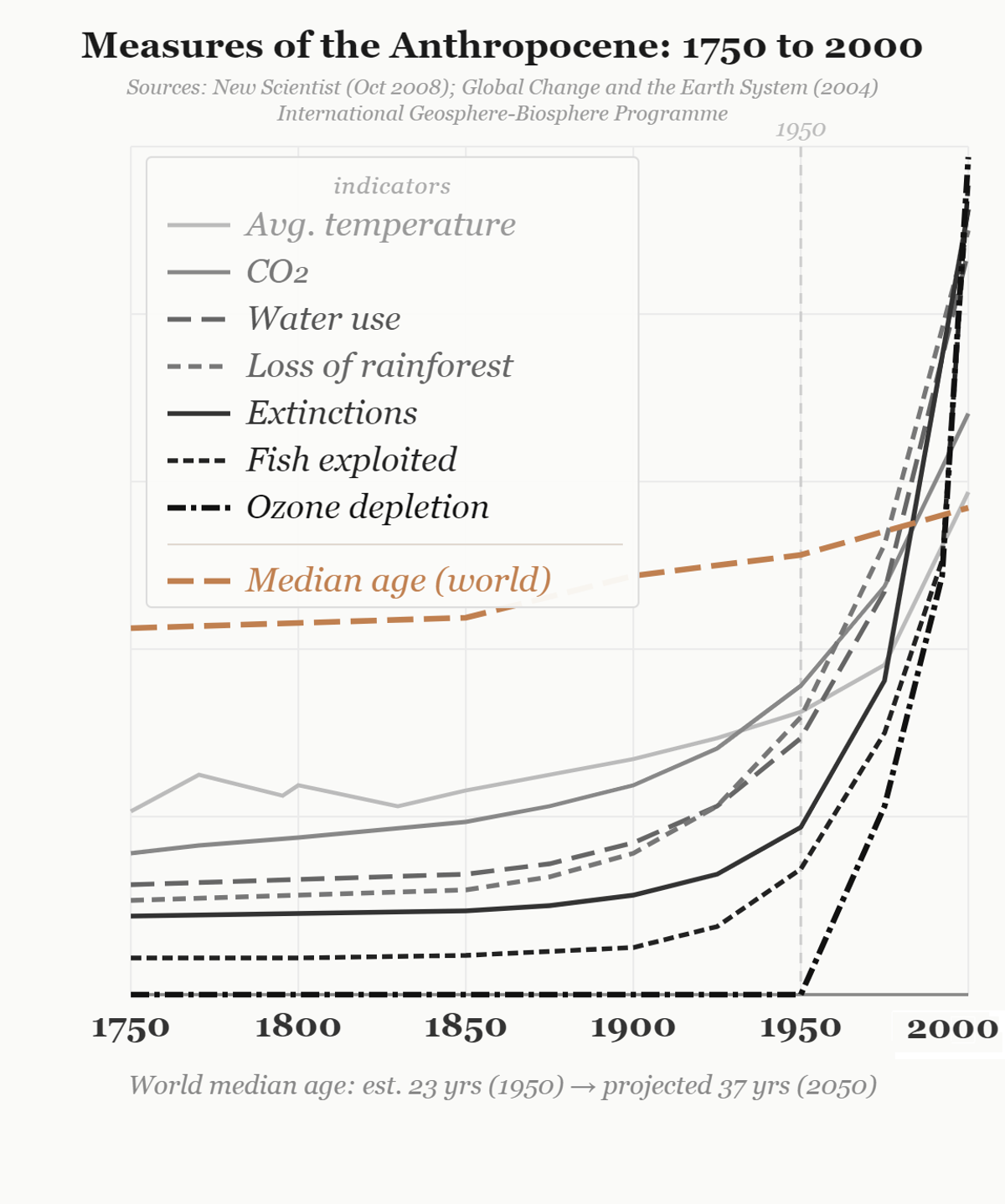
History shows that civilization tends to reflect the median aspects of its population’s inclinations, and its population’s median age plays a significant role in this. As our inclinations mature as we age, so too should a civilization’s. In other words, the longer each of us attends the school of life, the more wisdom deepens as we experience humbling losses and failures, and begin to face our own mortality and ultimate ignorance.
Global median age during Roman times is estimated to have been around 20 years old. Nearly 2000 years later, it had only risen to 22 years by 1925. The world wars of last century occurred when the global median age was barely above Roman levels, and the genocide in Rwanda occurred during an even lower median age of around 15. Fortunately, due to recent advance in medicine the global median age bounced up to 30 years by 2025. In another 100 years the median age is estimated to reach 45 years old. That’s double of what it was in 1925, or during Roman times. The trend looks exponential, and I would predict the chances of genocide and war to be comparably lower.
With AI’s help in exponentially advancing modern medicine, how much will it rise by the year 2225, 2325 — 12,025? Put another way, a population whose median age is in the twenties results in an overly active and teenagely impulsive civilization, as history shows. That would not be the case for a population with a median age of 45 and beyond, but is that just my naive certainty talking? Increasing median age improves the odds of collective wisdom. I know this is not guaranteed, since wisdom is never evenly distributed, but the probability shifts as more people become humbled by life. As the personal narrative of success gets repeatedly challenged by reality, the grip of rigid categories tends to loosen, which is the profound sameness chapter 56 emphasizes. There will always be outlier fools, but they will be outweighed by the abundance of wiser people.
A falling birth rate also moves a population’s median age upward, and wealthier populations have declining birth rates, meaning more old people humbled by life. The advent of robotics is arriving just on time. However, don’t hold your breath waiting for a major adaptation to the consequences of the tradeoff covered in this essay. Real stable change for the better may take hundreds or thousands of years, but it is inevitable. Even if this takes another 10,000 years, well, we’re half way there. In addition, the rate of change looks exponential judging from the Anthropocene chart above. Yes, this paints an ominous picture short-term, but the median age is increasing exponentially as well. In any case, Nature is always in command, so unlike our cup, nature’s cup is always half full.
Knowing True Causes
The downside of civilization is the destabilizing price it forces us to pay for our material comfort and security. Indeed, this tradeoff accounts for most, if not all, of the societal ills humanity faces — theft, rape, child abuse, addiction, war — each ultimately rooted in the psycho-emotional disconnection and hierarchical pressures civilization produces. Yet, we would not go back to the ancestral old way even if we could. Even so, there is hope if we can begin to comprehend the profound role civilization has had in creating the problems we find so serious. Knowing true causes always improves one’s probability for effective management. Conversely, ignorance invariably ends up playing Whack-a-Mole. Right Comprehension, the first step on Buddha’s Noble Eightfold Path, is the first step society must take to manage the consequences of civilization better.
However, any effort to enlighten the world reminds me of the maxim: you can lead a horse to water, but you can’t make him drink. People drink in whatever resonated with them intuitively; whatever tends to confirm what they already sense is true, and what they actually feel is missing from life.
Finally, you may ask: “So what? How does any of this knowledge solve anything for me right now?” Well of course it doesn’t. That ship has sailed. However, I find that simply knowing the underlying forces at work in my life allows me to settle fully into reality. Or as chapter 65 suggests: To the outside world, contrary indeed. Then, and only then, reaching great conformity.
Postscript and Perhaps Future Epitaph
I’ve been trying to figure life out since I was about 10 years old. I hunt and gather answers, which always reveal deeper questions. And I will be at this until I reach that happy hunting and gathering ground. Even so, I feel this essay is a milestone in this pursuit. Much of this journey has been a search to answer the problem of human suffering. This may stem from my inability to trust any cultural answer as adequate, although Buddha’s Four Noble Truths and the Tao Te Ching have come closest.
That has forced me to go through life reinventing the wheel, spoke by spoke, which isn’t a bad approach really. As Buddha advised: “Don’t accept my teachings on faith; instead, verify them through personal experience.” Indeed, how can we trust anything we have not found to be true through our own experience? Usually people rely on the recommendations of others, but how do these others truly know? It all rests on blind faith at some point. Again, as chapter 65 cautions: Of ancients adept in the way, none ever use it to enlighten people. They will use it in order to fool them. It is wise to be wary. The first line of chapter 71 truly says it all: Realizing I don’t know is better; not knowing this knowing is disease.
My reinventing-the-wheel quest began in earnest when my brother died in 1964. A quandary over the nature of life and death consumed me for months until I simply realized that life and death were two sides of the same coin, which made my later exposure to chapter 56’s profound sameness truly resonate. This culminated a few decades later in the Correlation process, which helped me neutralize the problem Paul Dirac described, i.e., that we cannot form a mental picture without introducing irrelevancies. We complicate matters by attempting to conceal the irrelevancies with the certainty of belief. The Correlation process goes in the opposite direction by disassembling language and its words, which breaks the blind faith in words.
Overall, my writings have sought to work out the diverse aspects of suffering and explore feasible solutions. The Tradeoff feels like the culmination of this search. I now fully realize how much human psycho-emotional suffering is a direct result of civilization and its hierarchical basis. All the same, I regard this as only nature’s evolutionary process working through the kinks; I’m just humanly impatient and want the situation fixed yesterday. Seeing all this as simply evolution gives me more peace of mind. Although not a solution per se, perhaps this overview of the tradeoff humanity made may help resolve some troubling issues for others… I find it helpful to keep the essence of this overview in an active corner of my mind. Chapter 52 recommends such mindfulness:
The Original Tradeoff Essay
Below is the original and more succinct version of The Tradeoff. Most folks found it to be a bit dense, so not being a truly talented writer, I enlisted AI to help change that. Eventually, AI and I worked through it paragraph by paragraph to produce the 7 Part version above. The meat is the same in both I imagine, but the 7 Part has more gravy.
The Tradeoff
Jñāna yoga
Many of us find life troubling at times. Knowing how humanity got to where it is today and what to do about it can put to rest many a puzzling and disturbing aspect of life. Jñāna yoga is a spiritual practice that pursues knowledge with questions such as “who am I, what am I”. This essay addresses such core questions.
To begin with, do we fully appreciate how recent the ancient practices we revere today came about? What drove humanity, after several hundred thousand years as modern humans just like us, to start suddenly down a path of such exponential cultural innovation? What deeper dynamics underpin religion, science, politics, literacy, economics… not to mention war and peace? I find the answers lie in the transition away from the egalitarian old ways of our ancestors to the hierarchical social structure permeating civilization… Happily, discovering deep causes can help cope with many of life’s difficulties.
Caution: My goal here is to draw as complete an overview of humanity as possible using a minimum of words. The Taoist in me knows more words obfuscate. As a result, I must lean heavily on the reader’s experience and overall sense of history to fill out the picture. The big picture this essay draws makes it dense and not a quick read. Study it patiently to obtain the most insight. For links to more detailed information, go to www.centertao.org/tradeoff. Printing out The Tradeoff may help.
Mental Pictures
Before plunging into The Tradeoff story proper, I would like to clarify what may be a major sticking point for many. The Taoist references in this essay can challenge one’s traditional common sense worldview. For example, chapter #56 of the Tao Te Ching says, Knowing doesn’t speak; speaking doesn’t know. Subdue its sharpness, untie its tangles. Soften its brightness, be the same as dust. This is called profound sameness. Last century’s discovery/ revelation of quantum mechanics parallels the Taoist core view. For instance, in The Principles of Quantum Mechanics (1930), Paul Dirac contrasted the traditional common sense Newtonian world and the quantum one: “It has become increasingly evident… that nature works on a different plan. Her fundamental laws do not govern the world as it appears in our mental picture in any direct way, but instead they control a substratum of which we cannot form a mental picture without introducing irrelevancies.”
Words form the framework of our “mental picture”. Quantum mechanics is just a more complex and indirect way of putting the Taoist view expressed in chapter #56 above, and throughout the Tao Te Ching. For example, The name possible to express runs counter to the constant name (chapter #1) and All realizing goodness as goodness, no goodness already (chapter #2). Finally, chapter #71’s Realizing I don’t’ know is better; not knowing this knowing is disease bluntly warns us of the danger of “introducing irrelevancies”.
Our mind is so utterly connected to words and language that it is our main way of knowing we know, and of perceiving the idea of the self. Perception outside that box is nearly impossible. When all we know from infancy onward is circumscribed by words, our psycho-emotional security hinges on words and the meaning they convey. Words, and the language we weave them into, allow us to pin down a secure symbolic and generalized reality in a cognitively convincing way. This is certainly useful up to a point. Still, how much is too much?
When we hear a word such as “tree”, we mentally picture a tree that has no reality other than in our mind. Even when we point to a physical tree, the word is an abstraction symbolic of that phenomenon unique in its own right. Words permit us to “introduce irrelevancies” which we then augment with emotion-tinged hierarchical “irrelevancy, such as this tree is more (or less) beautiful, useful, old, or tall, than that tree. Conversely, the more thoroughly you view life from a quantum mechanical (or Taoist) angle, the less certain reality becomes. Realizing I don’t know becomes easier. Hierarchy levels out into an egalitarian profound sameness wherein hierarchical “irrelevancies” can’t easily exist! Note: Before reading on, examine the graphics in this essay. It is important to appreciate the time scale these graphics show.
Polarity Severs Connection
At the outset, it is important to consider the era leading up to the prehistoric transition from hunting and gathering to settled agriculture. The discoveries of paleo-art of the Lower Paleolithic era (about 2,500,000 to 200,000 years ago) hint at the cognitive characteristics of this era’s Homo species. What inspired the artistic creativity in this group of modern humans (Homo sapiens) and our now extinct human ancestors?
From a symptoms point of view(1), the most straightforward hypothesis may be that this creative drive was symptomatic of these hominins’ concurrent cognitive evolution. Language, and specifically the dialectic nature of human language, “introduces irrelevancies” that split reality into polar extremes: good vs. bad, beauty vs. ugly, right vs. wrong, life vs. death, etc. This dialectic characteristic, with its polarizing quality, pervades human cognition causing us to feel a visceral sense of disconnection from Nature, i.e., Nature is not reducible to polar opposites! The disconnect with Nature we feel drives us to find ways to connect and feel Oneness again — Enter the arts, music, and spirituality of prehistoric peoples.
Note: The words and language we use to think about the world arise from the electro-chemical ON / OFF nature of the nervous system (neurons). This biology forces us to perceive reality in a dipolar way. While this ON/OFF process is just a speck of nature’s cosmic reality, this speck is the primary process life relies on to perceive and maneuver through the environment (i.e. survive).
In other words, survival rather than perceiving nature’s cosmic reality is the driving force of evolution. Obviously, our large brain fosters vast and subtle features of this ON/OFF process compared with protozoa or plants, for example. Alas, that advantage allows human language to intensify this dipolar perceptual bias.
The Tao Te Ching points to how language supplants intuition with cognition in its disclaimer in chapter #1: The way possible to think, runs counter to the constant way. The name possible to express runs counter to the constant name. Even so, archeology, along with research of unspoiled hunter-gatherer people in the last century, provides abundant evidence that our hunter-gatherer ancestors coped rather well with this cognitive dissonance through their profoundly egalitarian social structure and shared forms of self-expression. I’ll expand upon this later.
Domestication Ramps It Up
TheTradeoff story really begins with the domestication of fire 400,000+ years ago along with some degree of self-domestication (google [human self-domestication]). Even so, the event that kick started our shift into an hierarchical social order occurred just 15,000 years ago, with the domestication of dogs, soon followed by the domestication of meat animals, plants, and another round of self-domestication for us. Yes! Civilization’s hierarchical social structure is another form of self-domestication. Essentially, we forfeit some personal autonomy to conform, and thereby gain a secure niche in the social hierarchy.
The gradual process of domestication became truly problematic with the advent of grain agriculture, increasing population density and the top-down control of institutional hierarchy, beginning with fixed settlements like Jericho (9,000 BCE) and Catal Huyuk (7,500 BCE). The continuous surpluses made possible by grain agriculture are not natural in the wild. Surplus invites having, hoarding and greed, which stimulates the ego. This concurs with the “illusion of self”, as Buddha pointed out in his 2nd Noble Truth, “the illusion of self originates and manifests itself in a cleaving to things”. This enhanced self (ego) helps exacerbate competitive hierarchical instincts and suppress cooperative egalitarian ones.
Divide and Conquer
The Neolithic Revolution, a global transition between 10,000 BC and 2,000 BC, added to the cognitive schism between nature and ourselves by displacing the egalitarian ways of our hunter-gatherer ancestors with the hierarchical social system we experience as civilization. This new civilizing social model exploited hierarchical instincts at the expense of egalitarian ones in order to manage the larger populations made possible by exponential advances in technology and agriculture.
Civilization emphasizes specialization, and through various ways—such as calendars, expertise, literacy, social ranking, etc.—essentially divides and conquers the egalitarian hunter-gatherer in each of us. The more specialized the activities of a culture, the more multi-layered and hierarchical its society. Indeed, niche specialization is the hallmark of advanced and sophisticated civilizations (2).
Such specialization is socially disconnecting and yet essential for organizing labor and minimizing social chaos. Moreover, social disconnection deepens as a civilization becomes more sophisticated and specialized over time. This is an excellent and ironic example of how solutions cause their own problems! Everything has its price.
Original Sin, Disease, and Free Will
The increasing sophistication of civilization over the millennia also aggravated the cognitive dissonance that arose during the Lower Paleolithic period. The socio-economic changes caused by the Iron Age helped bring this dialectic knowledge problem to a head. Interestingly, both the Bible and the Tao Te Ching speak to this knowledge problem. Genesis 2:17, But of the tree of the knowledge of good and evil, thou shalt not eat of it: for in the day that thou eatest thereof thou shalt surely die. Similarly, the Tao Te Ching chapter #71 points out, Realizing I don’t know is better; not knowing this knowing is disease. It appears that what the Tao Te Ching calls disease parallels what Western religions call original sin.
Interesting also are the different ways each scripture deals with the sin/disease problem. The Bible goes on to imply that we have the free will to choose good over evil and thus avoid sin. In sharp contrast, the Tao Te Ching chapter #2 points out, All realizing goodness as goodness, no goodness already, i.e., the label ‘good’ awakens an opposite, ‘not good’, ‘bad’, ‘evil’, etc., making ‘good’ and ‘evil’ co-dependent. No wonder chapter #71’s advises, Realizing I don’t know is better. This is the Taoist way of avoiding the sin/disease problem… not free will.
Chapter #38 challenges the belief in free will too: Superior virtue never acts and never believes. The tipoff: This divorces action and belief from virtue, and by inference, any action influenced by a belief in free will. Absent an explicit (or implied) sense of free will, we can’t honestly credit anyone for selfless acts of virtue, or by inference, blame anyone for selfish acts of evil. Naturally, this seriously threatens the hierarchical dynamic upon which civilizations depend. (3)
Cognitive Dissonance + Social Disconnection
There are two fundamental and interrelated factors to keep in mind: (A) the social disconnection caused by civilization and (B) the cognitive dissonance caused by the dialectic nature of language. Each exacerbates the other. Humanity traded the social security of the old way for the material security of agriculture and the hierarchical social system required to support it.
This hierarchical social model counteracts the egalitarian social self-security engendered by the old way of ancestral humanity. That lessening of social connection (A) along with the language-induced cognitive dissonance (B) fostered a subtle, albeit persistent, sense of separate self that leaves people feeling insecure and isolated.
Self-preservation instincts then drive this increasing sense of separate self to find a secure niche in the hierarchy. This means specializing in a meaningful role in order to belong to society. The resulting niches of specialization divide and rank a population from high to low, usually in this order: gods, kings, priests, teachers, warriors, artisans, traders, farmers, slaves, beggars and barbarians, (or the modern equivalents).
In addition, the settled existence accompanying civilization allows individuals to hold on to things to extend and safeguard their niche — to ‘keep up with the Joneses’, as it were. The holding on to things increases the sense of separate self — “the illusion of self” that Buddha pointed out in his second truth, i.e., “the illusion of self originates and manifests itself in a cleaving to things” — “things” include both the material and spiritual, and the physical and mental. Such attachment augments the original sense of a separate self, which leaves one feeling more isolated and insecure.
To top this off, the hierarchical ranking of ‘good’, ‘better’, and ‘best’ combines with Buddha’s “a cleaving to things” to create another illusion — the illusion of perfect. This deepens our split from Nature. To paraphrase chapter #2, All realizing perfect as perfect, no perfect already, i.e., the label ‘perfect’ awakens an opposite, ‘not perfect’ ‘wrong’, ‘faulty’. Perfect and Nature are incongruous. Nature’s reality is not a duality! The duality we perceive is simply a symptom of “introduced irrelevancies” arising from our cognitive sense of disconnection from Nature. The illusion of perfection also offers a way to establish hierarchical rank — a social measuring rod with, for example, ‘dullard’ on one end, and ‘genius’ on the other (4).
Given the increasing pressures to land a secure niche, to connect, it is not surprising that notions of free will, success, and perfection hold more sway. A belief in free will helps give people a sense of control over life with the power to fill their niche in the social hierarchy. The free will ideal offers us hope that we can find our own way through life, and that there is the chance we can gain fame, fortune, prestige, rank, friends and admirers. Finally, the enhanced notions of self and free will help support and even drive hierarchical forces and counteract the egalitarian ones.
But Isn’t Hierarchy Everywhere in Nature?
The degree of hierarchy in the ancestral old way vis-à-vis civilization makes all the difference! Unlike the old way, civilization requires and promotes hierarchy. Heroes, religion, competition, rewards, wealth, class, sports, arts, music, knowledge, skin color, etc., all play a role in advancing levels of better vs. worse, high vs. low, etc.
Civilization is hyper-hierarchical, built layer upon layer, niche upon niche — all serving to disconnect us socially, yet provide a niche to which we can support and connect — to a degree. The point is, the hyper-hierarchy of civilization makes social connection more problematic. This exacerbates the sense of disconnection generated by the cognitive dissonance caused by “introducing irrelevancies”.
Enter Religion and Practices like Yoga
Another notable feature of the transition from the old way to civilization was a major shift in spirituality. Social institutions arose for disconnected souls seeking re-connection; that is the job of religion. Religious gatherings offer the promise of egalitarian reconnection. Actually, any gathering, be it musical, political, or a yoga class, offers much the same. Note, the word religion is from the Latin religare — re = again + ligare = to bind, to connect. Similarly, yoga is from the Sanskrit yuj — yuj = to join, to unite. As we see, both are primarily about our dire need for connection!
Deity oriented religions from Christianity to Hinduism generally draw on the simple hierarchical structure of a family or a tribe, where a father or a tribal alpha-male (a.k.a. God) guides his flock. In addition, deity religions — especially Western religions — generally support the idea of self, free will, and free choice. Finally, they depend on their followers’ belief in the verity and legitimacy of words. The Bible offers many examples, e.g., “For the word of God is living and active…” Hebrews 4:12; “Sanctify them in the truth; your word is truth.” John 17:17. (Google [Bible Verses Word of Truth] for more.)
Interestingly, the core Buddhist and Taoist paths, and yoga to an extent, approach religion (re+ligare) a little differently. As evidenced by Buddha’s Four Truths and the Tao Te Ching, they appear to draw more on egalitarian instincts to push back on ‘the illusion of self’ and ‘the illusion of free will’. This is not to say deity-oriented religions don’t also tap into egalitarian instincts, but rather that they depend extensively on hierarchical authority.
Still, the core of yoga, as expressed in the Bhagavad Gita, is also prescriptive and hierarchical. For example, “For if a man thinks of the Spirit Supreme with a mind that wanders not, because it has been trained in yoga, he goes to that Spirit of Light.” It is easy to interpret this as validating free will and perfection, which sets the hierarchical bar unnaturally high.
Nevertheless, the promise of controlling one’s life and finding connection in a secure niche — in a “Spirit of Light” or whatever — is what we often yearn to hear. On the other hand, we have the ancient yogic sentiment Tat Tvam Asi, “Thou art that”. This all-connecting yogic ideal is a joining together, linking “I” and “that”. It doesn’t get more egalitarian than this!
Tat Tvam Asi is Profound Sameness
The problem we Homo sapiens (Latin: “wise man”) must deal with is our illusion of distinction born of language and the naming that supports it. We think we make wise distinctions. Tat Tvam Asi challenges our cognitive perception of difference — our “introduced irrelevancies”. This “wise man” aspect likely has its origins in what Buddha called the “illusion of self”. Naturally, some sense of self is essential for survival of any living thing! However, we humans have way too much of this sense of self, an imbalance going back to our hunter-gatherer ancestors. Civilization’s hierarchical social dynamics only exacerbate this cognitive distinction and its ensuing sense of disconnection.
Tat Tvam Asi corresponds to the Taoist idea of profound sameness. Again, as chapter #56 put it…
This view of non-distinction reveals a subtler aspect of balance (5). When ‘thou art that’ there is no otherness. Without otherness, life can ride the wave of dynamic balance without dissonance. We can go with the flow, as they say. All this goes to point out how the egalitarian social settings of our illiterate “unsophisticated” hunter- gatherer ancestors helped imbue individuals with an innate sense of psycho-emotional balance. That sense of balance is the harmonious quality missing from civilized hyper-hierarchical society.
Our naming of things freezes the reality of the moment in memory, which we then do our best to impose upon nature’s wave of dynamic balance. Our fondly held illusions of difference produce and magnify a sense of psycho-emotional one-sidedness. Civilization’s incessant pigeonholing of reality increases hierarchical distinctions and we end up with a deepening sense of inequity even as we find our secure niche. We feel varying degrees of discomfort and scurry about throughout life striving to regain balance — to reconnect with the whole, so to speak. Even so, we fail. As the Tao Te Ching cautions, Realizing I don’t know is better; not knowing this knowing is disease.
But Language Helps Connect Us
Certainly, language facilitates communication and without it, we would lose a huge competitive advantage. Words impart a true survival advantage by categorizing nature even as their “introduced irrelevancies” disconnect us from nature. The innate need to feel connection causes language to evolve in storied ways that attempt to make up for this schism. This was adequate, at least in simpler times prior to civilization. Now it is often less than adequate. The words cause the disconnection, and ironically, we avidly use words to understand and increase our sense of connection.
Our cognitive dissonance along with the hyper-hierarchical dynamics of civilization deepens our sense of disconnection, social and otherwise. This compels us to fervently reach out and connect in a multitude of ways — gods, music, art, heroes, literature, clubs, sports, political groups, science… you name it! And, when this fails, we turn to drugs, alcohol and general self-indulgence to blot out our sense of disconnection.
The Old Way
In contrast to the circumstances of civilization I have just outlined, our hunter-gatherer ancestors had little opportunity to succumb to the problem of a separate self (ego) as Buddha pointed out, i.e., “the illusion of self originates and manifests itself in a cleaving to things”. Our ancestors, following the old way, were frequently on the move. “The illusion of self” could not develop as it does in the settled conditions of civilized society. Only when you settle down in one place for generations, can you accumulate enough things to augment “the illusion of self”!
Moreover, hunter-gatherer survival was best accomplished by group egalitarian instincts, with hierarchical instincts playing a minor social role. Any over expression of hierarchical instinct would threaten group cohesion and cooperation that was crucial for survival. In these circumstances, there would be little need for a spiritual ideal touting personal salvation via a God, a “Spirit of Light”, or whatever. The visceral sense of social security felt by belonging to one’s group was ample salvation.
In this way, we have evolved over millions of years, transiting through various Homo types — H. habilis, H. rudolfensis, H. ergaster, H. erectus, H. neanderthalensis — to the current H. sapiens. To assume we could sanely shift so quickly from that balanced egalitarian old way to the opposite hierarchical social system of civilization is an ideal born out of ignorance. The irony is that we assume we can fix the problems of civilization by means of civilized solutions. This easily turns into fighting fire with fire, as history shows.
Was the old way really that way?
Archaeological and anthropological research tells us much about the old way. One of the most important resources is the research done by Lorna Marshall, an anthropologist who in the 1950s, 60s and 70s lived among and wrote about the previously unstudied !Kung people of the Kalahari Desert. For details, see https://www.centertao.org/kung.
Note, I’m not claiming our ancestors were living in a Garden of Eden of egalitarian harmony. They had their difficulties like all other animals. I am just noting the naive tradeoff our ancestors made in their move to civilization. Up until now, our bias has been on how superior civilization and we humans are. I am attempting to reveal another side that we usually rather not see deeply… but perhaps should. This excerpt from Marshall’s research, The !Kung of Nyae Nyae, hints at what humanity lost in its unwitting tradeoff for material comfort and security:
The [Ju/wasi] are extremely dependent emotionally on the sense of belonging and companionship. Separation and loneliness are unendurable to them. I believe their wanting to belong and be near is actually visible in the way families cluster together in an encampment and in the way they sit huddled together, often touching someone, shoulder against shoulder, ankle across ankle. Security and comfort for them lie in their belonging to their group free from the threat of rejection and hostility.
I believe that the importance of the group showed clearly in the way that the people made decisions. Women were as much a part of this as men. The people would talk together, for days if necessary, until every point of view had been considered. Our notions of secret ballots and majority rule would have seemed unpleasant to them—they preferred consensus, with everyone knowing the thoughts and feelings of everyone else, and everyone pleased with the decision. Our notions of individuality would also have seemed inappropriate to the Ju/wasi—they expected to function as group members
A New Old Way
The downside of civilization is the destabilizing price is forces us to pay for our material comfort and security. Indeed, this tradeoff accounts for most, if not all, of the societal ills humanity faces. Yet, we would not go back to the ancestral old way even if we could. Even so, there is hope if we can begin to comprehend the profound role civilization has had in creating the problems we find so serious. Knowing true causes always improves one’s probability for effective management! Conversely, ignorance often ends up playing “Whack-a-Mole”.
“Right Comprehension”, the first step on Buddha’s Noble Eightfold Path, can help alleviate the consequences of hierarchical civilization and much of the ignorance that follows in its wake, at least on the personal level. No doubt, an honest public understanding of the underlying causes of civilization’s problems could help society manage this current phase of our evolution better as well.
However, any effort to enlighten the whole population reminds me of the maxim, “You can lead a horse to water, but you can’t make him drink”. People “drink” in whatever tends to support their beliefs and biases, and so we listen mostly to what we want to hear. Yet, I see a natural way around this.
Onward to 12,000 A.D.
Civilization reflects the median aspects of its population’s inclinations. A population’s median age plays a major role in these aspects, i.e., our inclinations mature as we age, and thus so should a civilization’s. In other words, the longer each of us attends the school of life, the more wisdom deepens as we experience humbling losses and failures, and face our own mortality and ultimate ignorance.
Life expectancy at birth was a brief 25 years during the Roman Empire, it reached 33 years by the Middle Ages and rose to 55 years in the early 1900s. Median age is a more accurate way to consider a whole population; however, data for that metric is only available for recent years.
The median age of the world’s population was estimated to be 23 years in 1950. The world’s median age is estimated to rise to 37 by 2050. With the exponential advances in modern medicine, how much will it rise by the year 2100, 2200, 2300… 12,000? Put another way, a population whose median age is under thirty results in an overly active and teenagely impulsive civilization, as history shows. That would not be the case for a population with a median age of eighty or one hundred and eighty — I’m certain (6)!
In addition, a falling birth rate also moves a population’s median age upward, and wealthier populations have declining birth rates. However, don’t hold your breath waiting for a major increase in global standards of living and median age. This may take hundreds or thousands of years, but it’s inevitable. Even if this takes another 10,000 years… well, we’re half way there! In addition, the rate of change looks exponential judging from the Anthropocene chart above. Yes, this paints an ominous picture short-term, but the median age is increasing exponentially as well. In any case, Nature is always in command so the cup is always half full!
Adapting Moment by Moment Personally
Most of what I do in life helps fill the void in me that would never exist were I born 10,000+ years ago in the more balanced egalitarian and physically demanding circumstances of the old way. Now, like everyone else, I just hunt and gather in other ways. My quest to figure life out has certainly been a major aspect of this adaptation. I hunt and gather reasons for why life is the way it is.
However, in the moment-to-moment, the most essential hunt and gather adaptation for me has been yoga. By yoga, I don’t mean any particular activity! To paraphrase the Taoist disclaimer of chapter 1: The yoga possible to express runs counter to the constant yoga. Let’s return to the core meaning of the word yoga: “to join”, “to unite”. Any life action that fulfills this process is a pathway for moment-to-moment connection. Eventually, as the Bhagavad-Gita puts it, “A harmony in eating and resting, in sleeping and keeping awake: a perfection in whatever one does. This is the Yoga that gives peace from all pain”… Well, peace from much of the psycho-emotional pain anyway.
This constant yoga offers me a way of paying a daily price for the civilized degree of comfort and security that I enjoy. Happily, a degree of life balance returns when I pay this price honestly and watchfully. Chapter #56’s Knowing doesn’t speak; speaking doesn’t know reminds me of the maxim, ‘actions speak louder than words’. To this point, Buddha’s Fourth Truth states in part, “There is salvation for him whose self disappears before truth, whose will is bent on what he ought to do, whose sole desire is the performance of his duty.”
Naturally, duty here is anything you sincerely feel a need to do right — a perfection in whatever one does. This applies to conforming to any activity, physical or intellectual, e.g., ballet, sports, math, cooking, music, raking leaves, brushing your teeth, and of course religious practices. Indeed, I can’t think of anything in life that is excluded. (See also Buddha’s Truths Pertain To All Life, p.545)
Consequently, performing your duty — your constant yoga — whatever that is in your life, can be your way of filling the void left by civilization and paying for the comfort and security you enjoy. A degree of life balance returns when you pay this price as honestly and watchfully as possible.
A meaningful life means a meaningful struggle
Civilization’s unbridled advancement of comfort and security allows us to take the path of least resistance more than would be possible living in the wild. This imbalance is detrimental to physical, and by extension, mental health.
Nature shows us that struggle is an essential factor in life. Take a tree for example, it diligently sends its roots down deep enough to fetch nutrients. The survival struggle lies at the root of its life’s meaning, for trees, for humans… for all living things. Indeed, just consider how everything nature does has intrinsic meaning.
All living things have evolved to struggle! In the wild, this struggle is obvious when you look closely at the lives and interactions of all living things. Living things struggle in two primary ways: (1) Internally via the interplay between the core emotions of fear and need—essentially flight or fight. Internally also via the immune system’s work to ward off invading threats. (2) Externally via the skeletal muscle system’s work to ward off threats, and hunt and gather the nutritional necessities for survival.
Evolution, in particular, is the process of adapting an organism’s biology to its circumstance. This struggle bestows the quintessence of a meaningful life for all living things. Human biology evolved to meet the challenge of life in the wild, not in civilization’s realm of enhanced comfort and security. Civilization’s success at circumventing the grittier aspects of life’s survival struggle comes at a price. Our survival energy ends up seeking other outlets—life energy must flow. Where and how it flows healthfully is the vital question.
For example, in the 19th century we discovered microbes and, through proper sanitation, how to protect ourselves from them. In the 20th century, we perfected this defense further through antibiotics and ultra sanitation. It now turns out that a lack of exposure to, and challenge by, the ‘dirty natural world’ can cause a person’s immune system to turn in on itself. Survival energy veers off course in unhealthy ways, e.g., allergies and digestive disorders
The same dynamic must also apply to the physical realm, and our skeletal-muscle system’s need for sufficient challenge to thrive. Without enough of this, emotions will take on the struggle, as it were, and we chase after life-meaning in ways that are more neurotic.
The simple lesson here is that hominids evolved a primal set of emotional and physical features over millions of years to promote their survival. Rampant human innovation interferes with these primal needs, which throws life-meaning out of balance. Overall, much of the dysfunction humanity experiences, at least in part, is a symptom of a fundamental life-meaning imbalance.
And yet, it’s all good
But so what, I ask? After all, nature uses the dynamic flow between balance and imbalance to carry out its evolutionary work. We’re still on track. Humanity’s primal struggle has been one of physical survival up to now. In the future, as humanity succeeds in conquering its physical comfort and security issues, our sense of disconnection will only deepen. Our struggle for a meaningful life will increasingly take place in the psycho-emotional realm. This simply means the focus of our evolutionary struggle will be shifting from the physical to the emotional.
Fortunately, one can restore some personal balance by pushing back on one’s ever-present desire for optimal comfort and security. This usually entails some type of lifelong daily practice that helps connect one to oneself (7). In short, hope lies in diligently compensating for the loss of natural pushback Mother Nature would provide one in the wild.
Diligence!
Buddha’s last words were, “All things are impermanent. Work out your own salvation with diligence”. This is straightforward, yet it is natural for any animal, human included, to avoid striving diligently when there is no clear and present need to do so. Free anything is an enticing natural illusion — a bio-hoodwink (8) I call it. In the wild, animals have no choice but to strive diligently and in return experience a truly meaningful existence. It can be intensely otherwise for us, as we know. Nevertheless, when all else fails, stepping up to pay the price, your duty — your constant yoga — is as easy as it is unavoidable (9).
In Summary:
Happiness is what we yearn for, right? Pinning down what brings true happiness is the problem. To me, happiness really amounts to feeling life meaningful. Lacking that, life feels empty, which makes life’s pleasures even more enticing—unbalancing.
So, what actually makes life meaningful? Examined closely, fear and need reveal the process for how life plays out for us, and all of life really. Briefly: fear ð need ð movement ð happiness. (Note: “⇒“ is short for “brings about”)
This shows why ideas, pleasures, objects, or money alone never brings happiness. They only are meaningful when they are an integral part of the flow ð portrayed above. For example, if a fear of poverty drives your need to work hard (movement) you will feel life meaningful, and probably end up with money as well. But, it is the need driving the movement that creates meaning that instills happiness, not any resulting wealth. Buddha’s “Strive on diligently” is just a summary of this full process. (See A final word on fear, p.634 and A final word on need, p.639)
Finally, you may ask, “So what?” “How does any of this knowledge solve anything?” Well of course it doesn’t! That ship has sailed. However, I find that simply knowing the underlying forces at work in my life allows me to fully settle into reality. Or as the Tao Te Ching suggests, To the outside world, contrary indeed. Then, and only then, reaching great conformity.
Postscript and Perhaps Future Epitaph
I’ve been trying to figure life out since I was about 10 years old. I hunt and gather answers, which always reveal deeper questions. And I will be at this until I reach that happy hunting ground. Even so, I feel this essay is a milestone in this pursuit. Much of this journey has been a search to answer the problem of human suffering. This may stems from my inability to trust any cultural answer as adequate, although Buddha’s Four Noble Truths and the Tao Te Ching have come closest.
That has forced me to go through life reinventing the wheel, which isn’t a bad approach really. As Buddha advised, “Don’t accept my teachings on faith; instead, verify them through personal experience”. Indeed, how can we trust anything we have not found to be true through our own experience?
Usually people rely on the recommendations of others, but how do these ‘others’ truly know? It all rests on blind faith at some point. Again, as the Tao Te Ching cautions us, Of ancients adept in the way, none ever use it to enlighten people, They will use it in order to fool them. It is wise to be wary. The first line of chapter 71 says it all… Realizing I don’t’ know is better; not knowing this knowing is disease.
My reinventing the wheel quest began when my brother died in 1964. A quandary over the nature of life and death consumed me for months until I simply realized that life and death were two sides of the same coin. This culminated a few decades later in the Correlation process, p.565, which helps counteract the problem Paul Dirac described earlier — “…we cannot form a mental picture without introducing irrelevancies.” (See p.550) We complicate matters by attempting to conceal the ‘irrelevancies’ with the certainty of belief. Correlations goes in the opposite direction by disassembling language and its words, which helps to neutralize this blind faith.
Overall, my writings have sought to work out the diverse aspects of suffering and explore feasible solutions. The Tradeoff feels like the culmination of this search. I now fully realize how much human psycho-emotional suffering is a direct result of civilization and its hierarchical basis. All the same, I regard this as only nature’s evolutionary process working through the kinks. Seeing all this as simply nature’s balancing process gives me great peace of mind. Although not a solution per se, perhaps this overview of the tradeoff humanity made may help resolve some troubling issues for others. Note: I do find it very helpful to keep the essence of this overview in a constant active corner of my awareness. I feel the last lines of chapter 52 recommend such a constant mindfulness.
==============
Note: I do find it very helpful to keep the essence of this overview in a constant active corner of my awareness. I feel chapter 52 recommends such mindfulness.
Squeeze exchange, shut the gates; to the end, oneself diligent.
Open the exchange, help its affairs; to the end, oneself no relief.
Seeing the small is called clarity, abide yielding is called powerful.
Use the light, and again return to clarity, not offer oneself misfortune.
This serves as practicing of the constant.
Endnotes
(1) A symptoms point of view, p.141, is the search for the underlying causes of observable phenomena, and the even deeper causes of those causes… ad infinitum. Here, the question reigns supreme; the answer becomes just a passing effect on the quest for noticing deeper causes. No leaping to the ‘answer of the day’ here.
(2) The more sophisticated a civilization, the more diverse its cultural activity. Diversity divides rather than unites. On the other hand, diversity is healthy if there is enough diversity to thwart a tyranny of the majority. You can see the inherent tension civilization must cope with. Wanting to have it both ways is challenging!
Cultural life divides itself up into narrower and narrower niches. Think of any area of life and compare it to history vis-à-vis specialization and sub-specialization. Advancing technology plays a big role in this, but so too does the bureaucratic infrastructure necessary to support an advancing civilization.
Dividing culture into niches is disconnecting, yet for the niche’s specialists, aspirants, and even fans, it does provide a sense of meaningful connection and life purpose. Overall, however, it works against the deep sense of social unity that our hunter-gatherer ancestors enjoyed.
(3) See posts: Free Will: Fact or Wishful Thinking, p.587. For more, review: Of Free Will, I Am, p.319; Is Happiness In Your Choices?, p.403; Instinctive Free Will, p.416; Free Willer’s Anonymous, p.420, and finally, Is ‘Free Will’ the Only Option? p.9.
(4) Our innate social instincts also express themselves much more intensely due to the social divide that civilization’s hierarchical structure produces. This effect is strikingly obvious when this rift pushes human behavior to extreme, albeit rare, outliers of kindness like Mister Rogers, Mother Teresa and Mahatma Gandhi, or of cruelty like serial killer H.H. Holmes, Khmer Rogue’s Pol Pot and Adolf Hitler. On the other hand, this effect is ubiquitous in subtle and insidious ways that often skirt our awareness. Fire up your ‘symptoms point of view’ and inspect aspects of society that concern you. Ask, “What role does this play in social hierarchy?” The connection will nearly always be there; you must just dig for it.
(5) The only time I feel ultimate balance is when all distinctions vanish. Naturally, that is a fleeting experience, but it helps at least to realize that the ‘no thing’ of balance is the ‘bottom layer’, the founding principle, the model, the ebb and flow cycle, and the primary pattern of emergent existence. No matter how I look at life, I always end back to balance as a key principle driving the whole shebang.
Balance is the fulcrum of emergent properties. (See post Tao As Emergent Property, p.121.) Balance is the circle around which emergent properties play out. Balance runs the show. Balance is the least common denominator of existence — and non existence. Obviously, I can’t sing the praise of balance enough!
(6) When I discuss this, people often disagree that aging confers wisdom, and so can’t accept increasing median age as a solution for the evils of civilization. Oddly, they will say they are wiser now than before — they just doubt most others are. I understand a younger person’s doubt. They have yet to acquire enough experience to verify this. However, older people’s doubt puzzles me. Is this because solutions that evolve naturally and exceedingly slow are unappealing?
(See Don’t trust anyone under 60, p.193; And Then There Was Fire, p.296; and Counterbalancing I.Q., p.372, for more on the impact of a rising median age.)
(7) See Hatha Yoga: The Essential Dynamics (www.centertao.org/yoga) Also see posts, Giving Your Life a Gift, p.264; Tao as Emergent Property, p.121; and The Nutty Things We Do, p.143.)
(8) The bio-hoodwink, p.11, p.100, refers to the underlying biological forces that drive survival. These primal forces of attraction and aversion steer all life’s responses to stimuli. For example, sunshine attracts both human sunbathers and sunflowers. The difference between the two is the human capacity for thought. Attraction and aversion stimulate thought, which generates expectations. For example, take a sunbather’s desires or worries about a vacation at the beach… not so for the sunflower. The bio-hoodwink plays out this way:
Attraction (need) + thought = desire, positive expectations.
Aversion (fear) + thought = worry, negative expectations.
Lacking thought, animals and plants don’t desire or worry, nor can they form either positive or negative expectations or regrets. Our ancestors could, but their egalitarian circumstances helped minimize the potential for cognitive dissonance.
Having lost the deeper social connection of our ancestors, we compensate by “cleaving to things”, be they physical (goods) or mental (stories, beliefs, ideals). This cleaving offers us a pseudo sense of connection and augments the “illusion of self” that Buddha described. (See also, Fear & Need Born in Nothing, p.485.).
(9) The matter of “stepping up to pay the price” invariably underlies our judgments of what we or other people should or should not do. Such opinions are usually a symptom of our own failure to “pay the price” honestly and fully. As a social species, we project onto others by means of mirror neurons whatever is important to us — and vice versa. This occurs in proportion to our own perceived failure to measure up, so to speak. (Correlations hint at what drives all this, i.e., fear ≈ failure ≈ loss ≈ death vs. need ≈ success ≈ gain ≈ life.)
This is not to suggest that you could be paying the price any more honestly or fully than you are doing right now. Merely comprehending what spawns your judgments may enhance self-honesty, and with that… Who knows?