1980 and on
When Leslie and I returned to California, we first lived in a small rental. I attempted my first garden, which was a complete failure; nothing came up. I had intensely studied agriculture in Japan to prepare for the homesteading plan Ingela and I had envisioned for the USA. Clearly, this failure highlighted the difference between book learning and actually getting your hands dirty.
Soon, Leslie and I moved onto my parents’ property and began the fixing-up process —a step-by-step project rehabbing ten houses that would eventually span over thirty years. In the summer of 1981, we dug out the cellar under our house by hand, moving some 200 cubic yards of dirt. During this time, we also devised a party game called Laugh & Bare It, a frisky adult icebreaker.
We had better luck with our second, much larger garden. But life brought significant changes. Leslie seemed more interested in partying, while I was truly ready to settle down.
During the brief visit to California in the early 70’s I happened to be driving somewhere with my parents, and something came clear without warning —the way the Bangkok insight had come clear on the bus. Not a thought I arrived at, more like a thirst I suddenly felt: I needed more empathy. Not as a goal or a project. Just an emotion-based recognition, the way the body knows what it needs before the mind can name it. I didn’t pursue it —I had no inkling of how I could generate such a thing. Over the next decade, it simply blossomed and ripened naturally and actually quite invisibly within me.
The Ingela breakup had already begun opening something in that direction. Being left —really left, after ten years —felt like a complete and utter failure, unlike anything experienced before. The connection to the whole that I’d glimpsed through my wandering years became something more solid. And with this clear difference in core needs between Leslie and myself, I had no alternative but to conform to reality, not to my need for a relationship at all cost. I was mature enough to follow reality over ideality and any current emotional needs. I could connect to life more broadly —to all of it, not just through the narrow channel of romantic attachment. The old addiction, if that’s what it was —dopamine and serotonin doing what they do, meeting the outlier’s deep need for connection through the only reliable path available —lost its grip.
By the time Leslie and I hit that fork in the road, something had genuinely shifted. I ended the relationship —the first time in my life I had been the one to end it —not from any negative emotion, but from something quieter. The love was real enough to want what was best for both of us, not just the attachment love that filled my need. No anguish, no regret. Just clarity. Wu wei applied to the heart.
The next day we made plans to marry. That fall, on the winter solstice, we wed in Nisene Marks State Park among the mossy trees and damp leaves. To seal the deal, we shared sake. Afterward, we went on our honeymoon accompanied by my mother.
I continued working on the houses, but then one day my mother informed me she was going to bequeath the property to the historical society. I figured we might as well head off for the South Pacific and eventually return to Australia. However, it seemed my mother actually wanted us to stay, so she offered to will the property to us instead.
With that offer, and my own deep desire to finally settle down, Leslie and I decided to have children. She had wanted them years earlier, but I needed to be sure —once bitten, twice shy. Now the time felt right. My bucket list was done. I was ready for a new adventure.
I switched my focus from a food garden to landscaping and bonsai trees, taking trips to San Francisco to find new ideas and varieties to plant. I bought a video camera just a few days before our first son’s birth. He was an unbelievable joy and a total surprise —and he helped me feel for the first time a tribal connection I had never felt before. Being older when he arrived meant I was far less likely to project my own needs and fears onto him.
When the big earthquake hit we were fortunately prepared —an earlier quake in Coalinga had warned us to replace the foundations and shore up the roof of the most vulnerable row house. All the old wall plaster cracked, leading to a full rehab of walls, plumbing, and electrical. My father had bought these condemned houses nearly twenty years earlier at a bargain, passing away just a year after acquiring them. My mother, and later Leslie and I, rented them out at the lowest price possible, hoping tenants would appreciate the gesture. We were naïve. The final wake-up call came when a tenant’s maneuverings drove us to a lawyer —ugh.
My second son arrived on the heels of the earthquake. Both boys were born at home —out of the womb and soon into the bathtub. Around this time I set up the non-profit Unio Foundation, also known as CenterTao, and began holding weekly meetings open to the public. Many attendees were ex-Catholics looking for an alternative, but they remained innately Christian and were mostly just passing through. I also bought my first IBM-style computer —a 5MB hard drive for a whopping $400.
1990 and on
Homeschooling was the obvious choice, though years before I had entertained the thoroughly idiotic notion of keeping my kids away from language as long as possible —some naïve Taoist idea about the corruption of naming. Reality, as usual, sorted that out immediately. What homeschooling actually gave us was the ability to tailor everything to each child’s interests and stage of development. No one-size-fits-all. I’m deeply grateful we were able to take that path.
Music was central from the start. We kept various instruments around for the boys to try, and both ended up with music careers —which still astonishes me. I had tried to play music since my Australia days with no real success. The utterly remarkable thing is that my kids ended up teaching me. This, and their refusal to ever ask for shoes —when they never did, I decided to join them and go barefoot —were two perfect examples of education running in the right direction. They taught me.
We took weekly day trips with my mother —countryside, coastline, cities, BLM land where we’d shoot guns, fire off rockets, and try the boys’ hand at fishing. I was no fisherman myself, so all I could teach them on that front was patience.
The garden became a try-everything experiment —corn, beans, wheat, buckwheat. We had ducks and geese, which turned out to be the garden’s best allies. My love of both was kindled years earlier in Thailand, riding on top of trucks hitchhiking through the countryside, watching herds of ducks move through the rice paddies clearing insects —a natural insecticide that had been working for a thousand years before anyone thought to name it. The ducks and geese moved through our beds the same way, eating snails and bugs, and developing a particular relish for cucumbers, which always produced more than we could eat anyway. I would have loved a donkey too, but never had the space. My affection for geese and donkeys runs deeper than mere fondness —both are only provisionally domesticated, obstinate, with plenty of wild still in them. The crows I offer peanuts to every morning are the same. They come expecting, they sit close and hang around, but won’t ever come within a few feet. Perhaps that’s why the man who never quite fit mainstream culture finds such kinship with creatures who never quite submitted to it either. I know the feeling.
We shelled the pinto beans by hand, winnowed and ground the grain, and made bread and tortillas. I wanted the boys to get at least a taste of the old ways before the world smoothed everything over.
In the mid-90s we began backpacking into the Sierra wilderness. Kyle was too young for long treks, but we could drive dirt roads to within three miles of our destinations and hike in from there. We traveled light —flour for tortillas, beans for the three-rock fire. Sometimes we brought fishing line. No luck. Patience was still all I had to teach.
In the late 90s bluegrass found us and put an end to the backpacking. We began volunteering at summer music festivals. Luke took to it completely, mastering every instrument. Kyle went along for a while but was always more drawn to the shamisen, a three-stringed Japanese instrument. A sign of things to come.
2000 and on
Luke and I worked out a simple system for playing music by ear —transposing instantly into any key, which is essential when you’re matching a singer’s vocal range. This became the ToneWay Music Method for mountain music, a category broader and considerably older than bluegrass, which is itself an outgrowth of it. Working out the system took a few years, and we eventually began teaching it through workshops. For me, finally understanding the how and why fulfilled a lifelong dream first sparked in Australia, hanging around an American guitar player and singer. From then on throughout my travels I would sing as I walked down the highways —I had the drive, just not the talent. A fellow I traveled through India with once put it plainly: “Too bad your talent doesn’t match your enthusiasm.” He wasn’t wrong.
The boys and a few talented friends performed as the Barefoot Boys at the millennium celebrations. We also played regularly on the downtown mall, tips going to charity. We drew good crowds —the boys were proficient and infectious musicians, I played guitar and sang, Leslie played bass, everyone sang harmony or lead.
Around mid-decade and out of nowhere we received an invitation to appear on the reality TV show Trading Spouses. I said yes immediately —I never turn down a new experience. The rest of the family was hesitant until they heard about the $50,000 fee for a week of filming. The trade involved Leslie going to live with a Black family in Tennessee, while their mother Vickie came to live with us. We got on wonderfully, much to the disappointment of the producers who were banking on drama and friction. These characters were having much too good a time to be earning $50,000. They had been counting on fireworks from the collision of Taoist California and Christian Tennessee. Their solution was Frankenstein scripting —editing the footage to make me say things I never said. Leslie, being deeply socially sensitive, was genuinely upset by the fabrications. Me, I punched back on the lies online and rather enjoyed the combat, never taking it personally. Social weapons can’t penetrate a social void. Sticks and stones can break my bones, but…
The weekly Taoist meetings I gradually reduced —first to twice monthly to weed out the tourists, then to monthly, on the theory that anyone who could remember once a month had at least some genuine interest.
We began a monthly gig at Phyl’s Fish Market in Moss Landing, playing for tourists and locals alike. Kids and sometimes adults danced to the mountain music. Other musicians joined in over the years. It was a genuinely good thing, and it ran for nearly a decade until Covid brought it to an end —which felt, honestly, like perfect timing. We had all said what we had to say with that particular music in that particular place.
I began replacing the roofs on all ten houses. I chose forty-year shingles, which means I’ll need to replace them again when I’m around a hundred. The TKR hardware installed in my knees may also need replacing around then —if the hardware lasts that long. You know hardware. It doesn’t repair itself the way good old skin and bone do.
My mother Esther —Gema, as we called her —caught the flu and was hospitalized. Weakened, she fell and broke her hip. Rehab was going well, but one day she told me she was, at ninety-six, ready to call it quits. I told her she could simply stop eating and that would speed things along. She died not long after. The day before she passed, we were all with her —she lived just next door —and she sang “So Long, It’s Been Good to Know You.” The day she died she seemed more at peace with herself than I had ever seen her, and she had been a real firecracker all her life. I had tried for years to get her to go barefoot, convinced it would have kept her more connected to the ground and to her body. That was a bridge too far for her. I suspect she would have lived considerably longer had she not broken that hip.
I began bicycling to the beach daily, year-round, to do tai chi and yoga and jump in the ocean. I eventually began taking the shakuhachi down and playing Honkyoku there as well. Growing up in Arizona I had always been a freshwater person —the ocean was alien to me. Now I embraced it completely. There really is a season for everything.
2010 and on
Luke married and eventually moved to San Luis Obispo. This was a real shock to our fondly held dream of the boys and their spouses living on this property and one day taking it over. I decided to wait and see before making any decisions. Eventually I excluded him from the will —for now anyway. This was very much in line with my own upbringing. I never expected to inherit anything from my parents. Only when I actually began putting in the work here did that change.
I began relearning Chinese with a specific goal: to translate the Tao Te Ching directly from the original characters. I had first learned Chinese from a Korean fellow I worked with in Vietnam —enough to read a newspaper. My years of picking up the basics of whatever language surrounded me had given me a useful instinct for finding meaning across languages. What I could now see clearly was that existing translations frequently compromise the original meaning for the sake of readable English. And beyond that, what academia naturally suffocates is the intuitive understanding that Taoist thought requires. You can’t translate from outside the experience.
By the way, throughout my traveling years I carried a list of five hundred words —two hundred basic, three hundred more —which I’d have someone translate into the local language as soon as I arrived anywhere. An English learner would invariably appear wanting to practice, and we’d trade. The key was always getting them to give me the common people’s words, not the high-class ones. Language as it’s actually lived, not as it’s formally taught.
Luke and I published several ToneWay books for the standard bluegrass instruments. I then set about writing a few for the ukulele in both regular and open tuning, while Leslie recorded video lessons to go alongside them.
Sometime during this decade my skin became paper thin —as it does in older white people —and I began bleeding easily from the slightest brush against anything while working around the property. It forced me to practice the watchfulness I had been preaching for decades. I had to ask myself honestly: had I really been applying theory to practice all those years, or just talking about it? Aging has a way of making that question unavoidable. The challenge, as always, is simply to step up and match the real to the ideal.
My strength and stamina in the garden began declining noticeably. A bout of tennis elbow from yanking weeds too hard reminded me I was no longer the young fit specimen I had imagined myself to be. The double hernia operations a decade earlier should have been the hint. But the real wake-up call was prostate cancer. I had resisted even being tested —the science suggested no clear advantage to screening —but my doctor finally convinced me the test itself couldn’t hurt. My PSA came back at twenty. Through the roof. Radiation treatment followed.
Interestingly, other people seemed more bothered by the cancer diagnosis than I was. Given my history, I have always felt I should have died decades and decades ago. Taking things in stride is simply my nature —except, as I’ve noted, when it involved the loss of a love attachment. That was always my real Achilles heel. Fortunately that particular vulnerability had long since resolved itself.
Around mid-decade a fellow shakuhachi player moved to Santa Cruz. He had studied under the same teacher I had in Japan —Yamaguchi Goro —but had made a genuine career of the music. He had the talent. I only had the drive. Nevertheless he suggested we get together regularly to play Honkyoku, and I accepted. I feel he arrived in my life at exactly the right moment. I was beginning to slow down, take my playing more seriously, and was ripe for the next step. We compiled a book of all the Honkyoku repertoire along with its history. After a while I decided to attempt playing entirely from memory, and was pleasantly surprised by how naturally it came. That was a major step toward genuinely feeling what I was doing rather than executing it.
I finally bought a beautiful old Araki flute —the culmination, in a sense, of nearly fifty years of practice. The flute I had been playing all those years was in fact the very first one I made back in Japan. Talk about beginner’s luck.
I began a weekly ritual that I came to genuinely look forward to: a cigar by the wood fire. Not a return to smoking —a short cigar was more than enough —just a quiet hour to sit, puff, and muse on life. The wood came from pruning the trees around the property, which by now had grown enough to generate more firewood than the BBQ could ever use. There is something about tending a fire that slows time down in exactly the right way.
Toward the end of the decade I wrote what felt like my magnum opus —The Tradeoff. It summed up much of my overall understanding of humanity: what we gave up when we traded the egalitarian hunter-gatherer life for the comforts of civilization, and why we can never have it both ways. I thought afterward that I might not have much more to say. That feeling led me to compile all my previous writings into one large book —Taoist Thought: Returning to Original Self —which I then spent the following years editing and re-editing, trying to make it as readable as possible. That effort, as it turned out, was only the beginning.
Kyle had been cultivating a relationship with Su during this time. She first came to learn how to build a shamisen, then returned to Germany. Back and forth their relationship deepened, until Covid interrupted things for a while.
Luke had good success with his Strum Machine —a software tool giving musicians a backup beat and strum. Both boys had found their way.
2020 and on
Covid didn’t change much for me. I genuinely enjoyed the empty streets and beaches —the world briefly returned to something quieter and more honest. During this period I underwent daily radiation treatments for the prostate cancer. Kyle and Su would drive me to the clinic, and on the way back we’d stop at the donut shop. It made the whole business something to look forward to rather than endure.
I had already begun resistance training before the treatments started, which turned out to be fortunate. Around seventy-five I had begun noticing serious muscle loss —which the science confirms accelerates sharply at that age. Now I had to rebuild what I’d lost, and the work also helped my body tolerate the radiation and maintain its ability to fight further decline. My only regret is not starting sooner. Though as I always say, ignorance is the best excuse.
On the subject of regret more broadly: I find it genuinely impossible to regret anything I’ve done. Yes, many things were silly and unwise —but all from ignorance, which is simply the human condition. I suspect this inability to regret runs genetic. It goes too deep and has lasted too long to be anything else.
Guilt and regret are among the most powerful social glues that bind people together —the emotional mechanisms that keep social animals accountable to each other. Which raises a question I can’t fully answer: did my lack of these feelings cause my outlier social sensibilities, or did my outlier temperament weaken the glue? Chicken and egg. Though if I had to choose, I’d pick the egg —the basic need to belong to the group that social animals feel. The chicken is the evolved complexity that produces the particular instincts that operate to implement that need. No one chooses which they are.
This is why I’ve come to realize —after enough futile attempts at personal improvement —that such things are idealized paths that offer hope but seldom, if ever, deliver on their promise. Yet so convinced are we of the goal that we fail to see it is not us who fell short, but rather that the goal itself is an illusion arising from the illusion of self —the ego. Simply put, all one needs to do is prioritize desires enough to follow what they truly need out of life, and follow that path as it winds its way forward. Each creature is unique to itself; it didn’t choose to be that which it is. The only path I see to actual improvement is through facing one’s fears and needs honestly and letting everything else just be —as the Beatles song says, “let it be, let it be…” It is in the movement where meaning and happiness await. Everything else is rearranging the furniture.
In line with the general theme of the old body asserting itself, I developed macular degeneration in my left eye —requiring a shot directly into the eye every few months to forestall further bleeding in the retina. One adapts.
My knees finally gave out entirely. Walking any distance had become painful, and garden work was measured in minutes rather than hours. The time had come for a Total Knee Replacement. What surprised me was how far the trauma of the surgery extended beyond the knee itself —appetite, mood, the whole system affected for months. The recovery required a full year and a half of dedicated work to regain mobility. But something else happened in that period too. It felt like a new beginning —an old-age crisis of the best kind, a turning over of a new leaf. The surgery helped me loosen what I can only call my tenacious grip on life, to go with the flow more than before. Or perhaps that’s just the years catching up with me. Or me finally catching up with my years.
I’ve begun cooking more intuitively than before —less hurry, more presence. I’ve always been someone who eats to live rather than lives to eat, but something has softened there. My playing —guitar, shakuhachi —has become more intuitive too. Less execution, more feeling. I seem to have given up the weekly cigar as well, though that may change.
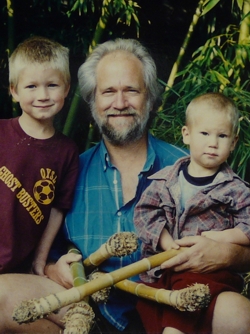
Picking backyard bamboo with my two sons, 1992
Now, in 2026, Kyle and I are preparing to make shakuhachi together. Back in 1974, on Sado Island in Japan, I harvested hundreds of pieces of root bamboo for that purpose. Plans changed and I gave most away, but sent about thirty of my best pieces back to the United States. They have been curing in the cellar ever since —fifty years of patient waiting in the dark. They are ready. And so, I think, am I.