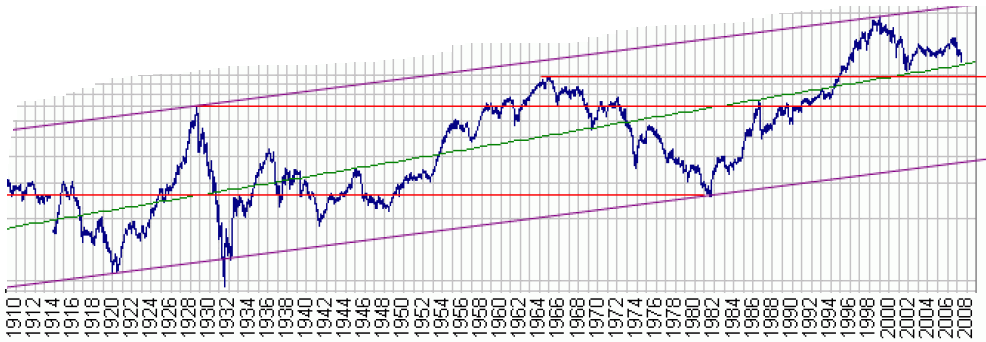
Dow Jones Industrial Average Adjusted for Inflation
The inflation-adjusted chart (above) covering the last 100 years of the Dow Jones shows the ebb and flow of the stock market. It is easy to see how the highs and the lows follow each other in a natural ebb and flow. As chapter 2 says, The high and the low incline towards each other and that Before and after follow each other. However, this doesn’t offer the details and timing we crave to make our fortunes.
Our cravings can be a handicap in our attempt to see life simply and act wisely. Self-interest skews perception and blinds us. The more we need something, the more certainty-biased perception takes over. Impartiality is lost.
Balance is crucial, no less in finance than in standing on one’s head. Bucking the tide is how to win at life. If the tide pulls you this way, you lean that way if you want to avoid falling over. The tide in yoga is the pull of gravity. In the stock market, the tide is either the fear to lose or the need to win. Emotional balance lies in being able to wax when the culture’s sentiments are waning, and to wane when they are waxing. To buy low and sell high is what everyone in the world knows yet no one can put this knowledge into practice, as chapter 78 puts it. When we feel doom is on the horizon, emotion (fear) drives us to sell. When boom times return, emotion (need) drives us to buy with abandon. To do the opposite can feel like suicide.
A poverty of wealth
The Dow Jones chart shows that wealth is increasing over time. However, what is wealth really? Especially in light of chapter 33’s point of view … He who knows contentment is rich. The chart does not represent this kind of rich.
Activity brings wealth, whether we are talking about bees gathering pollen for the honeycomb, or Bill Gates gathering customers for Microsoft. Moreover, from where does all this activity spring? Biologically, a lack of contentment drives us to act. When we feel we have enough of what we need, we rest content. As chapter 46 puts it, Hence in being content, one will always have enough.
The wealth in the land continues to rise over the decades, despite the ups and downs of the market. This tells me people are less and less content with life and so turn to more and more activity that, as the chart shows, increases wealth. Ironically then, you could say that the wealthier we become, the less rich we are — the less contentment we know.