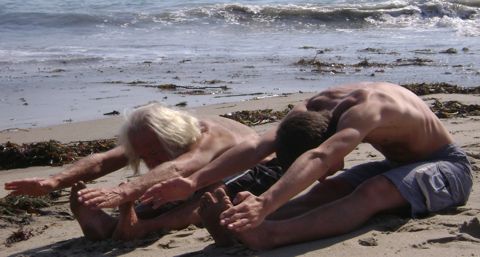
Who is doing the better yoga?
The photo here shows my son Kyle and I doing a forward bend. It appears that my bend represents an advanced stage of yoga, while Kyle’s represents an intermediate stage. In fact, we are at the same stage; we are both beginners.
Any activity you do with full integrity places you at a virtual beginning stage. In this case, doing yoga fully means that I thrust forward until I reach my limit. Kyle is doing the same. We are both at our limit; we are both beginners.
However, people don’t usually see life this way. Instead, Kyle appears to be the beginner and me the master. Seeing it this way is competitive and causes us to assume that the goal is to bend forward like the master. This often stirs up comments such as “I can’t do that” or “I can do that better”. Actually, the only goal in yoga is to do the task at hand fully and honestly. This applies to all action. The Bhagavad-Gita points this out, albeit, with an added measure of unrealistic implicit free will.
3:7 But great is the man who, free from attachments, and with a mind ruling its powers in harmony, works on the path of Karma Yoga, the path of consecrated action.
6:17 A harmony in eating and resting, in sleeping and keeping awake: a perfection in whatever one does. This is the Yoga that gives peace from all pain.
In this yogic approach to life, one is always a beginner, regardless of how it appears to the outside world. If one is always a beginner, why do we exalt mastery? That just sets up false goals and limits, e.g., “I must do that” or “I can’t do that”. Alas, comparing and competing are natural stages we go through on our way to impartiality — the Holy Grail of Taoist thought. Chapter 16 ends with, Impartial therefore whole, whole therefore natural, Natural therefore the way. The way therefore long enduring, nearly rising beyond oneself.
We instinctively admire expertise and strength, and in the case of yoga, flexibility too. There is also a social factor here in how we embrace role models who exemplify whatever we seek. Chapter 36 describes the ironic path we trod, In desiring weakness, one must first strive, In desiring to let go, one must first begin… Weakness is superior to strength.
I suppose you could say we begin at the end and travel back to the beginning. From a Correlations point of view (p.572) that makes total sense, i.e., time stays backward, energy moves forward.