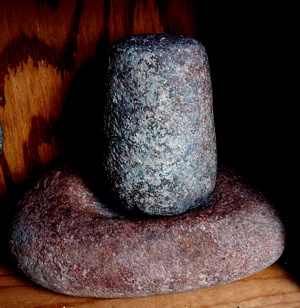
Indian grinder found at my parent’s farm in Tucson
After I finished grinding out Correlations to my satisfaction, I stood back and judged the process by the results, not by the process itself. (See Tools of Taoist Thought: Correlations, p.565.) This was akin to judging a book by its cover. In this delusion, I naively thought this process would shred other people’s preconceptions just as it had done for mine, and as a result, the process would change the world. It is very hard now to believe I ever thought that!
It took a few years for me to ‘correlate’ my way to the realization that our mind actually sees a world that agrees with our emotional needs. This explains why two people can see the same facts on an issue so differently. Our interpretations follow our needs, fears, and expectations. If anything, we view the world in a way that supports our preconceptions, and tend to reject any view that threatens them.
Looking back, I recall how it was no different for me grinding out Correlations. Frequently words would correlate just opposite to what I wanted to see. However, my core need was to find the underlying cause of things… regardless. It often took months for me to drop how I emotionally needed to interpret a word and accept the more probable view.
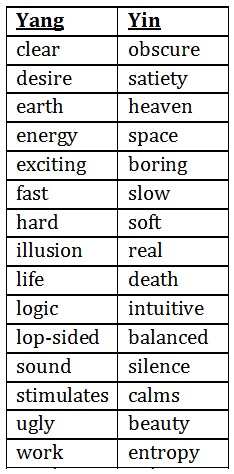 Probable is a key word in the Correlation process. No Correlation is set in stone. In fact, hard, concrete and illusion all correlate to Yang. Remember that the process is key — not the results — when you’re struggling to reconcile words through the Correlation process. You are challenging the way you think; resisting what you want to see versus what may be closer to reality.
The table here gives a taste. See if you don’t feel the Yang words share similarity and are complementary to the Yin words, which also share similarity. Of course, it helps to look for mysterious sameness here. Once you see the similarity within each group, and how the opposites complement each other, you will gradually feel an even deeper mysterious sameness between the two groups. As chapter 1 hints, These two are the same, But diverge in name as they issue forth. Being the same they are called mysteries.
Essentially, you are looking for what you have never seen, or thought you’d ever see, so it helps to keep the end of chapter 78 in mind: Straightforward words seem paradoxical.