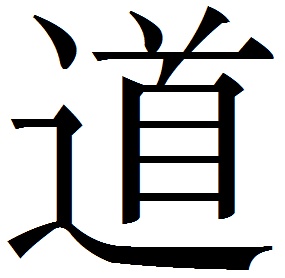
Tao: road, way, path, principle, speak, think, suppose.
The Tao Te Ching begins with The Tao that can be spoken of is not the constant Tao. This line from chapter 1 literally translates to “way can speak, not constant way” (道可道, 非常道). “Way” (Tao or Dao) literally translates as: road, way, path, principle, speak, think, suppose. Nothing said beyond those definitions is constant. Clearly, our mind is capable of perceptions more profound than our thoughts or speech can express. Thought and speech always falls short. Still, such beating around the bush does flush revelations out of the bushes at times.
Chapter 25 says this much: The way models itself on that which is naturally so. This suggests that I’d be wise to model my life on that which is naturally so. The question is, what is naturally so? Balance certainly plays a role in this. Natural processes from atoms to galaxies’ seek balance. Balance is integral to nature’s design. When balance is lost, chaos usually occurs until balance reestablishes itself and stillness returns. Certainly, life’s biological processes all strive to maintain balance, i.e., homeostasis: A state of equilibrium or a tendency to reach equilibrium, either metabolically within a cell or within an organism or socially and psychologically within an individual or group.
Clearly, the way [Tao] and balance are related. Balance is the fulcrum upon which nature’s naturally so plays out. Thus, knowing the nature of balance ought to give insight into the nature of the way [Tao]. Still, how can we be sure the balance we perceive is true balance? While it’s easy to see physical balance, like standing on one leg, discerning meta-balance is much more subtle.
Efficiency is another property of Nature. Nature is nothing if not efficient as she flows through time, although, like meta-balance, the meta-efficiency of nature is subtle. What often seems efficient to us in the short-term is extremely inefficient in the long run.
Chapter 16’s Woe to him who willfully innovates while ignorant of the constant reveals why we excel at false efficiency. For example, housing projects, unbridled technology, processed foods, mono-crop farming, over-fishing, are pseudo efficient solutions that bring about unintended unbalancing consequences. Efficiency without balance is inefficient and ill fated. Nature will ceaselessly push to rebalance circumstances until balanced efficiency replaces efficiency.
Is living an efficient and balanced life possible?
My life feels more balanced and efficient when I am vigilant. Being constantly watchful is the only way I can notice when I start losing balance. As chapter 64 observes, Deal with a thing while it is still nothing; Keep a thing in order before disorder sets in. I just need to notice while it is still nothing! That’s less possible when my mind jumps around between imagined needs and fears. Sure, need and fear are catalysts for efficiency and balance, but only if I am aware enough to know when to stop. As chapter 32 cautions, Knowing when to stop one can be free from danger.
The problem encountered in being vigilant is two fold — focus and space. Environmental stimuli trigger vigilance when it rises above the threshold of perception. At this point, focus easily becomes too narrow. On the other hand, when stimuli are absent, vigilance wanes and thought wanders off into imagination’s space.
Too much focus and too much space are problematic. Of the two, too much space is probably the more serious. In the wild, waning vigilance enables the predator to take down prey. In civilization, the bus runs daydreamers over. Constant vigilance, on balance, favors survival. “You snooze you lose”, as they say. For example, note how birds are always on the lookout for predators and good drivers are alert defensive drivers.
Essentially, it takes fearlessness to stay alert rather than following the mind’s flights of fancy. As chapter 73 observes, He who is fearless in being timid will stay alive. When I am “fearless in being timid”, I’m patient enough to watch the “space”, or what chapter 14 calls the shape that has no shape, the image that is without substance.
This brings to mind the spiritual ideal of all this, which boils down to maintaining vigilance even without external stimuli. As good as that ideal sounds, is it actually possible? Somewhat perhaps, for as chapter 71 advises, it is by being alive to difficulty that one can avoid it. In other words, maintain an ongoing sense of tentative apprehension described in chapter 15, Tentative, as if fording a river in winter. If I remain alive to the difficulty of remaining awake, I have a better chance of avoiding that difficulty.
Jumping into the deep end
All things travel a path whose theoretical end-point is ultimate balance. In traveling this path, all things ebb and flow, veer left and right, rise and fall, strengthen and weaken, struggle and surrender, live and die, as they continue on the way.
This end is not an end, per se. The end I refer to is Nothing, and thus no thing will ever arrive there. In other words, nothing can ever arrive because all things are at the beginning of each moment. Yet, the beginning of each moment is the end of each moment. Consider chapter 2’s, Thus Something and Nothing produce each other; and chapter 40’s, The myriad creatures in the world are born from Something, and Something from Nothing.
You could say this end is this beginning is this end… and so on. I know this is starting to sound like nonsense, but just consider the words needed to say this nonsense. “Begin vs. end”, like all dipolar labels (see Yin Yang, Nature’s Hoodwink, p.35), are poles apart and not the balanced golden middle, the balanced end. The way to that end is via the polar extremes, yet the journey is endless because we are already there. Huh? Balance is unbalanced if it lacks a degree of imbalance. In other words, balance and imbalance are also extremes and so require each other, just as yin requires yang. Thus, to paraphrase the great Taoist disclaimer of chapter 1, the balance that can be named is not the constant balance.
When there is a lot of rebalancing going on in our lives, life feels imbalanced in a kind of nasty, depressed, or stressed-out way. However, in the big picture, all is well and proceeding as nature intends; it just doesn’t feel that way. Our feelings are part of the dynamic. They create the ebb and flow, the balance and imbalance that is integral to nature. Our lives are naturally so, even when they feel like crap. As Chapter 25 sums it up, Man models himself on earth, Earth on heaven, Heaven on the way, And the way on that which is naturally so. So, let’s put a smile on our face, a song on our lips and be happy to be sad, or vice versa, of course. Well, it sounds good in theory anyway.
Note: The Correlation table may tie up loose ends and no doubt create new ones. Notice how end is in both categories depending on the antonym with which it is paired.
UPDATE 2020: It’s dawned on me that Einstein’s special relativity (and its frame of reference criterion) can offer a deeper sense of what Tao is. Frankly, even referring to Tao as the Tao easily conveys a false sense of an objective absolute Tao ‘out there’. There is no ‘the’ there. This is akin to seeking to know the real nature of space and time via classical physics. Now, I leave it to you to brush up on your laymen’s understanding special relativity to see its connection to Tao.
| ~Active~ | ~Passive~ |
| end | continue |
| begin | end |
| difference | similarity |
| illusion | real |
| life | death |
| linear | circular |
| movement | stillness |
| new | old |
| rise | fall |
| strengthen | weaken |
| struggle | surrender |
| temporal | eternal |
| unbalance | balance |
| yang | yin |