
Neurons in the brain
Right Mindfulness, Attentiveness, and Concentration (1) are three folds in Buddha’s Eight Fold Path. Just what is the difference between these approximate synonyms? Over the years, I’ve split many hairs trying to resolve this issue. Don’t they all refer to closely related states of mental awareness? Google [Specialis Revelio! It’s Not Magic, It’s Neuroscience] for a report on cognitive research and magic that delves into inattention blindness. This research sheds light on this synonym issue of mine.
“We’re good at focusing attention,” says Simons. “It’s what the visual system was built to do.” Inattentional blindness, he says, is a by-product, a necessary consequence, of our visual system allowing us to focus intently on a scene.
This “necessary consequence” causes us difficulty. This makes the virtue of being in-the-moment feel a bit ironic. Surely then, Buddha’s Right Attentiveness is not the same as “being good at focusing attention”, as Mr. Simons put it. As a result, I regard Right Attentiveness as similar to peripheral vision — focusing on not focusing, so to speak.
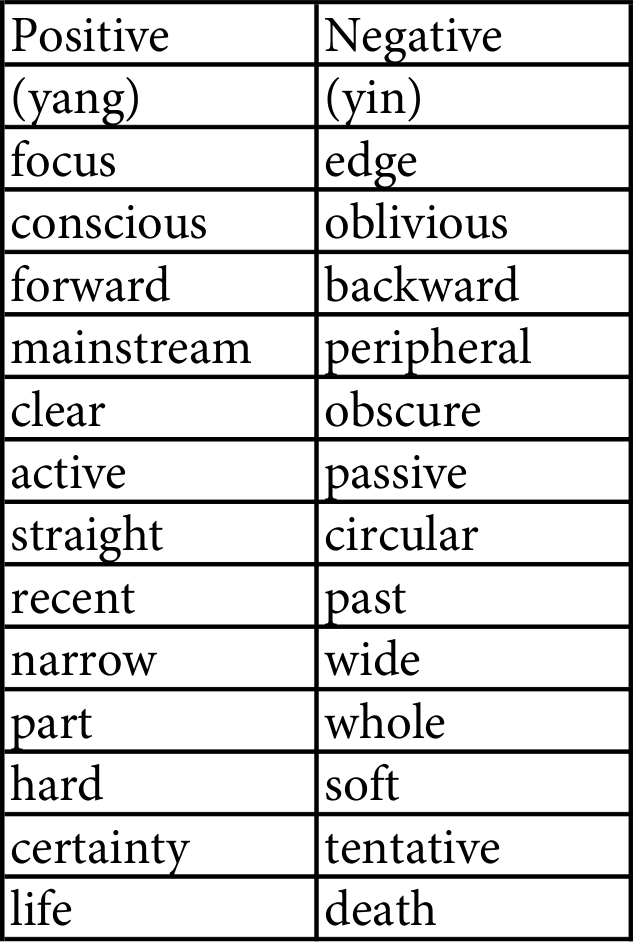 The Correlations (p.572) table here illustrates this point: The “attentiveness we are good at” matches up with the left column: “focus, conscious, forward, mainstream, clear, straight, active, certain, narrow, part, hard, certain, life”. Conversely, Right Attentiveness matches up with the right column: “edge, oblivious, backward, peripheral, obscure, passive, circular, past, whole, soft, tentative, death”.
Alas, language is a poor way to communicate or ponder a Taoist point of view. Language is an outgrowth of evolution and biology making it heavily biased toward survival. “Focus, active, certainty…” feel positive; they favor survival. “Edge, passive, and tentative…” often feel negative and favor survival less. Correlations helps notice this bio-hoodwink of language.
Finally, what is the connection between inattentional blindness and a Taoist point of view? Briefly, focused awareness hinders our feeling of ‘nothingness’ — the negative side of reality that correlates to, Mystery upon mystery, The gateway of the manifold secrets noted in chapter 1. Put simply, seeing something makes it difficult to see Nothing.
(1) I found a more accurate translation of Buddha’s Eight Fold Path (p.604). These three change to Resolution, Thought, State of Peaceful Mind, respectively.