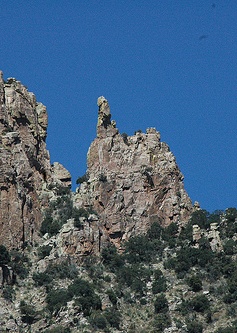
Finger Rock, Arizona
I was one troubled teenager for a time. I’d go off to the mountains for some peace and solitude. I wasn’t very concerned with my safety; life didn’t seem to offer much advantage over death.
One year I climbed Finger Rock without ropes. Going up was easy; going down was terrifying. Was this a latent suicidal death wish? I don’t think so, primarily because I am not very emotional by nature. Although, I’m not drawn to rock climbing or thrill seeking either, so who knows? As a kid I heard stories about a guy falling off Finger Rock and breaking so many bones that his body turned to the consistency of Jell-O. Fortunately, recalling that probably got me to turn around before reaching the top.
Singing Wayfaring Stranger the other night reminded me of those difficult teenage years and of Finger Rock (1). As with many Christian Gospel songs, Wayfaring Stranger promises a heavenly afterlife, e.g., “I’ll soon be free from every trial…” and “I’m going there to meet my mother, she said she’d meet me when I come…”. This promise of a heavenly afterlife is one of the sharpest differences between Judeo-Christian-Islamic religions and Eastern ones. Sure, the Eastern ones promise something as well. However, with Karma you are merely promised an upgrade (or downgrade), and while Nirvana sounds more heavenly, the path to it is a winding road of countless lifetimes, so the story goes.
The Eastern paradigm agrees more with the phenomenon of non-locality—a form of entanglement observed in quantum physics—although, you really need to read between the lines at times to appreciate that (google [quantum physics for 7 year olds TEDx]). The evidence of entanglement suggests that at the most subtle and fundamental level, everything and nothing are inextricably connected. Oneness, or is it Noneness, is real despite what our biological senses tell us. This suggests that the biologically induced sense of a separate self, the ego in humans, underlies the illusion of life and death.
Considering all of this, I can’t see how suicide or a promised heavenly afterlife accomplishes its goal. There is no escape; destiny is eternity. Of course, we can’t tell our emotions that. Our needs and fears drive us to do what we do, feel what we feel, and think what we think, regardless of non-local reality; emotions anchor our local illusion of reality.
I sometimes feel deep sadness. It’s nothing specific, just a general weariness with life. I now feel certain that pure consciousness(2) is continuous, which may account for this weary feeling… I sometimes feel like I have been and will be alive forever. Knowing that consciousness is eternal also makes any hope of ending that weariness through suicide futile. This also makes any hope of gaining or losing the advantage, whatever it might be, futile.
What to do, what to do? Chapter 64’s call to be as careful at the end as at the beginning, and there will be no ruined enterprises is a good place to begin dealing with life. I find the joy in living lies in giving my utmost care to the enterprise of living. Giving, however, is not as easy as it sounds (3). The survival instinct drives us to take — gain, win, succeed. We dread loss. Indeed, our fear of death is really about the fear of losing the pleasures and expectations in life to which we cling. We are in a life-and-death tug-of-war: our need to let go in order to enjoy life versus our fear of losing what we value and not achieving what we desire. Chapter 64 offers one way to deal with this battle, The sage desires not to desire and does not value goods which are hard to come by.
(1) An old friend read this post and remembered more of those teenage years, which I’ll add below. I don’t ponder my past often, so I’ve forgotten much. Fortunately I suppose, I can’t recall how much I forgot.
I just read some of your Tao blog, I was with you when you climbed Finger Rock, I waited at the bottom of the rock, you did not pressure me to follow, thanks for that. I did not see you as a troubled teen at all, you were very happy and excited about life and had many interests. You were a risk taker but were confident in your actions, like walking on your hands at the edge of a cliff in Sabino Canyon near the top of Thimble Rock.
I think you were so good at walking on your hands and had no fear, like a French tight rope walker. Fear kills. Our many trips in caves I had no fear also because I couldn’t see how far I would fall. Your lack of fear made me think everything we did was reasonably safe.
I know you were cautious when you needed to be, I remember many cases of testing before acting.
(2) Pure consciousness is the foundation upon which living things perceive their personal identity. When biological function dies, the illusions of personal identity end, yet the foundation continues. Naturally, I can’t prove it!
(3) Giving is not as simple as it sounds either. For example, chapter 81 says, The sage does not hoard. Having bestowed all he has on others, he has yet more; having given all he has to others, he is richer still. It is important to note that the bestowed all he has and given all he has doesn’t literally mean giving all the stuff you have to others. Such overt giving is discordant with the natural balance of give and take, and thus unintended consequences inevitably follow. “The road to hell is paved with good intentions”. The giving referred to here is a state of mind and emotion, an approach to living and not the handing out of $100 bills — although there can be a time and a place for overt giving as well!
(See: The Further One Goes [Biographical Notes, p.xii ]for background on this Times of Yore series of posts.)