 Chapter 46 puts forward a curious dilemma. According to that chapter, when the way prevails in the empire, fleet-footed horses are relegated to plowing the fields; when the way does not prevail in the empire, war-horses breed on the border. However, chapter 34 holds that, The way is broad, reaching left as well as right. Add to this chapter 1’s, The way that can be spoken of is not the constant way. Can we reconcile these seemingly conflicting views?
What does when the way does not prevail truly mean? Take a moment to ponder the reality of Nature versus how we feel about that reality. Saying, the way does not prevail speaks about the latter… About how you or I subjectively perceive the way, and not about The way that can be spoken of.
Regarding Nature, let’s consider the Chinese characters for nature. This can shed light on the immutable authenticity of nature. Nature = dàzìrán (大自然). The characters breaks down thus: dà (大) = big, great; zì (自) = self, certainly, of course, from; rán (然) = right, correct, so, like that. Here are some ways to assemble these English words: (1) great + of course + so, (2) big + self + correct, (3) great + self + so. Right now, I prefer great + self + so. In other words, ‘it is what it is’.
When I think that the way does not prevail, I am really projecting my perceptions onto the way. Essentially, all this amount to a reflection of my personal needs, loves, fears, and hates. This clearly doesn’t meet chapter 16’s Taoist standard of impartiality.
Moreover, chapter 19 counsels us to, exhibit the unadorned and embrace the uncarved block, have little thought of self and as few desires as possible.
Returning to chapter 46’s, when the way prevails in the empire, fleet-footed horses are relegated to plowing the fields, etc. How did this view that peace is nearer the way than war come to appear in the Tao Te Ching? After all, neither war nor peace exists independent from each other, i.e., to paraphrase chapter 2, War and peace, produce, complement, offset, harmonize and follow each other. Just because I hate war doesn’t mean war is not of the way. Indeed, as chapter 67 states, The whole world says that my way is vast and resembles nothing. It is because it is vast that it resembles nothing. If it resembled anything, it would, long before now, have become small.
The difficulty in seeing life through Taoist eyes is that the view seldom supports what we desire to see. Yet, desire doesn’t truly deserve the blame. From a symptoms point of view, desire simply reveals a lack of contentment. This deficiency generates desire. As chapter 46 literally says, Therefore, in being contented with one’s lot, enough is usually enough indeed.
Therefore, it helps to see the desire for anything as only a symptom of the lack of contentment. This bio-hoodwink (p.11, p.100) is how nature works. Feeling hunger and thirst arises from a perceived lack of food and water. In humans, this also translates into other symptoms of discontent… A desire, ‘hunger’, and ‘thirst’ to travel is a symptom of not feeling content where you are — whether it is to travel to the toilet to pee, or to travel to an exotic place to play. Chapter 80 addresses this contentment issue.
Although, how one is supposed to bring that about is beyond me. Feeling content is one of the most mysterious things to do. You can’t just ‘do it’, because doing it would have to arise from a lack of contentment with the status quo.
Remembering that the problem is constant, and solutions come and go helps. Although, you’d think this would be discouraging. Actually, fully accepting the dynamics of life fosters a sober and yielding contentment. Put simply, it is easier to conform to Nature than to fight it. As chapter 65 says, Only then is complete conformity realized.
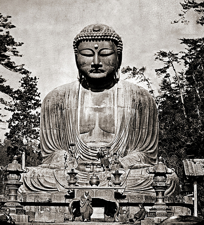
Kamakura Buddha, 1880’s
Finally, Buddha definitely nailed it with his first truth… “First Noble Truth is the existence of sorrow. Birth is sorrowful, growth is sorrowful, illness is sorrowful, and death is sorrowful. Sad it is to be joined with that which we do not like. Sadder still is the separation from that which we love, and painful is the craving for that which cannot be obtained”. If you really accept that, the rest takes care of itself!