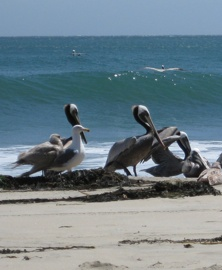
 I sat looking out over the ocean this crisp morning. I had finished my morning routine of yoga, calligraphy in the sand and tai chi, so I could just sit in the sand and let my mind think on itself. What stood out today was how deeply consciousness is separate from thinking. This may be a radical view. Indeed, many define consciousness as thinking, which implies that non-human animals are not conscious. That’s crazy!
First, to review:
Consciousness is the foundation of intuitive knowing for all animals. Chapter 71’s, To know yet to think that one does not know is best is important because it indicates a distinction between knowing and thinking. We tend to feel our thoughts are more important than our consciousness (1), and thus end up erroneously believing what we think is true and real. We wind up taking consciousness, the source, for granted.
Plain consciousness is impartial and unexciting. In contrast, there is nothing boring about feeling certain that our thoughts and judgments are true and reliable. As it happens, our emotions are giving us this subjective sense of truth and certainty. The stronger the emotion, the wider the gulf between what we think is real, and what is truly real. Emotion produces an illusion of truth, so to speak.
Survival instincts lay at the foundation of consciousness and from there direct thought. In particular, emotion steers the direction our thoughts take, and consciousness provides the space for thoughts to play out. When circumstances trigger emotions, our thoughts mirror those ruffled emotional feathers and invite us to dwell on the event. These thoughts then re-stimulate emotion and often set off a vicious circle, i.e., thought ð emotion ð thought ð emotion, etc. We maintain the stressful emotional imbalance long after the stimulus that ignited the initial emotion ends. (See What are the roots of thought?, p.602).
Time versus the timeless now
Future, present and past are figments of imagination. We think these are real because we think what we think is real. I see ‘time’ as simply a timeless continuum of consciousness. Past, present and future are but projections of emotion, particularly our desires and worries, which gives us the illusion of time we experience. The clocks and calendars of civilization only reinforce that illusion and separate us further from what, without mind chatter, feels like a timeless now. As chapter 56 hints, This is known as mysterious sameness.
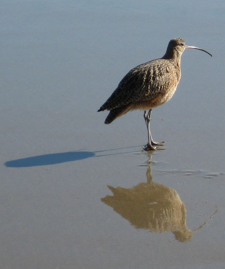 (1) Observing the birds on the beach helps me escape the trap of thinking. I imagine that is one of the prime benefits, besides companionship, that pet owners enjoy. For some reason I especially love that little long beaked bird. One of its kind is always there poking around in the sand looking for food.