
Emergent Termite Cathedral
Generally, emergence occurs when something has a trait that its parts don’t have individually. The emergent property exists only when its parts interact in a combined whole. In a Taoist version of this, the ‘simple’ forms the basis upon which the ‘complex’ emerges. Here, I see each layer of existence as an emergent property modeled on something more primal. This is similar to the Greek roots for the word archetype: archein = original or old, typos = pattern, model, or type. Chapter 56’s, This is known as mysterious sameness alludes to this relationship somewhat.
It can be helpful to consider ideas and ideals as emergent properties of deeper phenomena as you explore downward layer by primordial layer. The idea and ideal of balance is especially interesting. Balance is a virtuous ideal, not only in human affairs, but also in Nature overall. As I see it, Nature’s first law is the “will” to uphold the ideal of balance. It is the way of Nature.
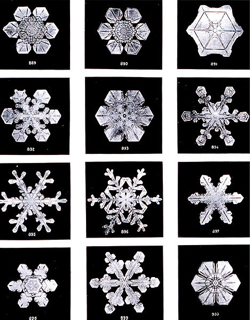
Emergent Snowflakes
Everywhere I look, I feel Nature’s heartbeat as it ebbs then flows, waxes then wanes, around its balance ideal. Each individual thing, be it an atom, a mountain, a cloud, a mouse or a person, strives to maintain what is for each the ideal balance or counterbalance at the moment. That is so important, I’ll repeat it: Each thing in existence does what it does to balance or counterbalance where it is at each moment.
 Nature does not speak about this law, this ideal. I know this is obvious, but it’s useful to point out. The words ideal and balance are themselves emergent properties symbolizing a silent primordial reality which we observe and label. In other words, Nature’s unspoken ideal of balance unavoidably spawns in thinking animals the words, “ideal” and “balance”.
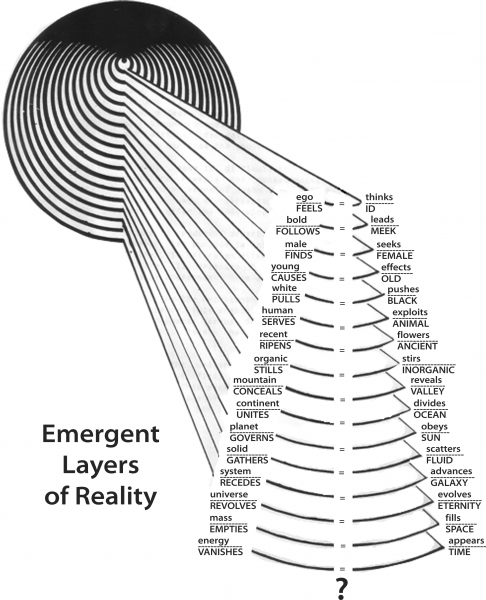
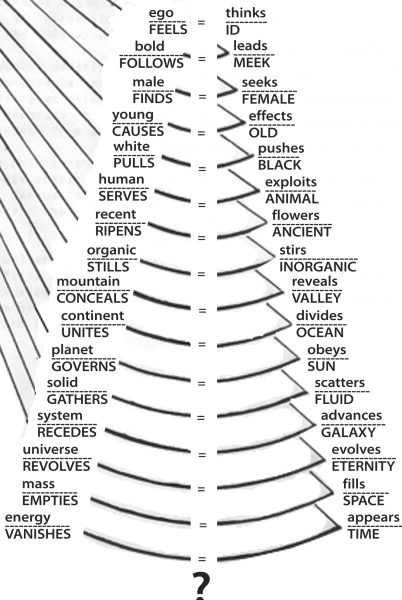
The Emergent Layers of Reality graphic (left) is my clumsy attempt to illustrate this layering idea. See the next page for a better view of these layers.
Emergent Layers of Reality
Correlations (p.572) helps get to the bottom of this emergent-layered reality. The layers can be read in a clockwise manner. View these as layers built one upon the other.
Begin at the bottom,
‘energy –>appears…
TIME –> VANISHES’,
And work upward to the topmost,
‘ego–> rejects…
ID –> ACCEPTS’.
Needless to say, this must be done with your subtlest Taoist eye on the lookout for mysterious sameness and mystery.
Intrinsic vs. Learned Morality
Noteworthy is the fact that Nature’s ideal is neither moral nor immoral. The ideal is balance and from that emerges ideals of morality, unspoken but common in most social animals. Morality, in its simplest unspoken form, is simply behavior that facilitates balanced group interaction and survival. Therefore, from an emergent property’s standpoint, balance is the underlying ideal from which morality in social animals emerges. Only in humans does this simple morality emerge as culturally learned and often hypocritical ideals. (See Belief: Are We Just Fooling Ourselves?, p.591, and Ethics: Do They Work Anymore?, p.594.)
Political and Religious Ideals
History shows how human culture, and the beliefs and ideals that validate it, fluidly adapts to changing circumstances — most especially those of economic necessity. Currently, democracy and capitalism are governing ideals that suit this particular time and set of conditions. In other words, these models are emergent properties of this era’s circumstances, just as autocracy or slavery was at one time. Deeper still and most enduring are the religious ideals each culture adopts to give its population a spiritual hub around which to unite to maintain sufficient hope, balance, and harmony.
Some, if not all, religious ideals appear inefficient and irrational to any non-believer, at least on the surface. They are high maintenance and can consume much emotional energy. However, these drawbacks disappear when seen as simply symptomatic of an existing deeper high maintenance imbalance. This imbalance naturally spawns an outer array of counterbalancing religious ideals. Of course, this begs the question, what accounts for the imbalance in the first place?
Balance rocks the emergent cradle
Civilization’s primary objective is to optimize human comfort and security. Tool use, from the stone axe onward, has done this by giving us an edge over life in the wild. If you doubt this, consider for a moment life without electricity, then life without iron, and finally life without stone tools. Without tools, we would live a simple hard life in the wild.
As with all animals, we instinctively seek comfort and security. In the wild, natural circumstances push back on this drive, leaving an animal more or less balanced. Our successful quest to maximize comfort and security through tool use allows us to avoid much of this natural self-balancing pushback.
The unintended consequence of bypassing Mother Nature’s pushback is that it leaves us in a state of perpetual imbalance. This drives us to compensate in innumerable ways — music, diet, exercise, politics, drugs, sports, warfare, posting on blogs, and religion of course, come to mind.
Nevertheless, thought, and the naming that thought embodies, is the primary tool that has enabled all the other tools. The power and success of thought must boost the overall cognitive certainty we feel, and this arrogance of certainty only serves to add to our difficulties. As chapter 71 warns, Not to know yet to think that one knows will lead to difficulty.
What is it that we don’t know, yet think we know? Chapter 32 gives us a strong hint beginning with, The way is for ever nameless and ending with, As soon as there are names one ought to know that it is time to stop. Knowing when to stop one can be free from danger. Sure, thinking enables us to figure things out, invent tools, and survive beyond our ancestors’ wildest dreams. The danger lies in the collateral damage we suffer by not knowing when to stop. We carve up Nature’s whole in an ever-increasing array of bits and pieces — knowledge and information. This is not the kind of knowledge to which chapter 16 refers,
Our ignorance makes us feel more disconnected, and that sense of disconnection drives us to innovate even more. It’s a vicious circle where greater innovations create an even deeper sense of disconnection and primal insecurity (1).
Returning to Balance
I see Taoist thought as an emergent property emerging from the circumstances in which humanity will increasingly find itself. A Taoist point of view offers a path unbridled by naming and innovation, and offers a way back toward the roots of cognitive balance. As chapter 16 begins,
Again, I see balance as being the bottom layer, the founding principle, the model, the least common denominator, the ebb and flow cycle, and the primary pattern of emergent existence. Whew! That’s a mouthful. No matter how I look at life, I always come back to balance as a key principle driving the whole shebang. For me, the Taoist point of view offers the easiest way to sense that.
(1) Primal insecurity is another word for fear. Not your ordinary fear, mind you, but rather a deep-rooted sense of the void, loss, death, and entropy. See, What is the root of thought?, p.602.