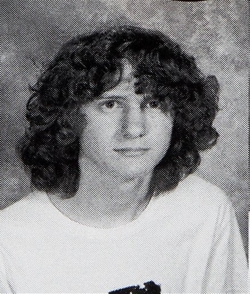
 YouTube [Tucson: Descent Into Madness] for the 60 Minutes documentary about a shooting in Arizona. It offers insight into what drives a person to such violence. The perpetrator was Jared Loughner. Excerpts from an interview of two of Jared’s friends are at the end of this post.
What caught my attention was when his friends said how “Jared literally believes in nothing, nothingness”, and that “He was obsessed with how words were meaningless”. That comes awfully close to how I’d describe a Taoist. Indeed, that describes me, albeit without that worrisome “literally believes in nothing” and “obsessed with how words were meaningless”. It sounds like he didn’t have anything to counterbalance his emptiness. This reminds me of chapter 72’s, When the people lack a proper sense of awe, then some awful visitation will descend upon them. Somehow, Jared’s mind fell into Taoist-like perceptions that he couldn’t handle emotionally. Evidently, stumbling into “nothingness” without the stabilizing influence of a Tao Te Ching-like context creates destructive forces.
Finding life meaning when the conventional forms of meaning begin to wither away requires three treasures mentioned in chapter 67, The first is known as compassion, The second is known as frugality, The third is known as not daring to take the lead in the empire. These anchor intention and counterbalance one’s loss of faith in civilization’s often-arbitrary principles and values.
 A symptoms point of view (p.141) tells me that we cling to things and ideas because we need the sense of connection this provides. Thus, nothing could be worse than feeling this need without enough faith in something in which to cling. “Believing in nothingness” is the worst of both worlds. That would drive any mind into lonely isolation — madness.
Indeed, years ago I worried for a time whether sharing my unorthodox views might really disturb some people’s mind by ripping away their beliefs. I was relieved to find that I never could affect anyone’s outlook, at least for more than a few moments. We hold on to our worldview tenaciously… for dear life in fact! Yet, Jared shows why I was concerned. Obviously, Jared had no stable worldview to keep him connected and grounded. Why?
I assume neither nature (his genetics) nor nurture (his childhood circumstances) could provide the wherewithal to cope in the modern civilized world. Indeed, human cognition exacerbates the nature and nurture dynamics for all of us. Chapter 71’s warning, Not to know yet to think that one knows will lead to difficulty applies to our species because we merely shape our understanding to match our current visceral sense of reality. A contemporary example of this is the Islamic terrorist who kills in the name of Allah. They are “Muslim” in name only. Their visceral reality is a desperate, disconnected hell from which arises their brutal misunderstanding of Islam. Jared was a kind of “Taoist” in name only.
(See also I understand, but do I know?, p.70, Learning What You Know, p.112, and You Know, p.203, for more on Taoist cognition issues.)
From the 60 Minutes interview with Jared’s friends
“I was afraid I was going to wake up and find and see his name in an obituary in a couple of days,” Bryce Tierney, a close friend Jared Loughner, told Pelley (the 60 Minutes’ interviewer).
“Up until he was about 19 or 20 he was always, you know, pretty enthusiastic, pretty passionate. He was always quiet but you could see that there was that passion in him. He did care, he was happy. He was always an observer and especially around the time he started getting mentally ill.”
Tierney and Conway say that’s because their friend was slipping into insanity and it was showing up in the poetry he wrote. “I started seeing heavy influence of just chaos and just non-connective patterning in his, in his poetry. Just ranting or mixing of ideas,” Conway explained.
“Did you ask him what he was driving at, what he was thinking?” Pelley asked. “Oh, yeah,” Conway replied. “And I told him, I was like, ‘Like, because I read it and I just don’t find, I find nothing. It’s like nothingness to me and he was like, ‘Exactly!’ You know, that’s where the meaning is. “People are gonna say he doesn’t believe in anything but it’s not that he doesn’t believe in anything he literally believes in nothing, nothingness.”
Tierney and Conway told “60 Minutes” Loughner was interested in a philosophy called nihilism; it essentially says life is meaningless. They say he was obsessed with the film “Waking Life” in which a man walks through his dreams listening to various philosophies.
A character in the film echoes something at the center of Loughner’s apparent delusions: that big government and media conspire to silence the average guy. To protest his lack of voice, the character in the film sets himself on fire.
Loughner told his friends reality has no more substance than dreams. “He was obsessed with how words were meaningless, you know, you could say ‘This is a cup.’ And he’d be like, ‘Is it a cup or is it a pool? Is it a shark? Is it, you know, an airplane?’ You know?” Conway said.