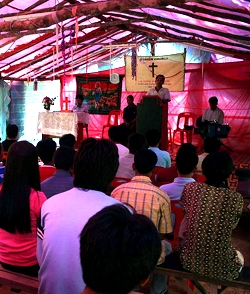
Jungle church in Malaya
Why God? I have not heard this question asked much… if at all. Debate focuses mostly on whose God is true, the nature of God, or does God even exist. I suppose asking “Why do we believe in God” is a zoological inquiry of sorts. That is the place to begin… After all, we are animals first.
I’ve long regarded the God idea as an emergent property (p.121) of our social need for leadership, i.e., an alpha male. Most, if not all, social animals have some member serving this unifying role. Being thinking apes, it is natural to imagine the existence of an alpha-leader God in his alpha-home Heaven. As social apes, we also enjoy gathering to share in the believing experience. Google [Science Connected at church, happy with life] for research on this.
Here are a few excerpts that caught my eye
Researchers have long noted that religious people report higher levels of happiness and well-being than nonreligious folk. Lim and Putnam offer a rare glimpse, based on telephone surveys of a national sample of 1,915 adults in 2006 and 2007, of how religion improves quality of life. “Our evidence shows that it is not really going to church and listening to sermons or praying that makes people happier, but making church-based friends and building social networks there,” Lim says.
What’s more, spiritual aspects of religion do little to further well-being, the researchers say. Neither survey participants who “personally experience the presence of God” nor those who often “personally feel God’s love in life” report more well-being than people who do not. Volunteers who do and don’t believe in God or heaven with absolute certainty display comparable satisfaction with their lives.
Being on the same page of belief enhances the feeling of mutual connection.
One-third of participants who had a strong religious identity and three to five close friends in their congregation reported being “extremely satisfied” with their lives, a figure that rose to nearly 40 percent for those with 11 or more such friends. The researchers defined “extremely satisfied” as a rating of 10 on a life-satisfaction scale ranging from one to 10.
In contrast, one-fifth of churchgoers who had three to five congregational friends but didn’t identify strongly with their faith reported extreme life satisfaction. The same figure applied to nonreligious people whose friends were not part of congregations.
So, the stronger the sense of connection between folks, the more satisfied they feel. Sharing a strong religious identity intensifies the sense of connection.
Private religious practices, such as praying and holding religious services at home, also show no link to greater life satisfaction, the new report finds.
Lim emphasizes that, according to survey data, spirituality and theology bolster well-being only for people who build friendships at church.
 This tells me that sharing a common identity is the essential feature, not “spirituality” per se. Shared belief in something — anything — is the glue that connects us, whether it’s politics, sports, food, music… you name it. Nevertheless, a church-like setting offers a means of social connection somewhat similar to a hunter-gatherer tribe. In those prehistoric times, people shared their entire lives, from birth to death, with several dozen people. The exceptional degree of socio-emotional security this offered died out as civilization took over the human experience. We unwittingly traded emotional comfort and security for increasing material comfort and security. Clearly, from a Symptoms Point of View, church and religion are merely symptoms of this loss, and our effort to compensate as best we can.
In addition, there is much archaeological evidence of human spirituality in the Middle Paleolithic, 200,000 years before civilization took hold. Curiously, no other animal appears to rely upon spirituality. What is the difference between other animals and us? Thought! Thinking creates a dilemma of which chapter 71 speaks, To know yet to think that one does not know is best; Not to know yet to think that one knows will lead to difficulty. Belief is simply thinking that one knows. Language has overtaken the human mind so extensively as to disconnect us from the moment-to-moment experience-of-being that other animals enjoy. According to scriptures, spirituality simply reflects our attempt to compensate for this disconnection.
 Okay, so why don’t I attend church? I lack sufficient belief. I do remember believing in God as a child, but I don’t recall when or why I dropped the belief. Years later, while hitchhiking across the Sahara Desert, I reached a faithless rock bottom. I even wished I could be a true believer like other people. Chapter 33 observes, He who perseveres is a man of purpose, and fortunately, I persevered. Indeed, perseverance and belief are all we have to make a meaningless life feel meaningful… and social connection, of course.
UPDATE 2020: Google [Why do we miss the rituals put on hold by the pandemic?] for more. Here is a brief summary of this research on ritual and synchronized activity that help bond people.
Anthropologist Bronislaw Malinowski observed fishermen in New Guinea in 1915. He noticed that when they stuck to the safe and reliable lagoon, they described their successes and failures in terms of skill and knowledge. However, when venturing into deeper waters, they practiced rituals such as chanting in synchrony during the journey… acts Malinowski collectively referred to as “magic.” “We find magic wherever the elements of chance and accident, and the emotional play between hope and fear, have a wide and extensive range. We do not find magic whenever the pursuit is certain, reliable and well under control of rational methods,” Malinowski wrote in 1948.
Recent studies suggest that individual ritual, such as reciting prayers, helps. But even individual rituals carry a social component. Researchers largely concur that the power of rituals rests within a larger social fabric. Rituals “are created by groups, and individuals inherit them,” Certain synchronized activities such as singing and dancing together are particularly good at amplifying group cohesion and generosity. In both sectarian and non-sectarian activities, synchrony is a potent social catalyst.
Anthropologist Harvey Whitehouse notes two basic kinds of ritual. One he calls “imagistic” rituals that fuse people together through intense moments and painful rites of passage, such as tattoos and walking on fire. The other being “doctrinal” rituals that characterize modern-day life — religious services and various rites of passage. This second type evolved as societies grew complex with the emergence of agriculture. While not binding as tightly as imagistic rituals, doctrinal rituals enable group members to both identify and unite those in their larger group and spot and police social deviants.