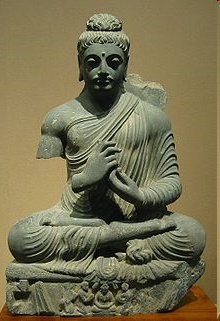
‘He who conquers self…’
The details of Buddha’s Four Noble Truths (p.604) vary somewhat depending on the source. I recently dug up the source for the most succinct and useful version that I found in Thailand long ago. At that time, I had a problem with how the Third Noble Truth was stated and so I changed a few words. Rereading the original source makes me want to reassess why I revised it back then.
The original says, “He who conquers self will be free from lust. He no longer craves and the flames of desire find no material to feed upon, thus they are extinguished.”
I changed the “conquers self” to “surrenders self”. I was immersed in the Bhagavad-Gita at the time, which advocates surrender, e.g., “no man can be a Yogi who surrenders not his earthly will”. Perhaps the idea of conquering self felt too aggressive.
As it happens, I thought back several years ago on my change and changed it back to my recollection of the original, “He who extinguishes self will be free from lust….” Now I see the original phrase is conquers self.
I see an oddly unworkable side to all this. The Second Noble Truth ends with… The illusion of self originates and manifests itself in a cleaving to things. The desire to live for the enjoyment of self entangles us in the net of sorrows. Pleasures are the bait and the result is pain. How is one to apply the Third Truth, which begins with He who conquers self will be free from lust, when self is an illusion to begin with. If something isn’t real, what does conquering it mean in practice? It certainly isn’t the same as conquering a physical enemy attacking you.
Another oddity is how the Third Truth continues with; He no longer craves and the flame of desire finds no material to feed upon. Thus it will be extinguished. However, the Second Truth begins by saying: The cause of suffering is lust. The surrounding world affects sensation and begets a craving thirst that clamors for immediate satisfaction. Thirst (need) gets the cleaving ball rolling in the first place! Yet conquering self allegedly frees you from thirst — the flame of desire. This feels unnatural. After all, need (thirst, hunger, lust, desire, etc) is the biological push behind survival itself.
So briefly, I ‘conquer’ this dilemma by remaining keenly aware that my needs, desires, fears, and worries all drive my “illusion of self”. The self-illusion (ego) has difficulty holding up against such watchful clarity. Conquering self then comes down to just maintaining enough perspective to avoid some of the tricks biology pulls on me — the bio-hoodwink (1). In other words, the more aware I am of how biology is pulling my strings, the less convincing the illusion becomes. Conquering self is really a matter of seeing how the trick plays out. Once I clearly know how a trick works, its illusion can no longer grip me as tightly. (See It’s Like Magic, p.17.) When the “illusion of self” can no longer captivate me, I’ve conquered it, or at least I’ve established a truce.
One final thought on Buddha’s Third Truth. If I were to rephrase it, I’d put it this way: “He who conquers, surrenders, and comprehends self will be free from lust. He no longer craves and the flames of desire find no material to feed upon, thus they are extinguished.” The conquering comes first as you wage battle with yourself to get your act together. Next comes the surrendering when you realize that conquering your self is not possible, at least in the normal wage war sense of the word. Finally, seeing what is actually taking place, and comprehending how a bio-hoodwink is always pulling strings diminishes the “illusion of self” enough to return to one’s roots and simply be who you innately are.
(1) Bio-hoodwink: I coined this term for the trick biology plays on perception. (See Peeking in on Nature’s Hoodwink, p.11.) Chapter 65 says: Of old those who excelled in the pursuit of the way did not use it to enlighten the people but to hoodwink them. The oldest of old, when it comes to living things in nature, is the biological process of life, hoodwinks, and all.
For example, a bio-hoodwink tells the brain that the richer the food, and the more you eat of it, the better. This was the case in the wild before we cleverly devised ways around natural limitations in order to make food as rich and plentiful as we wished. Alas, the bio-hoodwink is inherited DNA and out of sync with our clever yet ignorant innovations. The only counter-measure we have against this is understanding, which explains why Buddha put Right Comprehension at the head of his Eight Fold Path.