“To use words but rarely is to be natural.”
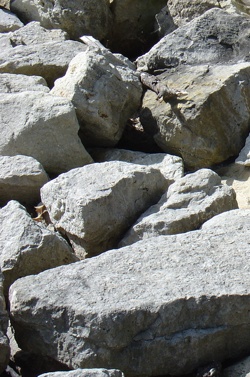
A while ago, I attempted to pin down a friend (1) of mine on the subject of consciousness. My view that a rock could be conscious didn’t go over too well. He said, “Words are sounds that gain meaning with use. Saying that a rock is conscious is like saying a rock is alive. That might work in a poem, but not for logical communication. Look in a dictionary for usage rather than rely on my memory”.
Accordingly, I looked up the word conscious in a few dictionaries and then tracked down some of the words used to define that word. I felt like a dog chasing its tale. Clearly, word definition is a messy affair when you scratch the surface. No wonder we prefer simple answers lying on the surface of life’s mystery. All the same, I can show why a rock or even an atom for that matter, qualifies as being conscious using the following trail of definitions.
Some definitions of conscious specifically refer only to living organisms. That being the case, I’ll limit this to living things — initially. Limited to organisms, it is easy for me to see how even a virus, bacteria, or amoeba is conscious, or perhaps subconscious. Actually, I should say it is only easy to see as long as you follow the trail of definitions below.
The Trail of Definitions
Conscious (Date: 1592)
perceiving, apprehending, or noticing with a degree of controlled thought or observation <was conscious that someone was watching
Perceiving (Date: 14th century)
to attain awareness or understanding of
Etymology: Middle English, from Anglo-French perceivre, from Latin percipere, from per- thoroughly + capere to take.
Awareness (Date: before 12th century)
a: watchful, wary b: having or showing realization, perception, or knowledge
Etymology: Middle English iwar, from Old English gewær, from ge- (associative prefix) + wær wary
Subconscious (Date: circa 1834)
the mental activities just below the threshold of consciousness
Mental (Date: 15th century)
the conscious mental events and capabilities in an organism
Mind (Date: before 12th century)
a: the element or complex of elements in an individual that feels, perceives, thinks, wills, and especially reasons b: the conscious mental events and capabilities in an organism
Etymology: ME mynde < OE (ge)mynd, memory < IE base *men-, to think > Gr menos, spirit, force, L mens, mind
Spirit (Date: 13th century)
an animating or vital principle held to give life to physical organisms
Etymology: Middle English, from Anglo-French or Latin; Anglo-French, espirit, spirit, from Latin spiritus, literally, breath, from spirare to blow, breathe
Breath (Date: before 12th century)
a: the faculty of breathing b: an act of breathing
The faculty of breathing…
No, I feel I should stop here. This is looking more like a vicious definition-defining circle to me.
Chapter 32 hints at the problem, beginning with… The way is for ever nameless.
Though the uncarved block is small… And ending with… Only when it is cut are there names. As soon as there are names, One ought to know that it is time to stop. Knowing when to stop one can be free from danger.
The sharper word definitions are, the more their cut reflects human-centric, culture-centric, and self-centric bias. The long held beliefs that children, women and Africans were not fully conscious and mentally capable, exemplify such bias. Clearly, where we draw our definition lines in the sand reflects the depth of our self-understanding and self-security… or the lack there of. We desperately need to define reality, and we do so in arbitrary ways that prop up our own self-image.
Inside vs. Outside-the-box
Classifying experience boxes perception in to preconceptions that we absorb from infancy onward. Perceiving any reality outside such cultural indoctrination is nearly impossible until we leg go and unlearn some of this definitional status quo. In other words, it is healthy to consider the possibility that a rock is conscious.
Frankly, dictionaries endeavor to define an inside-the-box point of view. Naturally, as all humans raised ‘inside this box’, I understand the viewpoint from inside it. If I couldn’t, I’d be incapable of writing any of this. The Correlations process arose out of my need to peek outside-the-box enough to more deeply examine my inside-the-box point of view. Contrast is the issue here; I need to find a ‘there’ in order to see a ‘here’. (See Tools of Taoist Thought: Correlations, p.565.)
So, is a rock conscious?
It all depends on what you mean by “conscious”. By my definition, rocks are conscious, although they don’t think or breathe. Only we think, as far as I know, and so only we have coined the word “conscious”. If we limit the definition of consciousness to thinking, then only humans are conscious. And even then, only after the age of 12 months or so after we’ve learned enough names, words, and language to begin thinking. Before that, feeling dominates perception, i.e., by this definition, feeling is not thinking.
What is thinking? I define thinking as a brain function that requires symbolic language. Thus, according to this definition, without language, there is no thinking. Think is also a synonym for believe. To paraphrase chapter 71, To know yet to believe that one does not know is best; Not to know yet to believe that one knows will lead to difficulty.
Clearly, we are stuck with thinking. Symbolic language is an integral and instinctive part of who we are… our awareness, our consciousness. What we think, however, can be infinitely fluid. Allowing that a rock may be conscious is obviously more fluid, and conforms to chapter 71’s To know yet to think that one does not know is best’. Allowing for this leaves the door open for mysterious sameness, as chapter 56 puts it, to tickle your consciousness. Mysterious sameness hints that all existence shares an essence of being, a consciousness of being… Beingness.
(1) This is the same friend who instigated my last post, See No Evil (p.209). This post, Is a Rock Conscious?, and that last post are somewhat connected.