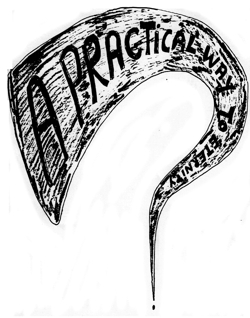
A Practical Way to Eternity
Some say “love” is their favorite word. Others say “God” is. I’ve also had favorite words over the years, but “why” beats them all. So I ask myself, why continue posting these observations? It’s certainly not for money or fame. I actually prefer anonymity. In fact, years ago when my yoga students showed hints of guru worship, I went out of my way to discourage that. Do I just need to vent? Well, there was some of that urge early on, but I have most of that off my chest now. So why continue?
One reason is the art and challenge of it. My most intriguing observations pop into my mind during my morning yoga headstand, while soaking in the bath, and in dreams during the night. I suppose that’s the art of it. Writing them well enough to resonate with someone else is the challenge. I don’t suppose this is any different from playwrights, for instance, who dream up scenarios and write plays. Posting my observations is like putting on a play… way, way, way off Broadway, of course. At first glance, I suppose that answers why I continue to write. Yet, “why” lingers on. “Why” would linger on, of course. It is the deepest existential question of all… and ultimately unanswerable, at least from a Taoist point of view.
The question mark-like graphic for this post is the graphic I made for my first serious attempt at writing in 1976. My wife says the poems in the essay are her favorite part. Well, at least they help lighten it up. If you want to read that first attempt, go to: Why_First-Writing-1976.pdf.
As I ponder that first attempt, I realize how this process allows me to record and then rethink my observations. This sort of analysis helps me figure out life. Of course, all this is mostly reinventing the wheel since what I discover is essentially rediscovering what others have discovered throughout time. To me, that says the path to truth is universal and awaits anyone hungry enough to make the journey… an endless journey, I imagine.
It is interesting to see how much my thoughts have changed over time, yet not in some fundamental ways. At first, I started placing an (X) when I really wished to disavow the dumb idea I had back then, with an eye to updating it. Then I realized, what has changed over the 40 years is not anywhere near as important as what has remained more of less constant. Therefore, I have left it as is, except for attempting to correct spelling.
The major change between then and now is my shift away from an advocacy of free will towards mysterious sameness. Still, if you believe in free will, you may find the essay speaks to you, but again, keep in mind that it comes from where I was 40 years ago when I thought A Practical Way was merely a matter of free choice.
Curiously, my son Luke said my writing back then was better than now. I can’t really believe that is true, as I’ve worked so hard over the last several decades to write as well as possible. Then it occurred to me that when one intuitively knows what a writer is saying, that writing would tend to feel well written and vice versa as well. (See, We only understand what we already know, p.254.) My A Practical Way is easy to understand, straightforward and written with a righteous flavor similar to the Bhagavad Gita, which I read daily.
Below is the essay’s introduction. It gives the flavor of my thinking back then.
* * * * * A Practical Way to Eternity * * * * *
I wrote some poems to give delight
While reading about my spiritual plight
You’ll probably see I’m too uptight
Well, here is the Way I make it all right
I fought and thought and wound my mind too tight
Broke the mainspring and saw the light
I wrote this essay so all of you might
Also decide it’s better to put up a fight!
INTRODUCTION
Most of us humans spend our whole lives finding fault with the “condition” of the world, marriage, government, job, life, and so on. We expect everyone to do the right thing and become annoyed when they don’t i.e. Nixon as president, communist repression, wife’s overspending, children’s misbehavior, worker incompetence, capitalist’s spoiling the environment, permissive society or too restrictive one, and so on. We insist on everyone doing their “best”.
However, when it comes to taking care of, improving, nourishing our own body and mind, of ridding ourselves of the imperfections in our own personality and life, then we all of a sudden become very tolerant of faults and laziness.
How can we ever honestly expect the outside world to be any different when we aren’t even willing to do our best for our own “inner world”? The “inner world” is one thing, the only thing, we really do have a chance to control and improve. Indeed, without the “inner world” what do you have? Death!! And those who care not for the “inner world” are living a “life in death”.
An improvement in your inner world improves the whole universe by a small degree, depending on the extent of improvement. Buddha improved his to a high degree and so had a big effect on the world. If we all did our best for our inner world, the outer world would take care of itself easily.
Therefore, we must cease blaming and finding fault with the “outer world” and do what we can for the “inner” one. I wrote this essay to help you and me towards this goal.