 As a child, I marveled at how everything seemed to work so well. The infrastructure and logistics to run society blew my mind, although I didn’t know that was the word for it. How the authorities dealt with all the sewage and garbage my hometown produced baffled me.
I am still in awe that civilization works as well as it does, although I now know it is actually nature’s logistic ability running the show. I also notice how ‘it all’ just barely works, and that’s not surprising given that civilization is a manmade social structure. Various chickens are always coming home to roost… climate change, depleted aquifers, new diseases, social dysfunctions of various forms, to name a few.
“Out of the mouths of babes” is no empty saying, as the 10 year old me demonstrates. It almost seems like we get more stupid in some ways as we become adults. That may be due in part to our ability as adults to willfully innovate while ignorant of the constant, as chapter 16 cautions. Such power is intoxicating and blinding. As we age and approach death, I suspect many begin sensing the danger that chapter 71 warns of… Not to know yet to think that one knows will lead to difficulty. Naturally, this does little to help matters because death soon removes all those who finally realize they don’t know. Then, the next generation, fully in their prime, continues to repeat the errors of their elders, willfully innovating in their quest for progress while ignorant of the constant. Happily, the rising median age of the population should ameliorate this a bit. By the way, doesn’t death feel like a suitable synonym for the constant?
Change causes change, ripples through time.
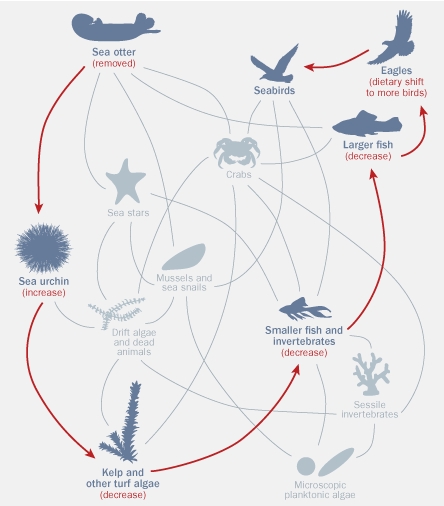
The Science News article, Lopped Off, highlights just how profoundly we as a species usually have no clue what we’re doing. (See a brief excerpt from this article below.) Young children and elderly people may have always had their intuitive doubts, but who listens to them? With any luck, science will compel more of us middle-aged know-it-alls to sober up and face our ignorance.
Chapter 16’s Woe to him who willfully innovates while ignorant of the constant, is very prescient on the unintended consequences of our clever and willful behavior. Back then, the “woe” was small scale compared to now when our innovative abilities threatened the entire planet. It is ironic that science both leads to technological innovations that cause the destruction, and now forces us to realize the full range of consequences of our actions. We can only hope the lag time between innovation and realization is decreasing.
Speaking of innovation
Compared to all the other species inhabiting earth, it appears ours may be a unique evolutionary innovation. Surely, this is not Mother Nature willfully innovating while ignorant of the constant, so she must just be experimenting. ‘Nothing ventured, nothing gained’ appears to be nature’s rule of thumb. Certainly, these are interesting times… as that old Chinese curse says, “May you live in interesting times”.
Our belief in what we think we know blinds us from deeply appreciating what we don’t know. Knowledge is a two edged sword. It empowers us to overcome many obstacles, yet the certainty of knowledge simultaneously blindsides us. Overcoming small obstacles actually creates what often turns out to be a larger obstacle… that’s the law of unintended consequences. Knowledge gives us a false sense of security. Despite being awfully limited, knowledge gives us believers the illusion that we truly know. This begs the question, “How do we know what we know is truly so?” That makes chapter 71 an effective test of self-honesty… To know yet to think that one does not know is best; Not to know yet to think that one knows will lead to difficulty. Of course, one must take the test as fearlessly and self-honestly as possible to make a passing grade.
We assume we’ll find solutions that eventually result in happiness ever after, a biblical land of milk and honey. That is certainly a hallmark in Western religion. Such thinking doesn’t conform to nature’s reality, but only to how nature intends for us to perceive life. You might say that optimism is an emergent property of the bio-hoodwink. (See Tao As Emergent Property, p.121 and How the Hoodwink Hooks, p.100.) Our species can’t afford to indulge in this species-centric dream much longer. No worries though… As chapter 51 says, Circumstances bring us to maturity!
Here is a brief excerpt from that article. (Google [Removal of top predators trickles through the food web].)
“We’re eliminating large predators very quickly around the world,” says wildlife biologist Michael Soulé of the Wildlands Network, who works out of Paonia, Colo. “It’s estimated that 90 percent are already gone.”
These end-of-the-line carnivores, known as “apex consumers,” can influence the lower rungs of their ecological ladders. By keeping the critters they dine on in check, the apex species affect the next rungs down, and so on. The system remains balanced as populations fluctuate in sync.
But sharks aren’t the only predators under siege. A host of carnivores perched atop food webs are being eliminated by humans, the real killing machines. Although marine species such as sharks are primarily caught for food, large terrestrial hunters (think lions, wolves and grizzlies) are often targeted for removal because they threaten humans moving into previously wild spaces.
Chapter 16 fits this sorry situation so well that I couldn’t resist submitting a comment (below) to Letters at Science News. They printed it, so finally science and religion find common ground. 😉
Predators inspire poetry and fear
Regarding “Lopped off” (SN: 11/5/11, p. 26): One of the Tao Te Ching’s chapters (excerpt below) is very prescient on the unintended consequences of human behavior. It was written around 500 B.C., long before our innovative abilities threatened the entire planet. It is ironic that science both leads to innovations that cause the destruction, and now allows us to realize the full range of consequences.