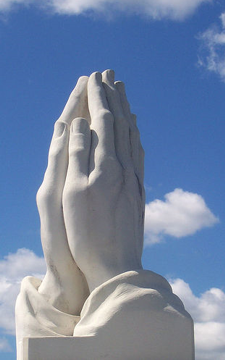
What do you pray for?
“Be careful what you wish for”, followed by “it might just come true” is an ironic maxim concerning the perils of wishing without grasping unintended consequences.
First, we need to stipulate that wishing for something is relatively synonymous with desiring, expecting, hoping and praying for something. Next, is there a fundamental source for all these sentiments?
We feel a visceral need, which stimulates thought that creates a story that conforms to that need. Thus, primal need is the lowest common denominator for those rather synonymous sentiments above. Next, we expect reality to match the story. This feeds back on the larger framework of cherished ideals developing within us since childhood.
Finally, how do we feel when our wish for a certain result falls through? Not happy! As Buddha said, Painful is the craving for that which cannot be obtained and pleasures are the bait, the result is pain. Therefore, “Be careful what you wish for, it will be the source of your suffering”.
The core ideals we cherish help determine what we wish for in life. This sets up the potential pitfalls that lie ahead. My experience in the stock market serves as an example. It plunged and decimated the value of our stock. If my core ideal were to make money, this crash would have been very painful. As it happens, my core ideal is patience and balance. The plunging stock market actually handed me a good opportunity to ‘practice what I preach’ — another core ideal of mine.
Therefore, we can improve the maxim further: “Take care in what you idealize to limit future suffering.” That is the value of embracing so called spiritual principles as sincerely as possible. They counterbalance the more-is-better urge that pushes us to get all we can as quickly as possible. (See How the hoodwink hooks, p.100.) Christ put it well, Lay not up for yourselves treasures upon earth, where moth and rust doth corrupt, and where thieves break through and steal. But, lay up for yourselves treasures in heaven, where neither moth nor rust doth corrupt, and where thieves do not break through nor steal. For where your treasure is, there will your heart be also. That last line says it all.
Speaking of being careful of what we wish for
Grover Norquist advocates never increasing taxes. Many regard this view extreme, including me. On the other hand, he points out that raising taxes is what politicians do instead of governing or making hard decisions. He is correct historically. In a democracy, people wish for things and vote for politicians who promise to deliver them, preferably without raising taxes. Later, when the chickens come home to roost, we naturally and irrationally blame scapegoats (e.g., corporations, politicians), but in a democracy the buck stops with ‘we the people’. Well… that is the dilemma! Chapter 70 speaks to this irony, Our words are very easy to know, very easy to do. Under heaven none can know, none can do.
Modern culture increasingly appeases our innate urge to get something (benefits) for nothing (no taxes) if possible. Nature is a pay as you go scheme, so such expectations normally run counter to reality in the wild. There, windfalls are rare, yet when they occur, the natural urge to seize them is healthful.
In modern times, we have contrived clever ways to borrow from the future to make up for the deficit of today… in a kind of perpetual, albeit artificial and unbalanced windfall. Generally, people the world over are innately incapable of paying as they go unless compelled to do so by circumstances—nature.
The naïve wish to get things ‘today’ and pay for them ‘tomorrow’ supports Norquist’s position. Yet, this also means Norquist’s plan is doomed. Taxes will go up… but spending will outstrip any tax increase in the end. Getting more for less is an instinctive urge, and so impossible to pass up let alone eliminate. As chapter 16 cautions us, Answering to one’s destiny is called the constant, knowing the constant is called honest. Not knowing the constant, rash actions lead to ominous results.