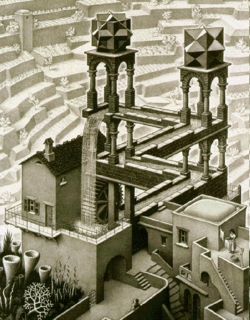
 Human imagination is both a valuable survival asset and the source of lingering anxieties. Ironically, imagination also promises us ways to quell these anxieties. I say promises because fulfillment can’t truly be possible. This peculiar dynamic reminds me of the Möbius like geometry of Escher’s Waterfall.
We can imagine a better something and so we tend to expect that better something. Animals feel the same emotions that drive imagination in us, but only briefly and directly connected to current external stimulus. In addition to external stimuli we sense, we produce self-stimuli from our remembered past and imagined future images. In due course, these memories and images then stimulate and re-stimulate our deeper-seated needs and fears.
This imagination–emotion feedback loop keeps us chomping-at-the-bit waiting for reality to match our imagined ideals of what it “should be”. We end up contending with reality and pushing to make it mirror our desire. Undoubtedly, this was/is a key factor in the survival success of our species. For our hunter-gatherer ancestors this asset would have been largely benign.
This imagination–emotion feedback loop still works beneficially, especially when our ideal and reality closely align with one another. However, civilization functions by a different set of rules than our ancestors followed. Now, more than ever, progress is integral to civilization’s DNA. The perceived virtue of progress makes any success fleeting, and off we rush imagining an even better world to push for… that’s progress!
Our hunter-gatherer nature is always pulling the strings through a deep-seated more-is-better instinct. Naturally, this is beneficial in the wild… now, not so much. Continually imagining an even better world increasingly leads us to actions that bring unintended consequences. As chapter 16 warns, Not knowing the constant, rash actions lead to ominous results. We easily overlook the constant in our rush for progress.
Need + Fear + Thought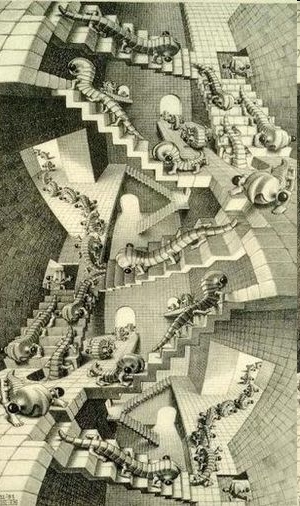
The pains of life are inevitable and natural. Our ability to imagine ways of resisting what is natural only adds suffering to life’s pain. Non-thinking animals avoid this additional suffering. They can’t maintain a well imagined past and future, and so can’t imagine a better way. Does this mean humans suffer more? I suppose so. Imagined gains and losses (need + fear + thought) create our desires and worries. These do seem to add a degree of discomfort beyond what other animals can experience. The question is how large is the difference?
Judging degrees of difference will always be a projection of the observer’s needs and fears, so who knows? The human mind, bolstered by ego, has great difficulty seeing, realizing, knowing, and finally accepting its own fallibility. A couple of Taoist observations speak to this issue: Chapter 56, Knowing doesn’t speak; speaking doesn’t know (I think of thought as the internal aspect of speaking, or vice versa); chapter 71, Realizing I don’t know is better, not knowing this knowing is disease; chapter 10, When understanding reaches its full extent, can you know nothing?
Memory Poisons Consciousness’s Well
I suppose it sounds heretical to say, but human memory is a somewhat destructive and sorrow causing aspect of our unique cognitive ability. A sharp knife blade cuts both ways. First, the good side of the memory coin: it is one of humanity’s foremost survival tools, and it offers us the sweet and bittersweet joy of nostalgia.
Now, here is the other side of the coin. We’ve all experienced how hearing negative gossip about someone leaves us with poisonous preconceptions to overcome when meeting them in person. That is, if we wish to follow chapter 16’s model, Knowing the constant allows, allowing therefore impartial, Impartial therefore whole, whole therefore natural… or perhaps adhere to Christ’s “Judge not, that ye be not judged.”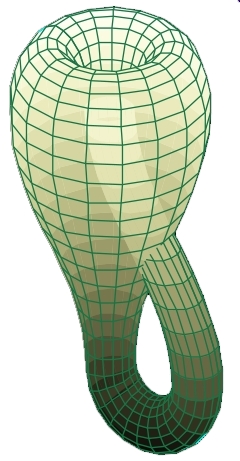
Another pernicious side to memory is favoritism. As D.C. Lau puts it in chapter 79, It is the way of heaven to show no favoritism. Just as we tend to see and hear what we desire, we also tend to form and retain the version of memory that supports our viewpoint. That makes memory even more unreliable. Indeed, such biased memory is in some ways worse than no memory at all.
Being acutely aware of this tendency to use memory as ammunition to push an ideal or action helps me take the certainty and the push out of my memory. Honestly seeing this bio-hoodwink (p.11) for what it is, has so far turned out to be my weapon of choice against my own delusion.