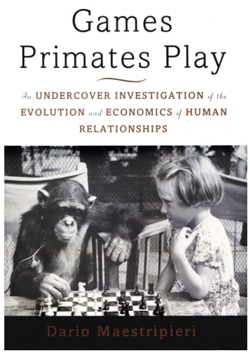
 The Science News book review, Games Primates Play, is worth reading. It is short so I’ll paste the whole review below first, and then add my tangential two cents.
Games Primates Play: An Undercover Investigation of the Evolution and Economics of Human Relationships
Even decked out in cultural finery, people make monkeys of themselves. Maestripieri, a veteran monkey investigator, builds a fascinating and occasionally disturbing case for fundamental similarities in the social shenanigans of people, apes and monkeys due to a shared evolutionary heritage.
Maestripieri spies unspoken primate customs lurking in mundane human encounters. In a crowded elevator, people instinctively stand still and avoid eye contact, keeping their distance when only two remain. An ingrained need to defuse potential aggression when confined with strangers drives this behavior, Maestripieri argues. He has observed similar behavior in pairs of female macaques put in a small cage. To break the ice, the monkeys bare their teeth to signal fear and friendliness before grooming each other. It’s a short jump, he says, from caged macaques to two people in a high-rise elevator chatting nervously about the chance of rain.
Maestripieri also describes the evolutionarily deep appeal of nepotism. In female-run macaque societies, big shots’ daughters are guaranteed privileged lives while daughters of bottom-feeders eke out a miserable existence. Maestripieri relates this behavior to his own run-ins with kin favoritism in Italy’s military and universities.
Both people and macaques often hurt competitors if they can get away with it, Maestripieri says, but play nice in public. So it goes among scientists: Senior researchers attack rivals and young challengers in anonymous peer reviews. This would improve instantly with open review, he predicts.
Other research described in the book finds commonalities in primate cooperation and friendship, as well as in power plays, playing favorites and other dark social arts. In the end, Maestripieri’s theme is hard to deny: Monkey business is everyone’s business.
By Dario Maestripieri (Review by Bruce Bower)
Thanks to advances in science and technology, we are finally beginning to make real progress towards knowing and understanding ourselves as we are. In other words, we are beginning to see ourselves as animals first and foremost rather than the ideals we conjure up to prove our Homo sapiens’ superiority, which our species’ ego compels us to do.
The ultimate value of science and technology lies in its ability to help us see ourselves more impartially. No doubt we have a long way to go, and even longer before the populace feels comfortable with the unvarnished truth. The ‘cool’ scientific innovations most valued by the populace at large are merely distractions along the way — soon forgotten and replaced by the next novelty; with unintended and ominous results invariably following behind. As chapter 16 puts it,
Such impartiality is the overall aim of science, but how long must we wait? This answer lies in the eye of the beholder. Normally, we judge time from the perspective of a human lifetime. More to the point, our sense of time connects directly, although subtly, to desire. Buddha in his second truth said, “… The surrounding world affects sensation and begets a craving thirst that clamors for immediate satisfaction. The illusion of self originates and manifests itself in a cleaving to things.” A “cleaving” to our imaginary ideals, plus a “clamoring for immediate satisfaction”, drags out time, reinforces self (ego) and delays Impartial therefore whole…. nearly rising beyond oneself.
Buddha succinctly sums up the essential framework for our conception of time. The more you desire some particular outcome, the more narrow time’s window feels. ‘Now’ becomes intertwined with your desire for immediate satisfaction. From this standpoint, several hundred years feels like a long time, yet from a desire-free evolutionary perspective, it feels like the blink of an eye. It helps me to feel ‘now’ as a great long flowing river. Where does it begin? Where does it end? I feel awe as I float along in the middle reaches watching the waters of time flowing around me. Now and eternity offset each other, yet share the same space-time. As chapter 56 put it, This is called profound sameness. Chapter 14 also comes to mind…
Note: Disciple is the root of discipline. Pondering that helps deepen the meaning.