 Why does government function the way it does? One thing that often stands out is how the authorities in bureaucracies, both leaders and subordinates, easily over-react in silly irrational ways. From a symptom’s point of view, I immediately notice fear as the operative force behind this. To be sure, this applies to most, if not all, actions of any animal at some level.
In bureaucracies however, fear is in force throughout every level. We’ve all heard the ludicrous example of the school principal expelling grade-schoolers for having aspirin pills. This is clearly a fear driven response. The official in charge is viscerally, even unconsciously, fearful of being faulted of not doing enough. To avoid reprimand, the official over compensates. Certainly, when people are generally uncertain and insecure they tend to either over or under react, and this is generally a healthy response for personal matters. However, this becomes problematic when fear drives a society’s bureaucratic rule.
Alas, I can’t see any viable fix for this societal malfunction due to the hierarchical nature of civilization. Subordinates will always worry about accusations of failing to act, and thus over-react. However, appreciating how natural underlying processes like fear are at work helps me keep events in perspective. In other words, no one has free will and thus everyone is driven to act according to the fears and needs they experience. Civilization is a “recent” human creation and the flaws we see are mostly a result of scale, i.e., humans evolved to live in small groups, not the huge numbers that necessitate a bureaucracy.
On a more practical level
The difficulty our government faces jumps out at me through the comments I hear about what the government should do. Oddly, people don’t appear to realize fully that in a democracy anyway, they are the government. Effectively, this means that the diverse self-interests I am hearing, no matter how noble and egalitarian they appear, reveal the difficulty big government faces.
The political stalemates we see are the result of opposing groups struggling to make matters better without regard to what is naturally possible. Their self-interests and underlying fear blind them. As chapter 30 cautions, Making matters better as a long term rule, is not of the way. Not of the way ends early.
Opposing forces, driven by self-interest and fear, amount to pushing the proverbial boulder uphill. Leadership lies in seeing ways to roll it down hill instead. Pulling together with sincere common-interest and common-purpose is the only effective way. Having only half the country aligned with your interests is not a mandate in common-purpose. It is a “mandate” only in the eye of the proponents.
We only seem able to distill our individual self-interests into common-purpose when we are experiencing a crushing disaster. World War II was probably the last time that actually occurred here. Not coincidentally, that is also when true leadership held sway. Therefore, I’m a fate realist. We humans, like all animals, are reactive, not proactive. Sure, we are able to imagine, talk about, and project our proactive vision of a perfect answer to the question, “What should government do?” We are particularly helpless in the follow through. As chapter 70 reveals…
Our words are very easy to know, very easy to do.
Under heaven none can know, none can do.
Ultimately ‘Needs must’ prevails
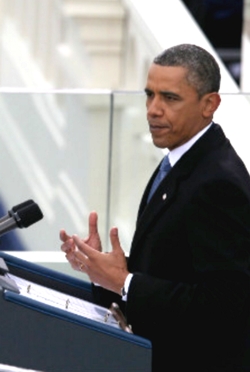
Perhaps President Obama would have been wise to address the country’s social safety net, a looming crisis that makes up half the budget. All economists, regardless of politics, see the non-sustainability of the path we are on, and propose remedies like raising the retirement age and means testing.
Had Obama seized reality’s moment, could he have won over enough people, conservative, liberal, and independent alike? Seeking to establish common purpose builds trust, which can then help enable movement on other intractable issues. As far as I can tell, the national debt, climate change, and immigration are the most important and intractable issues. Just marshalling common purpose around one of these concerns would help resolve the remaining issues. Alas, a leader who can herd the populace into common purpose is rare in this world. Of course, one can’t herd people where they don’t wish to go. It appears that circumstances need to reach the tipping point of disaster before the populace as a whole can set aside their personal agenda long enough to find within themselves a sense of common purpose. See also, Democracy as Myth, p.177, for another angle.
The lack of common-purpose and trust in the populace is the most corrosive influence in society, bar none. If people connect in common purpose, they establish trust. As they establish trust, each faction becomes more open to compromise on what they would otherwise reject. Again, I’m a fate realist. Like all animals, we humans are reactive. Chapter 70 (above) says it well. I find it very helpful simply to understand how nature works. Chapter 77 helps take it a little deeper…
What I notice overall, is a profound hypocrisy that permeates the ideals we profess. Almost without exception, it is always the other person we blame for giving to the surplus, and also the other person we insist should give to all under heaven. Our ability to hide behind the sin of our own self-interest and throw stones at other people’s self-interest is extraordinary! We inhabit two realities: One is the reactive fearful animal we truly are, and the other is the rational person we imagine ourselves to be. All this teeters between being laughable and pathetic, depending upon which side of reality’s mirror I am. Chapter 18 sums it up well…