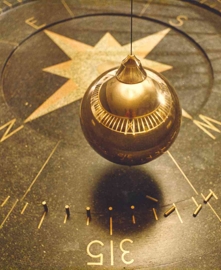
 The Syrian war illustrates our intrinsic tendency to swing from one extreme to the opposite. In wondering why, chapter 64 came to mind, Its peace easily manages… and so on. D.C. Lau translates this view more clearly, e.g., It is easy to maintain a situation while it is still secure. Interestingly, the adage, “a stitch in time saves nine” parallels this insight. Indeed, many common sayings convey Taoist points of view well and logically to boot. Nonetheless, the value of the often more obscure phrasing of the Tao Te Ching lies in how it can pull pondering deeper… for those willing to make the journey, anyway. Even so, such wisdom, whether stated obscurely or clearly tends to go unheeded. Why?
It is natural that wisdom goes unheeded. In this case, can we ever moderate the pendulum-like extremes that throw us off balance? Such good ‘a-stitch-in-time’ advice overlooks the fact that the pendulum process began long, long ago — some 14,000,000,000 years ago. Once swinging, it just keeps going. Curiously, Newton’s First Law of Motion applies here, albeit in a broadly fuzzy kind of way: ‘Every object in a state of uniform motion tends to remain in that state of motion unless an external force is applied to it’. Naturally, a pendulum isn’t exactly in a state of uniform motion. Instead, it swings ‘left’, then swings ‘right’, ad infinitum in a frictionless vacuum. Chapter 40’s Having is born in nothing reveals what kicked off the first swing. Nothing also kicked off the Big Bang, and the universe that ensued, Newton’s Third Law of Motion applies here too: ‘For every action there is an equal and opposite reaction’. Are we helpless then?
Where’s the peace?
It is distressing when circumstances swing toward chaos. We yearn for enduring peace, balance, and justice. Yet nature’s pendulum continues to swing, reversing every condition. However, awareness only truly notices and reacts to the extremes, whether favorable or otherwise. Chapter 13 hints at the stress this causes, Bestowing favor and disgrace likewise startle; Treasure and trouble likewise seem personal. To alleviate the stress this causes we either over-do or under-do life in our effort to settle matters once and for all. We struggle to actively nail down our advantages and escape our difficulties. Ironically, this amplifies the stressful pendulum-like consequences we experience, i.e., ‘For every action there is an equal and opposite reaction’.
To a degree, the peace we yearn for is a function of our personal approach to life. Our expectations for life can intensify the swings we experience in life. Resisting life’s ebb and flow is the main source of our trouble. Great Conformity brings peace, as the end of chapter 65 hints,
Chapter 58 highlights the confusion we face when personal expectations override our reaching great conformity…
Yes, we have been long confused. That is how nature intends it to be. The beginning line of chapter 65 supports this, albeit obliquely: Of ancients adept in the way, none ever use it to enlighten people, They will use it in order to fool them. So, what ancient is most adept in the way? Mother Nature and Her bio-hoodwinking ways are, of course. See Peeking in on Nature’s Hoodwink, p.11 and How the Hoodwink Hooks, p.100.