Occasionally I feel a little forlorn since I’m making the same essential points repeatedly. Then I remember the necessity of constant vigilant review. This is akin to attempting to maintain balance under wobbly physical circumstances. Surely, psycho-emotional circumstances are no less demanding, balance-wise. Whew! Hope rebounds as I remember the secret of living balance…
The Secret of Living Balance
Living balance is an ongoing moment-to-moment awareness and therefore never finished. Normal physical balance, like just standing upright, happens at a subconscious level. Once you get past the toddler stage, you maintain normal physical balance via the subconscious awareness of your inner ear and autonomic nervous system. This permits you to carry out your daily concerns with deliberate awareness, or just daydream if you like. If we don’t venture too far out on the physical limb, we maintain balance automatically and naturally. Yes, most of us can walk and chew gum pretty well.
However, what happens when you attempt an unusual physical task like standing on your head or walking on a railroad track rail? You can’t just find your balance and forget it, and go on to other tasks. You must review your balance status continually. The more novel the balance task is, the more essential maintaining active watchful review becomes.
Maintaining psycho-emotional balance, even in normal daily life, is a whole other matter. Other animals don’t have this balance issue, mainly because they don’t have psychological issues overall. They just feel what they feel, without an “I” second-guessing everything… not so for human animals. Chapter 71’s, Realizing I don’t know is better; not knowing this knowing is disease, speaks to our unique mental disease problem. Most likely, our species has yet to evolve an innate way to counterbalance the emotion-based cerebral triggers of this disease. Until that occurs, it is up to us to watch out for the cerebral certainties that throw us off psycho-emotional balance. That means continually re-Realizing I don’t know is better. Knowing when we are leaning (biased) is crucial. Only then do we have a chance to return to greater impartiality. Impartiality is the key to psycho-emotional balance. Chapter 16 couldn’t be clearer…
 Is ‘stupidity’ just a failure to remember?
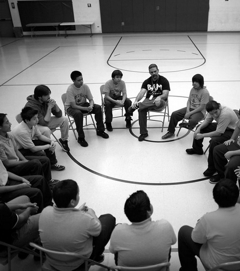
An NPR interview, Therapy Helps Troubled Teens Rethink Crime, speaks to the failure to remember. This excerpt sums it up.
Most serious violent events are almost Seinfeldian in their origin — someone saying something stupid to someone else, and that escalating and basically turning into a tragedy because someone had a handgun in their waistband at the time. “The solution to the problem”, Ludwig, Pollack and their colleagues surmised,” might lie in getting kids to slow down and think about their actions”.
Ludwig says the course was based on a kind of training called Cognitive Behavior Therapy — a mainstay in modern psychotherapy. The technique aims to get people to think about the way they think, and to recognize unconscious patterns of thought that produce unhappy life outcomes.
Unfortunately, within a year after the program ended, its effect seemed to fade. Teens in the group who had gone through the training went back to having the same arrest rates as kids who hadn’t gone through the program. Ludwig says the researchers are still exploring how to help young people retain the powerful benefits of this sort of psychological training, as part of a range of efforts in Chicago to stem homicide.
The comment above, “researchers are still exploring how to help young people retain the powerful benefits…” is curious. The answer is obvious: learn, remember, and review! The hitch here is that one must desire to review, and desire is the main distraction thwarting review. Therefore, as chapter 64 says, Taking this, the wise person desires non desire. Naturally enough, the young have yet to acquire sufficient wisdom to desire non desire. These researchers found the only thing that actually works, yet they “are still exploring how to help young people…”. Evidently, the researchers don’t comprehend the issue deeply enough yet.
We are all attending the ‘school of life’. Clearly, the longer you stay in this school, the better your chances of learning life. The researchers have shown that the kids need constant in-person contact with older people who know the side of life that can’t be formally taught. Alas, civilization makes this difficult to bring about. Ironically, all society can do is fund programs that try to solve problems that it inadvertently causes. The last time constant role model contact was truly possible was back in the hunter-gather epoch where social divisions were minimal, and there were far fewer ways to get off track. Back then constant in-person contact with older and wiser people was unavoidable! All I can say is, how can we manage problems adeptly when we have yet to come to terms with the ultimate cause? Every ‘solution’ only serves as a stopgap measure at best. Oh well, that’s evolution for you. (See Exquisite Balance, p.127, for other factors at work here.)