 Chapter 56 offers what could be another description of sleep…
Profound sameness is a continually enlightening point of view. Thus, any research that explores this, even tangentially, warrants review. First, listen to a short NPR report on sleep. Google [Memory Pinball And Other Reasons You Need A Nap – Dr. Matthew Walker]. For more, google [Sleep loss linked to psychiatric disorders – Yasmin Anwar].
One thing Dr. Walker said about sleep stands out in particular… “So it’s almost like memory pinball — you’re bouncing that information around, you’re testing which connections to build”. “Testing the connections…” as he puts it, is an accurate way to describe the cognitive process underpinning profound sameness.
Sleep Summary
On learning and memory: There are several things that we’ve been discovering that are critical. The first is the role of sleep in learning and memory. And now, there’s really very good evidence that sleep is critical at almost all stages of memory formation, memory processing and long-term memory retention. And then secondly, we have more recently been discovering that sleep plays an intimate role in regulating our emotional well-being and our mental health.
On Creativity: We’ve got wonderful anecdotes throughout history of sleep-inspired creativity. Paul McCartney apparently came up with lots of music, in dreams. Frankenstein, Mary Shelly’s text – Dmitri Mendeleev came up with the creation of the periodic table of elements – the construction of that – by way of sleeping. Well, recently, we’ve been able to find evidence to statistically show that sleep can support that type of creative memory processing. And there seems to be some type of memory processing that’s creative that starts take pieces of information that we’ve learned recently and starts trying to test the connections between that recent information and all of that information you’ve got stored in your brain. So, it’s almost like memory pinball. You’re bouncing that information around. You’re testing which connections to build. And I think when those types of processes start to happen in sleep, when we start to fuse things together that shouldn’t normally go together, they cause marked advances in evolutionary fitness. And that’s what we’re starting to find in our science.
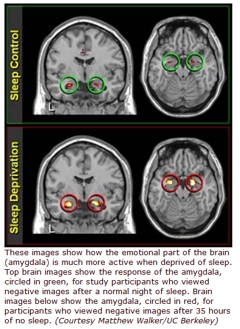
On lack of sleep: A whole constellation of different brain and body functions start to deteriorate. You can’t learn information as effectively. So, pulling the all-nighter is a very bad idea. Your brain is about 40 percent less effective without sleep in terms of absorbing new information. It’s almost like a waterlogged sponge. Nothing more can be soaked up. But we also know that if you don’t sleep after learning, you lose the chance to essentially hit the save button on that information. And that information isn’t transferred into long-term memory. We also know, from an emotional perspective, that certain regions within the brain, deep within the brain, those regions become amplified in their emotional reactivity. So, you become excessively emotionally reactive and part of the reason is because your frontal brain – a part of the brain that we call the prefrontal cortex – that becomes impaired. And it normally helps regulate those deep emotional senses, so we don’t become irrational, we don’t become Neanderthal. But without sleep, that’s exactly what seems to happen.
Sleep’s paradox: From an evolutionary perspective, everything screams at us that sleep is the very worst thing that you could do. When we’re sleeping we’re not eating, we’re not protecting ourselves from predators. The fact that sleep has fought it way heroically through every step along the evolutionary pathway, what that tells us is that sleep is essential at the most basic of biological levels. And what we’re finding now is that it was very smart because sleep serves so many wonderful beneficial functions that far outweigh those potential downsides to it.