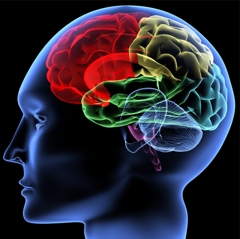
 Members of Alcoholics Anonymous and similar addiction management programs begin recovery by first acknowledging their addiction and powerlessness over it. Clearly recognizing a problem is an indispensable prerequisite for finding a solution. Such Right Comprehension is the first step on Buddha’s Eight-Fold Path. Until then, life is always a dog chasing its tail.
Primal instinct drives them all
To realize that one is an instinctive free willer—powerless over core emotions—can be a first step towards returning to one’s innate nature… one’s original self.
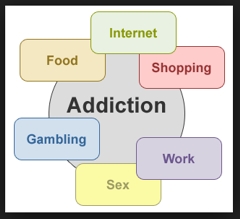
Primal instinct drive them all.
To continue believing “I” control life and “I” can find ways to change or enhance “self” is the dead end every addict travels until they surrender and admit they are powerless. Alcoholics Anonymous and other addiction programs have shown this is true. What is new here is my view that we are biologically addicted (via survival instincts) to our need for and sense of free will… choice, control, power.
We need a program!
“Hello, my name is Carl and I am a free willer”(1). I imagine many would balk at this idea. While this isn’t a substance abuse addiction as such, there are too many parallels to other addictions to deny. Nevertheless, denial is certain until we addicts are willing to see our addiction. The hump we must surmount is the blind spot the addiction causes. The blind spot is clear… If we believe we are in control, how can we entertain any suggestion, let alone biological proof, that we are not? We believe, “I can control (you name it)”. If not us, then we believe others can and so hold them responsible, unaware that instinct is actually in control.
The brain has a mind of its own
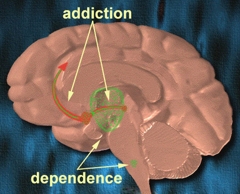
The brain has a mind of its own
Like all animals, we are born feeling an instinctive need to control life as best we can, by either contending or cooperating. Feeling innately driven to wield power and control to win at life generates thoughts in us that mirror this visceral confidence. Even if we doubt we have control, we want it and/or think other people have it, or should have it. This illusion of control begins as soon as we begin to think. Chapter 71 says, Realizing I don’t know is better; not knowing this knowing is disease. We get off on the wrong foot so early in life that it is easy to see why it takes so long, if ever, to realize I don’t know.it is easy to see why it takes so long, if ever, to realize I don’t know.
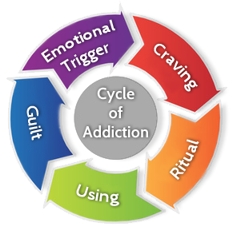
Admitting the cycle weakens it.
Admitting the cycle weakens it.
I’ve taken the 12 Step Program and modified it to fit with a Taoist point of view. This means dropping references to wrongs, God, and Judeo-Christian-Islamic morality in general. If one actually does well on the first step, the rest will follow naturally without forcing the issue. Sincere acknowledgement gets the ball rolling. I chose ‘we’ rather than ‘I’ because this is more about our human condition than an individual ‘I’ condition. I also reference parallels to Buddha’s Eight Fold Path: Right Comprehension; Right Resolution, etc.
- We admit we are powerless over instinct. Believing ourselves in control makes life less manageable. (Right Comprehension)
- We come to understand that a power greater than ourselves — nature — can help restore us to sanity through balanced understanding. (Right Comprehension)
- We resolve to turn our will and our lives over to the care of nature, as we understand it. (Right Resolution)
- We strive fearlessly for self-honesty. (Right Comprehension, Right Resolution)
- We admit to ourselves and to other human beings the exact nature of our disease. (Right Comprehension, Right Speech, Right Action)
- We’re ready to allow nature to be responsible for all aspects of our character. (Right Effort, Right Thought)
- We humbly ask to see our so-called shortcomings and virtues as merely natural variation — the diversity of life for which we can neither accept blame nor claim merit. (Right Comprehension, Right Living, Right Thought)
- We recall all persons we have judged and are willing to reconsider matters until we find balance, often by noticing the same fault within ourselves. (Right Thought)
- We will make direct amends to such people wherever possible, except when to do so would injure them or others. (If one is in accord with all the other steps and feels amends necessary, this would happen naturally). (Right Action)
- We will continue to take personal inventory and to be constantly vigilant. When we see our blindness in life’s rear view mirror, we promptly admit it. (We can assume blindness was/is present whenever we felt/feel emotion—the stronger the emotion, the blinder we become.) (Right Thought)
- We seek through thoughtful introspection to improve our conscious connection with nature as we understand it, praying only for knowledge of nature’s will for us and the ability to yield to it gracefully. (Right Thought, Right State of Peaceful Mind)
- When we have some awakening as the result of these steps, we model this in action and word as a means to bring the way to other likewise diseased folks. (Right Speech, Right Action, Right Living, Right Effort…)
- Right Speech, Right Action, Right Living, Right Effort…)
That’s not all Folks!
 Merely realizing that free will is a myth doesn’t purge the instinct that drives our deepest sense of it. Still, just acknowledging that one is addicted to a sense of personal power and free will is a quantum leap. Nevertheless, it is fair to say that managing this addiction is more difficult than abstaining from normal forms of addiction. Like all animals, we do have innate survival willpower and exercise it continuously. We can’t abstain from innate willpower, and being a primal survival emotion, it continuously kindles thought. Therefore, the only countermeasure is the counter-thought of Right Thought — applied continuously.
I manage this by challenging the illusion of free will each time it appears. That means, for instance, suspecting any thought where the word ‘should’ rears its judgmental head (2). Chapter 71’s Realizing I don’t know is better; not knowing this knowing is disease, keeps me on my toes as long as I continuously keep it in the back of my intuitive mind. Life is serious business; chapter 64 points the way:
(1) For much of my life I believed in free will — explicitly. I knew I had the power to choose what I wanted. I was in control, or so I thought. I do have a rather strong will and persevere until I drop, which undoubtedly helped bolster this belief. Then around age 40, I had an epiphany. I wasn’t as independent as I thought. I admitted that I depended upon everything for life, right down to every breath of oxygen I took. This oxygen graciously supplied by plants. Within a few years, I began wondering about free will itself, and began earnestly looking for evidence of its existence that I couldn’t explain in simpler biological ways.
Now, 30 years later, I have found no evidence for free will. All I see are biological forces directing the choices I make. Poof went my belief in free will, and yet feelings arise at times that suggest I still believe in free will. I now finally realize that it doesn’t matter what we believe or don’t believe—instinct rules us in the end. The human belief in free will, whether explicit or implied, arises from a visceral instinctive need felt by all animals to control their lives, i.e., win, succeed, come out on top. We can’t help it; it is innate. However, we can come to recognize this instinct’s influence over our lives. We can be recovering free-willers.
Once we begin to distrust our belief in free will, we break the backbone of certainty and are then ready to sincerely practice chapter 71’s … Realizing I don’t know is better; not knowing this knowing is disease. The certainty of knowing we have free will is the disease, not the instinctive need to control circumstances—that is universal. Finally, clinging to the belief we have free will is one of the most powerful forces producing the “illusion of self” — the “I”— in the first place. The best part of all this is how this realization makes me less hypocritical. Hypocrisy does not enhance the quality of life — just the opposite. Indeed, hypocrisy and self-honesty are opposites. I am independent by nature, but no longer see this as the strength I once did.
(2) The continuous ‘shoulds’ we project daily are generally subtle. To notice them requires vigilant self-honesty. Keeping a daily chart for a while to mark down your own ’transgressions’ can help deepen awareness.
Obviously, the younger you are, the less life experience you have to validate my observations. Evidence, if you seek it, will accumulate over your lifetime. In the meantime, challenge what I say and review your experience of life. Having doubts is healthy and wise because this often helps put the brakes on your list of ‘shoulds’. Certainty is simply a symptom of one’s own insecurity, and the attempt to hold on—cleave to—one’s story, i.e., Buddha’s 2nd Truth: “the illusion of self originates and manifests itself in a cleaving to things”. It is from that insecurity steeped in fear and need that the strong sense of ‘should’ will rear its judgmental head.
Finally, isn’t what I’m saying here just another story? Certainly it is. After all, chapter 1 begins with, The way possible to think, runs counter to the constant way. Anything spoken or written must also run counter to the constant way, including the Tao Te Ching. You could say confession forgives. Like the Tao Te Ching, I strive to find as impartial and balanced view as possible, mostly observing and giving voice to the connections and similarities I see. As chapter 56 observes, this is called profound sameness. Indeed, the road of similarities leads to truth, while the road of differences leads to illusion and half-truths at best. See Peeking in on Nature’s Hoodwink (p.11) and How the Hoodwink Hooks (p.100).
The paradox here is that while all this is a story, the origin of the words is not a story, but rather an observation. For example, seeing the Sun rise in the East is not a story; saying the Sun rises in the East is a story. Correlations (p.565) serve as a window into reality; nailing down the details in a story fogs up that window. It is a delicate balance between two sides of awareness chapter 56 describes, Knowing doesn’t speak; speaking doesn’t know. To what extent I maintain balance or to what extent Correlations are that window into reality, is up to each observer to decide. In the end, truth is in the eye of the beholder.