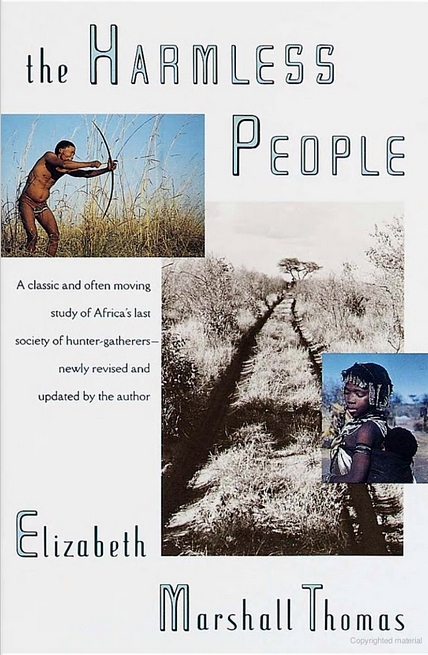
 In the early 20th century, a few pioneers combed the back woods of rural Appalachia to document and record the last remnants of American roots music still unchanged by the cultural upheavals of the 20th century. This music later evolved into the folk, honki tonk, and country music of the 20th century. Similarly, Laurence Marshall and his family, through three expeditions beginning in 1950, set out to document and record the !Kung of the Kalahari Desert, who were among the last surviving hunter-gatherer societies in the world yet to exchange their old way with the ways of civilization.
The Harmless People, authored by the daughter, is a unique and beautifully written record of the hunter gather experience just before encroaching modern civilization brought about its demise — at least as a self sustaining ancestral tradition. I bought this book seven years ago and just got around to reading it. It corroborates my own analysis of civilization and its effect upon us based on my years of traveling and living abroad mostly in developing countries.
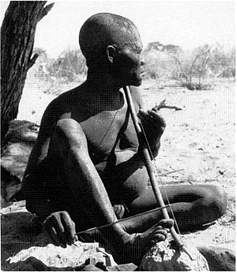 Are you a bushman at heart?
I imagine anyone sincerely drawn to a Taoist worldview is a hunter-gatherer at heart. This means anyone skeptical of civilization’s many promises of progress. We intuitively know the unintended tradeoffs humanity has made following the agricultural revolution some 10,000 years ago. I suppose you could say we Taoists are genetic outliers to a degree. We don’t fit in, despite how civilization’s storyline has been programming us from birth onward. To be fair, I honestly think everyone fits this description to some degree, albeit, perhaps only deeper down subconsciously. It is a matter of degree. Folks most enamored with the comfort and security that civilization promises will not be able to relate to this… yet, that may only be a matter of time (1).
I don’t have much more to say other than that I highly recommend The Harmless People by Elizabeth Marshall Thomas! The observations help put context and meaning into what it is to be human. Although we are not hunter-gathers in life style anymore, the instincts that drove them then still drive us today! Those instincts just manifest themselves differently now in emergent property ways, (e.g., shopping is a form of hunting and gathering). Reading this ethnographic research can help reconnect us to our ancestral roots. Particularly noticeable is how much of the hunter-gatherer life hinges on a deep social connection and sense of belonging. This is still a crucial human need, but now manifests itself more self-consciously and with greater difficulty in civilized people.
Evolution: ‘no loss and failure, no gain and success’
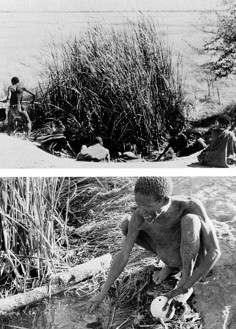 I don’t hold with Elizabeth Marshall on about how she sees the loss of the hunter-gatherer life style as deplorable. Yet, I do sympathize and deeply morn the tragedy, but then that is life, isn’t it? Life encompasses unavoidable suffering as it ebbs and flows through loss and gain — at least from a Buddhist and Taoist perspective. Certainly, at some level we all feel that something is amiss, and idealize either the ‘good old days’ or ‘a better future’. The truth is, something must always be ‘wrong’ in the evolutionary process. If everything was always ‘right’, then what would remain to evolve?
Evolution is a journey down the bumpy road of extinction and renewal. Accordingly, I see the hunter-gatherer losses as plainly another passing season in our species’ evolution. To be honest, the hunter-gatherer old way life style replaced the life style that preceded it, perhaps 60,000+ years ago. Thus, embracing nature’s ways, both the ebb and flow, is the only way I know to travel life gracefully. As they say, “If you can’t fight ‘em, join ‘em”.
(1) Distractions play a role in this for everyone really. None of us escapes the bait of pleasures promised. Another angle to this is how closely connected one needs to feel to buy into civilization’s promises. For me, a genuine sense of connection only occurred after I had a family and children of my own. I never could feel tribal bond through sports, clubs, politics, religion, etc., as most “normal” people. That said, I know I’m not alone, and I know normal is a bell curve. In the end, differences are illusionary; similarity is reality. Chapter 56 says it all: