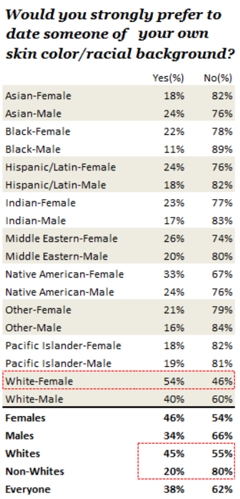
 The online matchmaking site Okcupid surveyed its members. Google [Okcupid Race and Attraction]. They looked at first-contact attempts and who was writing who back. They say it was immediately obvious that the sender’s race was a huge factor. That offers some proof to what has long been obvious to me: Homo sapiens are naturally racist. However, what does racism truly mean? Certainly, emotional bias is obviously the deep driving force at racism’s core.
Simply put, emotional bias is to racism as fear is to worry. Fear + thought = worry (1) and emotional bias + thought = racism (bigotry, prejudice, narrow-mindedness). Yet, fear and emotional bias are fundamental pillars of biology. So, what’s the problem? Clearly, thought is the straw that breaks the camels back here.
I know I’m biased in numerous ways, although not with regard to race. My biases arise over politics, religion, work ethic, diet, to name a few. Our biases are merely channels for our innate visceral insecurity (fear) to play out. No matter what form one’s bias takes, one common denominator is the hierarchical advantage with which such biases reward us (2). “I” am better than “them” because I __(fill in the bias)__. The list is as endless as the issues we value. That we place such high value on certain matters is proportional to our self-insecurity. The ‘lower’ one feels, the more one hungers for a ‘higher’ position on the social ladder. Thus, when we put “them” down, that automatically elevates our sense of self worth. Naturally, this superficial and vicarious ascent is fleeting because it isn’t a genuine security of being.
Ignorance is ignorant of its own ignorance
A racist, (bigot, prejudiced person) doesn’t normally know they are such. We are ignorant of our own ignorance. This is the disease to which chapter 71 refers… Realizing I don’t know is better; not knowing this knowing is disease. Thought, and its cohort belief, pushes instincts to extremes by locking emotional bias into memory.
There is an ironic and somewhat paradoxical side to this. If you know you are biased in a particular way (racist, or whatever) you’re not genuinely biased. You are able to feel your emotional bias as an integral part of your biology, even as the resultant thoughts are disease. That awareness helps defuse biased thoughts and impulses. When ignorance is aware of its ignorance, ignorance is much less blinding, i.e., Realizing I don’t know is better.
This cognitive disease that chapter 71 refers to is unique to humans, as far as we know. Knowing the constant is our protection from the misdirection that thinking and knowledge cause. Chapter 16 points the way…
What is this constant that we need to know? I see a few clues. First, biology offers a clear step toward returning to the root cause. Biology is obviously a major constant for any species. Mind you, the constant also alludes to that which is beyond all words and definition. Even so, the constant of biology helps transcend the culturally programmed biased “knowledge” that we all inherit beginning in childhood.
When I realize any aspect of my thoughts or knowledge are not impartial, I know my thinking is still biased. Knowing that, I can ponder deeper until I see the impartial whole. Still, thinking and feeling are truly separate issues. Animals only feel, we do both. Feeling attraction to one’s race is natural, as that survey suggests. As they say, “Birds of a feather flock together”, which also includes coming together via common interests and purpose. The problem, the disease, arises when feeling drives thought so much that we believe our thoughts accurately reflect reality.
More broadly, this all comes down to the dynamics of attraction (need) and aversion (fear). These forces are the workhorse of life itself, from protozoa to presidents. Our thoughts simply reflect what we need and fear in life. Yet, this subjective bias blinds us so fully that we believe we see life with little bias.
Try some rigorous hair splitting
The Correlation process (p.565) helps uncover the underlying forces playing out in one’s cognition. This process only works by challenging one’s biases and preconceptions. The hitch: we mostly seek confirmation of our biases rather than a challenge to them. We hang on to our biases because they shore up our illusionary sense of self as Buddha’s pointed out: “The illusion of self originates and manifests itself in a cleaving to things”, and biases are among our most precious “things”.
There is a side issue here too. The thinking that drives perceptions in one direction must have an antithesis in order to maintain the illusion of difference. Contrast is the name of this game. Conversely, duality vanishes in the stillness of true impartiality. This is called profound sameness, as chapter 56 puts it. Does this mean it is all a figment of our imagination? I imagine that is ultimately the case!
(1) Also, Need + thought = desire, expectations. Similarly, need is a vital pillar of biology for all living creatures. Here again, thought is the straw that breaks the camels back.
(2) I’ve found forms of racism everywhere I’ve been (See: Biographical Notes p.xii). It’s biological. Sure, society must push itself to minimize the effects of this. Nevertheless, it helps to lower expectations given that none can win a fight with Mother Nature.