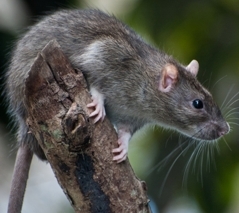
 Google [Rats Experience Feelings of Regret] for research discovering that when a rat realizes it made a mistake, its body and brain show signs of regret (1). Research like this challenges the beliefs of human exceptionalism that we’ve been cultivating to support humanity’s “illusion of self” collective ego. Sure, we are different from rats, but so are butterflies and cats, and each is ‘exceptional’ in its own right.
Before delving into humanity’s collective ego, we best stipulate a fundamental part of Buddha’s second noble truth: “The illusion of self originates and manifests itself in a cleaving to things”. Now, Buddha advised people to verify this and his other observations through personal experience, and not merely accept them on faith. As it happens, it took me many decades to genuinely verify this “illusion of self” origin despite finding Buddha’s Four Truths very useful overall. Consequently, I won’t assume you’ve viscerally verified this “illusion of self” yet, but I hope you can consider it as a working hypothesis.
A Pandora’s Box of cultural evolution
Before the agricultural revolution, physical survival was humanity’s principle challenge. Like wild animals, our main concern would be finding the next meal. Not that this would be a problem, it is just life as usual in the wild. In the several hundred thousand years of pre-agricultural humanity, there was no post-harvest free time. This made each day a more spontaneous affair. Daily life was a simple process of hunting and gathering, and extemporaneously managing whatever problems arose. In the wild, there are no opportunities for growth; living is truly a circle of life. Genuine progress occurs only on an evolutionary scale in balance with the rest of nature.
As we settled down to cultivate crops and domesticate animals, our day-to-day survival issues greatly diminished. However, we naturally retained our core survival instincts. This changing circumstance set the stage for a growing list of existential problems onto which these instincts could focus. A settled existence also made possible an ever-increasing variety of “things” on which to “cleave”… land and structures, crops and livestock, hierarchical social ranks (e.g., farmers, warriors, artisans, priests, rulers) and the rules and beliefs that support all this. We expanded our horizons for growth, and in the process, multiplied matters over which we could desire or worry. Clearly, we have been cultivating more than just agricultural crops!
Feeling you don’t quite fit in?
The agricultural revolution facilitated an increasing sense of the individual self—an “illusion of self” (ego)—along with its imagined desires (need + thought) and worries (fear + thought). Culture educates this “illusion of self” into us throughout childhood, which we then augment throughout the rest of our lives by “cleaving to things”, both mental and physical. This leaves us with a greater sense of overall disconnection compared to our hunter-gatherer ancestors. Yet, archeological evidence shows that hunter-gatherers also had difficulty coping with their sense of disconnection long before. This was most likely due to our brain’s increasing ability to imagine. Civilization simply deepens the disconnection.
It is natural for any animal to try to fix problems it feels, like the research rat feeling regret and lamenting its decision (1). Humanity’s departure from the hunter-gatherer life style launched a whole set of existential problems as the “illusion of self” (ego) developed. The more firmly established the “illusion of self” became, the more easily threatened its self-identity. It is truly a house of cards built on an illusion. And so, we set about developing schemes to shore up our self-identity, and ostensibly fix the problem. We can see this quest for a fix in every area of human endeavor, particularly in religion, politics and the arts.
So, what now? Clearly, we are casualties of complex circumstances set in motion many millennia before we were born. The problem can feel insurmountable given this key factor: All of our fixes have in turn become yet more “things” on to which we “cleave”. Simply put, we are fighting fire with fire.
Compounding Baseline Suffering
First take note of Buddha’s First Noble Truth, the existence of suffering: “Birth is sorrowful; growth, decay, and death are sorrowful. Sad it is to be joined with that which we dislike. Sadder still is the separation from that which we love, and painful is the craving for that which cannot be obtained.”
We alleviate this baseline suffering partly by “cleaving to things”. However, the suffering described in the Buddha’s truth above is an integral part of each living thing’s experience. Imagine a dog, a mouse, or even a worm “being joined with that which it dislikes”, or feeling a pressing need “for that which cannot be obtained”, or “the separation from that which it loves”.
“Cleaving” to expectations is our way of escaping the difficulties of the present… for fleeting moments at best. As it happens, attempting to avoid baseline suffering only compounds the suffering. Similar to addiction, once “cleaving” promises happiness, the “cleaving” becomes yet another source of sorrow, i.e., “painful craving” or “sad separation”. Ironically, our seeking to escape ‘solution’ actually intensifies baseline suffering. The ego that the added “cleaving” cultivates suffers its own set of existential issues. Is there no light at the end of this tunnel?
All roads lead to natural evolution
How can we mitigate the existential difficulties that result from the ever-expanding role ego plays in self-identity? For me, a keen awareness that my life-struggle is an integral part of nature helps take ego down several notches. My suffering has this natural purpose; a purpose shared by the rest of creation… it is not about me; it is about ‘we’.
In particular, the life-struggle drives evolution, which for us means contributing to human biological and cultural evolution. Sorry to say, both these forms of evolution occur too gradually to perceive, and thus appreciate. While all living things experience the stressors produced by the various imbalances that drive the evolutionary ‘work’, those same stressors blind us to the role we play in evolution. All we feel is, “I want it, and I want it now” kind of pressure for change. The secret is to know what is happening intuitively. Indeed, we can only know this ‘big picture’ intuitively. The five senses are wholly inadequate. All we have to work with is what I call the constant consciousness. (See also The final solution is cultural evolution, p.597)
The Consciousness Constant
To paraphrase chapter 1, The consciousness possible to think, runs counter to the constant consciousness. The consciousness possible to express runs counter to the constant consciousness.
These verses from the Bhagavad Gita speak to this constant. Note: “A rose by any other name would smell as sweet” applies here, i.e., Spirit ≈ Consciousness ≈ Constant ≈ Way.
2:24 — Beyond the power of sword and fire, beyond the power of waters and winds, the Spirit is everlasting, omnipresent, never‑changing, never‑moving, ever One.
2:30 — The Spirit that is in all beings is immortal in them all: for the death of what cannot die, cease thou to sorrow.
If you are alive, you are conscious and therefore intuitively sense this indescribable ‘light’. Applying this sense usefully to daily life is the challenge. A story that beats around this bush can help. Here’s mine…
Constant consciousness is everlasting; it can’t be added to or diminished; it is eternal. It is here that I find immortality… the suffering of birth, growth, decay, and death, not withstanding. (See You are Immortal, p.391) Granted, the roar of expectations drowns out this conscious whisper, and the glare of a cultivated ego eclipses its light. So what, I say! It simply helps knowing that this constant consciousness exists. Chapter 16’s Devote effort to emptiness, sincerely watch stillness tells me how to tap into it whenever I really need to.
(1) Excerpts from Rats Feel Regret, Experiment Finds (Science News)
The first hint of rat regret came unexpectedly, says neuroscientist A. David Redish of the University of Minnesota in Minneapolis. While watching rats forage for food, graduate student Adam Steiner noticed that one rat looked as though it lamented a previous bad decision.
That chance sighting led the researchers to build a regret-seeking experiment they called restaurant row. It consisted of a large arena where rats could sample four stations that served up plain food pellets or those flavored with cherry, banana or chocolate. At the entryway to each restaurant, the pitch of a chime indicated how long the rats would have to wait for sustenance.
Each rat had its own flavor preferences, Redish says, allowing the scientists to figure out which restaurants and wait times represented a sweet deal to each animal. For instance, a rat that relished chocolate would happily wait about 22 seconds for a chocolate meal but would tolerate only about a 16 second wait for a plain one. Crucially, the rats had only an hour to dine, so the pressure was on to find the most satisfying food with the shortest wait.
As four animals ran through multiple scenarios, Steiner and Redish noticed that rats that skipped a good deal and wound up with a bad one exhibited behaviors that looked like regret. The rodents paused and looked back toward a restaurant where they had turned down a good meal. After forgoing a favored meal with a short wait, rats were more likely to wait longer for a less-desirable meal at the next restaurant. And when food arrived, the rats didn’t seem to relish it as much. “Normally they’ll take 20 seconds or so to eat the food and get ready to go to the next place,” Redish says. “After the regret, they eat in three to five seconds. They just wolf the food down.”
Activity in the rats’ brains also suggested the rats were ruing missed opportunities. The researchers monitored cells in two brain regions, the orbitofrontal cortex and the striatum, that fired in a distinct pattern when each rat was in a particular restaurant. When a rat skipped a good meal of banana with a short wait time but then encountered a long wait for a less-than-ideal cherry meal, for instance, the neurons behaved as though the rat were back in the banana restaurant, the team discovered. The results suggest to Steiner and Redish that the rat was replaying its bad choice in a moment of regret.
The brain activity wasn’t caused by simple disappointment, the team found. When the rat got a bum deal but made the right decision at the previous restaurant, the animal didn’t show the same behavioral or brain signs.