 Fear and need are the primal life forces underlying many of my observations. I know this basis often raises more questions than it answers, so clarification is in order. Not that I haven’t tried before… see Fear is the Bottom Line, p.139 and What are the roots of thought? p.602. Well, third time’s a charm, right?
On its surface, life is very much like the surface of the sea, from roiling waves to calm ripples. The depths, on the other hand, have a profound sameness(1) about them. Similarly, plunging deeper in life offers a profound sameness in perception. Chapter 40’s deep dive reveals the key role fear and need play in life.
Carefully contemplate chapter 40
This post’s title echoes the last line of chapter 40. Fear and need are two cornerstones of life’s process. Likewise, chapter 40 lays out the cornerstone for existence… not just a cornerstone, but the cornerstone. This is very specific, and yet it doesn’t contradict chapter 1, i.e., The way possible to think, runs counter to the constant way, The name possible to express runs counter to the constant name. Then again, all this still beats around the bush. Indeed, it seems that any attempt to think about or express nature’s way will always beat around the bush. Oh well…
The Fear and Need Linkage
Fear: Note the reference to “loss” and “death” in chapter 40. If you delve deep into your subtlest sense of fear, you will find some sense of loss. We instinctively fear loss. Every loss we experience, regardless of how minor, evokes within us a subtle sense of death. The survival instinct engenders within us a countervailing visceral need to hold on and to have.
Need: Note the references to “having” in chapter 40. The opposite of loss is gain, and the consequence of gain is having. The sheer act of living results in gaining whatever is necessary for survival. This drives life inexorably in the opposite direction of entropy (a.k.a., the loss and death of order).
By gaining the necessities for survival, life moves “in the opposite direction, of the way moves”. We can infer this from the last line, “Having is born in nothing”. The penultimate of “loss” is “nothing”. Life’s innate deep-seated fear of “loss” and “death” (i.e., “nothing”-ness) drives it to need and have.
Does this make any sense? I feel my effort to elucidate chapter 40’s link to fear and need can just as easily hinder understanding. Perhaps the succinct account stated in chapter 40 hits home better.
Fear and Need are more than we think
I use the terms need and fear to convey, in the broadest possible sense, the primal biological driving forces of life. Feeling need (of food, sleep, social connection, etc.) attracts us to what ostensibly facilitates survival. Feeling fear (looming loss of what we have and cherish) repels us from what ostensibly impedes survival. Such need and fear are subtle, often below the threshold of thought — sub thought — and only evoke conscious thoughts once they pass a certain threshold.
I trust that you can see I’m referring to forces that lie at the root of instinct itself, and not any particular manifestation, be that anything from subtle insecurity to fleeing danger in screaming terror. In addition, the dynamic expressed in chapter 40 extends to all creation, not only living things.
Thinking animals, like Homo sapiens, must cope with many severely under-appreciated consequences of their intelligence. Chapter 71 certainly speaks to this problem, Realizing I don’t’ know is better; not knowing this knowing is disease.
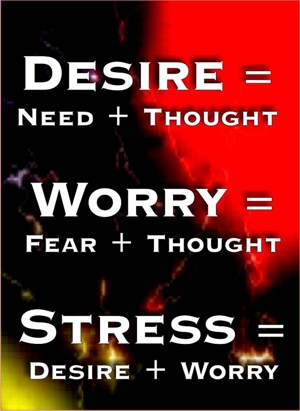
I’m breaking all this down to show the blinding influence that need and fear have upon thought. If taken to heart, the admonition to “just let go of desire” or “just don’t worry about it” are impossible platitudes unworthy of the breath it takes to express them! If taken seriously, this analysis also helps maintain a continuous realization of “I don’t know”. Namely, whenever you feel emotion currents tugging within, you can be sure irrationality has supplanted rationality, causing you to perceive only projections of your need and fear. Merely maintaining some peripheral sense that Need + thinking = Desire and that Fear + thinking = Worry helps to serve as a kind of ‘canary in the mind’ to alert you of this impending danger.
How does profound sameness apply to need and fear?
Ironically, some things are too obvious to see clearly. Profound sameness fits that description. At some point, I began to suspect that the underlying cause of need was fear, yet I couldn’t see the connection clear enough to understand how that could be. This exemplifies how we only understand what we know, p.254. The feeling was the beginning of an intuitive knowing that took some years more to understand cognitively.
Take the idea that worry is simply fear + thought. The emotion of fear evokes corresponding thoughts, and worries are born. When we begin to worry about something, we soon feel a need to find a solution… a way to leave the worry behind. Simply put, fear summons the need for a solution.
Fear also drives the need to control. Helping others is one way we control other people in a “helpful” socially acceptable way. I imagine making the connection between helping, the need to control, and fear may be a stretch. However, pondered deeply, this “helpful” dynamic certainly parallels the old adage, “The road to hell is paved with good (a.k.a. helpful) intentions”.
Mother Nature’s Mysterious Mastery
The link between fear and need makes more sense if we stipulate that Mother Nature is efficient and wastes nothing. Indeed, nature doesn’t ‘abhor a vacuum’, but rather makes use of the vacuum… emptiness… nothingness. Again, Having is born in nothing. Think of fear as the essential building block of life. The life process uses fear to co-generate need as a way to keep living things moving and having. Need incorporates the illusion that satisfying the hunger born of emptiness will relieve the fear of emptiness. However, emptiness born of entropy always returns. Fear needs resolution just as need fears emptiness and loss… and loss through death is a universal constant. No wonder life feels like a vicious circle at times.
The closer I look, the more fear and need are indistinguishable. I’ve often heard bickering over the existence of God; does he, she, or it exist or not. Those that say yes, need to believe in God. The belief assuages some of the fear of the unknown we naturally feel. Folks who say God doesn’t exist, don’t share that need. Yet they have an aversion (fear) of other people believing in God. They need believers to wake up; the believers need non-believers to wake up. Naturally, all this applies to anything over which we bicker.
UPDATE 2020: It’s important to note that fear fuels both need and anger depending on circumstances. The utility of knowing this is that when you deal with people (or yourself) who are expressing a lot of need or anger, you’ll know the deep source of these intense emotions. That helps mitigate the innate tendency of being drawn into the drama yourself.