 Civilization simultaneously asks and answers this question, “Who are you?” The cultural story we hear from infancy drums into us both who we are and who we should be. Essentially, this is a form of natural brainwashing — natural in that the brainwashers are themselves brainwashed. Because this cultural story is essentially arbitrary, we can spend much of life striving to find our proper role, our niche in culture’s hierarchy. How well each of us succeeds affects our mental health and happiness. Now, contrast this cultural-narrative induced self-identity with the ancestral old way that existed prior to the agricultural revolution.
The old way
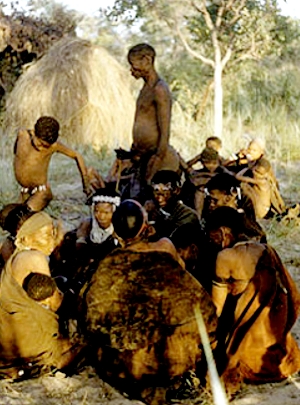
In hunter-gatherer times, people acquired an intuitive deep sense of who they were through a life-long coexistence with their tribe mates. That intimate experience naturally instilled a secure sense of self from infancy onward. Tribe mates among the hunter-gathers of the Kalahari exemplified this up until the middle of the last century.
The Marshall family, (google [Lorna Marshall]) lived among and wrote about the previously unstudied !Kung people of the Kalahari Desert beginning in 1950. This excerpt from daughter Elizabeth Marshall’s book (1), The Old way: A story of the first people, describes this secure tribal bond well.
“The [Ju/wasi] are extremely dependent emotionally on the sense of belonging and companionship,” wrote my mother. “Separation and loneliness are unendurable to them. I believe their wanting to belong and be near is actually visible in the way families cluster together in an encampment and in the way they sit huddled together, often touching someone, shoulder against shoulder, ankle across ankle. Security and comfort for them lie in their belonging to their group free from the threat of rejection and hostility.”(1)
I believe that the importance of the group showed clearly in the way that the people made decisions. Women were as much a part of this as men. The people would talk together, for days if necessary, until every point of view had been considered. Our notions of secret ballots and majority rule would have seemed unpleasant to them—they preferred consensus, with everyone knowing the thoughts and feelings of everyone else, and everyone pleased with the decision. Our notions of individuality would also have seemed inappropriate to the Ju/wasi—they expected to function as group members.
(1) Marshall, The !Kung of Nyae Nyae, p.287
Consider Lorna Marshall’s observation here, “Separation and loneliness are unendurable to them.” Undoubtedly, this human need for connection is innate and very deep. Our ancestors fulfilled that need naturally through an intimate experience shared in real time. The hierarchical nature of a civilized social system makes this “organic” kind of connection quite impossible. Of course, civilization offers many physical benefits unattainable for our ancestors, but what price have we paid for these benefits? (See The Tradeoff, p.549)
Civilization uses ideality; the old way uses reality
The sense of who we are as civilized people—our sense of self—is largely based on various idealistic narratives. These cultural stories tout archetypical characteristics that citizens are encouraged to model. These encompass religion, politics, sports, dress, diet, music, moral codes, and you name it! Which aspects, and how fervently we embrace them, depend mostly upon one’s inherited characteristics, upbringing, and cultural environment.
Naturally, some of this was also true for our ancestors living the old way. Nevertheless, the out-and-out simplicity and intimacy of the tribal experience offered its people a genuinely natural means of acquiring a secure sense of self. The disconnection from tribal identity required for civilization to function efficiently rules much of that out.
Optimizing Security and Comfort
Lorna Marshall also observed, “Security and comfort for them lie in their belonging to their group free from the threat of rejection and hostility”. Not surprisingly, maximizing security and comfort is also a core function of civilization—its raison d’être, I would say.
Optimizing security and comfort is a core focus for all other animals too. Consequently, animals have evolved a range of abilities to detect environmental changes and respond fittingly. They accomplish this “career” via a visceral sense of wariness (3), which makes them ultra-sensitive to the unknown in general and to potential dangers in particular. Naturally, this is much more noticeable in wild animals than domesticated ones, like our pets, our livestock, and ourselves.
Civilization, and its ancillary domestication, offers our animals and us a safer and more comfortable world—overall. That is its promise and without question, civilization has fulfilled that promise extraordinarily well, at least on the material level. However, this benefit comes with the loss of the deep organic sense of security and comfort that Lorna Marshall observed among the !Kung hunger-gatherers.
So, what can be done about this?
Obviously, nothing can be done about this directly… even if we wanted to. More to the point, who would be willing or even able to give up the material benefits civilization offers? The survival instinct pulls on us constantly to optimize our own comfort and security. Like any benefit generally, ‘more is better’ is what our biology tells us. What can withstand the insistence of this instinct? Fortunately, chapter 29 offers one way to approach this dilemma, at least in one’s personal life:
With our hunger for progress controlling most every facet of life, I assume chapter 29 is not music to many ears. There have certainly been many attempts throughout history to turn civilization’s clock back, and all failed… naturally! Aren’t the Islamic fanatics attempting that now? We attempt to solve the inherent problems civilization creates by either turning the clock back or pushing for an idealized “progressive” future. For the progressive side of this coin, socialism comes to mind.
We need a Twelve Step program
As a species, we have not even recognized our core problem. To put this in terms of the first step of the 12-step program of Alcoholics Anonymous:
- We admit we were powerless over “our addiction to comfort and security” — that our lives had become unmanageable.
Like any addiction, we always try to solve the problems inherent to civilization with more of the same. In steadfast denial, we think we can have it both ways. That won’t change until we are courageous enough to take this first step.
Naturally, accepting the reality of our situation won’t turn the clock back, but it may stabilize it and put the brakes on our clock’s fast-forward to some extent. If nothing else, such self-honesty should favor a greater natural conformity, and therein find a deeper peace of mind. Chapter 65 sums it up…
Right Comprehension…
Taking this first step, “we admit we are powerless over…”, corresponds to the first step of Buddha’s eight fold path—Right Comprehension. The reason we can’t admit we are powerless is because we are blinded by what we desire to see. If nothing else, Right Comprehension comes down to impartially observing life without a sugar coated ‘power of positive thinking’… or negative thinking, for that matter. That’s a tall order, for what we need or fear to see, strongly influences how-and-what we think we are seeing. It’s a real conundrum.
Buddha’s Noble Truths can be a practical way to tackle all of this. For instance, his Second Truth, p.604, directly links to the sense of who we are as civilized people, and the cultural narratives we are encouraged to embrace and model.
(1) Google [Marshall, The !Kung of Nyae Nyae].
(2) For an outside-the-box look at our cognitive ability, see Counterbalancing I.Q. (p.372), Think what you believe? Believe what you think? (p.37), and The Story Trumps Truth (p.167).
(3) Wariness is an offshoot of fear. I assume my use of the word “fear” often fails to elucidate the particular point I’m making at the time. Many people probably picture the word fear as an effect, as in panic or horror. It helps instead to consider fear as the cause of these reactions. Correlations can also help put the word fear (as I use it) into context. For example, fear correlates with: uncertainty ~ unknown ~ hidden ~ shadows ~ dark ~ silent ~ empty ~ death ~ loss ~ nothing ~insecurity… and entropy obviously. In other words, I use the word fear to sum up some dimensions of what is an inexplicable realm that haunts all living creatures as they strive to survive.
It is best to consider this realm as a fear-instinct. It lies at the core of experience for all life. How it manifests itself is as varied as life itself. Indeed, its branches spread out in myriad ways, often unrecognizable as being a result of fear—at least at first glance. It is necessary to ponder carefully what you see on the surface and reverse engineer until you see its fear-instinct origin. (See also Fear & Need Born in Nothing, p.486)