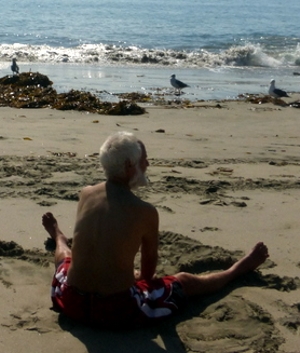
 I enjoy doing yoga on the beach because I can easily pause to look seaward and skyward to soak in eternity, or glance closer in to bond with my friends, all the sand flies and seagulls around me. Today I got to thinking how small and insignificant we are—they and me. Then I thought, they don’t know they are small and insignificant, but I do. All humans do. This apprehension of our own insignificance drives us to bolster our self-image any way we can. Guided by a symptoms point of view, this led me to an epiphany regarding the collective knowledge and cultural stories we hold dear and share.
Our Cognitive Placebo
Among the great ape species, we are among the most social. For us though, our ‘we don’t know’ cognitive insecurity pulls us even closer together. We use each other to tell, or listen to, our collective knowledge and story… from the most mundane to those of wondrous spiritual transcendence. The Bible’s account of God creating us in his image exemplifies this, as do creation myths from every other culture… even hunter-gatherer cultures.(1)
Human story telling is a kind of placebo that enables us to feel that we actually do know at least something, at least for a few moments. Because stories are merely figments of our imagination, we need to keep retelling them to maintain their illusion of truth. This gives even more meaning to chapter 56’s Knowing doesn’t speak; speaking doesn’t know. In other words, the deeper we feel this ‘we don’t know’ insecurity, the more important stories that offer us a sense of certainty feel. Simply put, we buy into the story that eases our uncertainty the most (2).
Knowing doesn’t speak;
Conversely, speaking doesn’t know. Certainly, speaking must also include thinking and writing. How about, ‘Thinking, speaking, and writing don’t know’. Now, that exposes one reason why I think and write. I am simply refreshing the story continually to keep it real. I am also working it out as I go along, stumbling upon new connections… observations of various parts of the elephant (3), so to speak (google [Blind men and the elephant] parable). You could say that my speaking, writing, and thinking are symptoms of my innate ignorance. On the other hand, “Out of the mouths of babes” exists at that ignorant edge of knowing. I suspect this means that only in the fog of not knowing can a lucid moment of knowing occur. At times, I suppose something useful comes into view, or at least I like to think so.
Frankly, chapter 56’s Knowing doesn’t speak; speaking doesn’t know has challenged and intrigued me ever since I stumbled upon the Tao Te Ching in 1964, ironically at a US Army BX in Vietnam. It’s challenging because it flies in the face of what my ego yearns to hear… “Carl, you’re brilliant”. Fortunately, life gradually whittled away enough of my illusion of self (ego) for me to face my ignorance. Yes, just as chapter 40 says,
Raison d’être (4) relentlessly seeks ‘more and more’
We need to keep retelling our most meaningful story to keep it real because we are biologically incapable of remaining emotionally still and continuously appreciating life… including the most profound experiences and realizations. Essentially, a sense of appreciation for anything is a very weak and fleeting experience. We always quickly return to feeling our cup half empty to one degree or another. Appreciation only serves to weaken urges that drive survival, at least in the long-term. Indeed, survival necessity underpins every facet of life at some level.
This biological imperative (5) keeps all living creatures, including humans, on the lookout for ‘more and more’. The fear of not having enough always lurks in the background of awareness. Entropy shadows life’s every move constantly and forms the foundation for primal insecurity. This produces the fear of loss and the unknown that drives all life.
Naturally, this seeking ‘more and more’ imperative of life balances out well in the wild. This is not the case for thinking and civilized animals like ourselves. We cleverly augment the pleasurable and shield ourselves from nature’s wild unknown and less benevolent characteristics. In so doing, life becomes increasingly synthetic and imbalanced. As chapter 18 suggests, When intelligence increases, there exists great falseness.
We partly compensate for our imbalanced relationship with nature by prioritizing life’s issues in degrees of importance, a.k.a. doing our duty. As Buddha advised, “There is salvation for him whose self disappears before truth, whose will is bent on what he ought to do, whose sole desire is the performance of his duty”.
Truth, no matter how profoundly felt, soon fades from view… alas, entropy rules. To maintain focus, we must constantly refresh our memory to recall our priorities — our truth. (See also Refreshing Redundancy, p.535) In reality, thinking, speaking, and writing don’t know, so we think and speak to remember what we know, or search and ponder the unknown in order to know, and ultimately, to know that we don’t know — I call this ‘cognitive hunting and gathering’ for the human animal.
Up from the ocean of emotion
In our heart of hearts, we know that we don’t know. Maintaining a hierarchy of knowledge is one cornerstone of civilization that helps us avoid facing that stark reality… “I don’t know, but at least the expert knows”. Isn’t the core view presented in the Tao Te Ching seeking to point this out? Chapter after chapter pokes holes in our reliance on knowledge, thinking, speaking, and still deeper down, their cause — words and names. Knowledge builds itself upon the foundation of names and words. Belief in them is prerequisite to knowledge.
Consider how, from childhood onward, we use words to define words. After a few decades, we end up with our “true” stories as we enter adulthood. Each story along our way through life helps to define word meaning further. Truth is, all this rests on a shifting foundation of emotion. Thought, and any subsequent knowing, arises from our ocean of emotion and the meaning those emotions lend to words. Indeed, a word’s meaning actually lies in the emotion that the word evokes. Deep down this leaves us all cognitively insecure with a bottom-line intuitive sense that we don’t truly know. (See Correlations. p.565, for a deeper look into words.)
You could say we don’t know that we don’t know… and we intuitively know that. I call this a visceral intuitive knowing because it bubbles up from emotional sources. That is not to say it bubbles up and informs thought, per se. More likely, it leaves us with an uneasy empty sense that can drive us to fill up mind space, usually with a believable story that confers context to the strongest emotion we currently feel. This all operates in a cycle, with each feeding back and reinforcing the other: feeling (emotion) kindles thought; thought induces emotion; and so on… It can get crazy.
Intuitive knowing is practical too
Fortunately, intuitive knowing also bubbles up and drives action! I’ve found that when I intuitively know, I have no choice but to act accordingly. It happens naturally and without intention or effort. Frankly, I don’t know if this kind of knowing actually counts as knowing — it goes deeper than that. Certainly, it doesn’t count as knowledge! Actions do speak louder than thinking and speaking, which is where knowledge manifests itself. Still, there are no cut and dry lines here either because knowing, by whatever definition, is itself a gradual and layered process. We gradually grasp various parts of the elephant as the years pass, and knowing deepens until one day — poof! Realizing I don’t’ know is better; not knowing this knowing is disease. Then, as I said at the beginning of this post, I can more “easily pause to look seaward and skyward to soak in eternity or closer in to bond with my friends, the sand flies and seagulls around me”. Open-ended ignorance, unencumbered by belief places universal connection within my mind’s reach! Indeed, perhaps infinite ignorance = infinite knowing.
Who are You? (part 6)
I suppose this post is actually the final post in the Who are You? series. It strikes at the heart of the human cognitive problem so it applies to civilized and hunter-gatherer alike. While I’ve drawn out the differences between our ancestors and civilized people in this series, I need to restate an essential point: Differences are relative and therefore illusionary. Profound sameness holds deeper truth, or if not that, at least serves as a fine palliative for ignorance. Noticing similarities brings the mind closer to what Buddha called, “Right State of Peaceful Mind”.
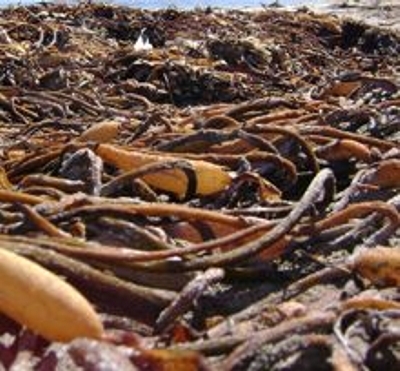
seaweed is sand fly heaven!
Alas, our visceral sense that we all know we don’t know makes this “Right State of Peaceful Mind” ephemeral. This is mainly due to our need to know, to be certain, and to nail down reality. If you are observant, you’ll notice how natural it is to judge differences, whether between “this” vs. “that” or between “us” vs. “them”. It is part of our biology. We just do it in various ways and to various extents. Emphasizing “us” or “this” and marginalizing “them” or “that” offers the enticing sense of certainty, both for ourselves and our group-identity. Note: Deepest down, however, “this vs. that” is what makes thinking, speaking, and writing possible as well. Sigh… it always ends up in profound sameness, which makes writing on this subject matter a quixotic affair… yet still I write!
The Old Way vs. Civilization?
Sometimes my “Who are You” series ( I to V ) may seem like I am marginalizing civilization, pitting “us” vs. “them” … ‘civilization’ vs. ‘the old way’.
Actually, rather than marginalizing civilization, I’m un-marginalizing our hunter-gatherer ancestors. I’m pointing out that, rather than being a boon to humanity, civilization is a root cause of the pressing problems civilized humanity now faces. Still, I’m not suggesting we abandon civilization, even if we could. I’m not even saying were ever going to be able to do anything about the unintended consequences of civilization. However, honestly facing the truth of our journey from the old way to the present may offer a roadmap towards mitigation of some issues.
We are ‘them’. I feel that knowing who we are organically and originally (long-term view) affords perspective on who we think we are now (short-term view). Sticking our head in the sand, touting the advantages of civilization only ensures being stuck in the status quo. The advent of the Agricultural Revolution and civilization are simply the two steps forward, one step backward progression of evolution. Now the advent of the Electricity Revolution has set humanity up to take another few steps forward, and naturally another step backward as well.
Finally, here are a few chapters that point out the shadows of knowing…
The multitude all explain with their knowledge;
The wise person, each and every child. #49
Our words are very easy to know, very easy to do.
Under heaven none can know, none can do. #70
Speaking of nothingness…
(1) This cognitive insecurity began perhaps a million years ago when hunter-gather Eve ate the apple. It just became more problematic when we traded our ancestral way of life for the benefits of agriculture and the hierarchical social infrastructure — civilization — that agriculture requires.
(2) Naturally, this also must apply to the storyteller… meaning, anything I say or write. The fact that I offer my thoughts as observations, hypothetical and not truths carved in stone, suggests that insecurity is not driving me much. An instinct to socially connect and help drives me more.
(3) Making connections between conflicting points of view increases self-honesty and reduces hypocrisy! (See What is Not the Elephant?, p.293) Indeed, my ability to see more of the whole elephant makes describing the view less feasible. It becomes simply too broad to pin down in words and so silence becomes the better description.
Perhaps chapter 56 should read, Knowing can’t speak; speaking can’t know, instead of, Knowing doesn’t speak; speaking doesn’t know. So-called Enlightenment can’t help but keep its mouth shut. Naturally too, this means we could never know anyone truly enlightened… there would be no evidence — silence can’t count as evidence. That seems a little ironic to me. It also suggests that enlightenment is a story closely tied to the illusion of self and free will. (See, A How-To for Extinguishing Self, p.88; Is Enlightenment Something or ???, p.24; and So, You Want Enlightenment, Eh?, p.174)
(4) Raison d’être is a French expression commonly used in English, meaning “reason for being” or “reason to be”. It is the thing that is most important to someone—the reason for which a person or organization exists. Why do the words raison d’être feel like they capture the existential question best? It goes to show how words and emotions are so intimately connected. For me, “raison d’être” nails it much better than “reason for being”, although certainly not for any rational reason.
(5) A devil’s advocate would say, “Hold on, the biological imperative is just a science story, and many people don’t buy such stories, e.g., climate warming, evolution”. Okay, I agree in principle. However, the science story relies on the rigorous examination of empirical evidence, which at least helps us avoid rash actions. As chapter 16 reminds us, Not knowing the constant, rash actions lead to ominous results.
Interestingly, Buddha’s truths are similar in that Buddha calls for verification by each person, i.e., don’t believe it until you prove it through your life’s experience. In science, the proof lies externally; for Buddha, the proof lies internally. (Actually, continuing discoveries in science support both Buddha’s and Taoist views. See for example, Science Proves Buddha Right!, p.483; Stressors of Comfort and Security, p.498; Don’t trust anyone under 60, p.193; Reward, Fear & Need, p.181; Mind Over Milkshake, p.440; The Proof is in the Pudding, p.408.)