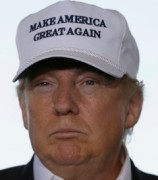
 To better comprehend the Trump phenomenon, I need to examine it from a symptoms point of view (1). Simply judging circumstances at face value leaves out all the underlying causative forces at play, and this just perpetuates my ignorance. First, Trump is symptomatic of the deterioration of the cooperative politics essential for maintaining a stable civilization. Compromise has fallen out of favor in recent decades as each side vilifies the other. Secondly, economic dysfunction must also accounts for much of this political instability.
The need for political stability has been critical ever since we gave up hunter gathering ways for agriculture and the civilized ways that make agriculture possible. Civilization is a man-made social scheme for managing the larger populations that settled agriculture requires … a task the egalitarian nature of hunter-gatherer ways couldn’t manage. (See The Tradeoff, p.549)
Civilization, unlike the hunter-gatherer way, has a predominantly hierarchical structure. This pyramidal form has a broad base of ‘worker bees’ ascending upward to the narrower top strata of the ‘queen bee’. When there is sufficient faith and cooperation between the strata, the hierarchy has the Mandate of Heaven, as the ancient Chinese put it. When top and base lose trust in each other, the status quo crumbles and the ruling class top loses the Mandate of Heaven. Nothing disturbs this status quo more than economic dysfunction. In a hierarchical structure, responsibility for this rests on the ruling class, the top. You know… “The buck stops there”.
The Mandate of Heaven in democratic civilizations is more multifaceted. On the surface, the top are still the politicians — left and right! However, when the Mandate is lost, it is not only that the top and base are at odds with each other; there are also large schisms in the base. This makes compromise between politicians at the top less possible. After all, they take their cues from the base. Each faction believes it knows best… A disease chapter 71 warns us of, Realizing I don’t’ know is better; not knowing this knowing is disease. What a mess! See also, Democracy as Myth, p.177.
Not knowing this knowing augments natural ignorance
Natural ignorance is the ignorance of not knowing the future. This plays a role in maintaining life’s ebb and flow. For example, the fortunes of a species will switch from surplus to scarcity when that species overeats; it will then suffer as circumstances rebalance. This is true, from a virus so aggressive that it decimates its host enough to threaten its survival, up to the fishermen that decimate their fisheries.
The disease chapter 71 points out exacerbates this innate natural ignorance in our species. This disease allows us to think that we know what we know! That certainty dissipates an innate the fear of the unknown, which gives us a false sense of security. Chapter 16’s Not knowing the constant, rash actions lead to ominous results suggests the results of such widespread blindness.
We’re now in the Anthropocene. (i.e. the current geological age beginning around 1700, and viewed as the period during which human activity began being a dominant influence in nature). The exponential technological advances occurring during this time greatly increase the role innate ignorance and our disease play in human destiny. The Great Depression, Hitler and WWII, global warming, nuclear bombs, the Cold War, Vietnam War, Iraq War, invasive species, and drug use, quickly come to mind. Fortunately, increasing human longevity should offset this somewhat—long-term anyway. (See Don’t trust anyone under 60, p.193; And Then There Was Fire, p.296; Counterbalancing I.Q., p.372; and The Trade Off, p.549, for more good news.)
Back to the Mandate of Heaven

Tribal instincts impel us to align ourselves to a group. This ties in with Buddha’s point, “The illusion of self originates and manifests itself in a cleaving to things”. In “cleaving” to our tribe, we bolster our self-identity. Moreover, the more insecure we feel, the more we “cleave” to some ideal, person, or thing to safeguard “the illusion of self”.
“Cleaving to things” is only problematic in civilization. Civilization is actually an assemblage of numerous sub-tribes, e.g., sports, occupations, arts, religions, politics, etc. When people align themselves intensely with their sub-tribe, competitive instincts surge, and relationships to people not in their tribe suffer. Indeed, history abounds with examples of such competition gone wild!

Politics is the glue that holds a civilization’s sub-tribes together. For us, this is the Yin and Yang of a two party system — Democrat and Republican. Picture that classic Yin Yang symbol; each side is connected to its opposite, and indeed revolves toward that opposite side. In life, when someone becomes utterly attached to one side of anything they lose their Mandate of Heaven, as it were. Unbalance follows naturally along with forces that help recover balance.
Revolution and war have historically been the main way civilization rebalances economic dysfunction and the ensuing political imbalances. America has had a few rebalancing episodes already — the Revolutionary War and the Civil War. Let’s hope the Trump phenomenon is a sufficient wake-up call to nudge Democrats, Republicans and everyone else in between back to political sanity. Alas, much of that hinges on economic realities. It feels like a vicious circle; economic dysfunction causes political dysfunction, and political dysfunction does nothing to resolve economic dysfunction. Again, a mess made worse because the underlying dynamics are more profound than we can fully comprehend. Nature is in charge.
Economics and survival; survival and nature
The Mandate of Heaven metaphorically addresses primal economic influences. For example, the fall of Rome and its economic instability opened the door for Christianity; the economic disaster of post WWI Germany opened the door to Nazi ideology. Economic realities probably opened the door for a Donald Trump and a Bernie Sanders too. Indeed, Trump and Bernie embody the fears and frustrations spawned by the shifting sands of global economics overall. Clearly, the recent Great Recession aggravated all this… A Great Recession brought about by rash behavior, as chapter 16 warned … rash actions lead to ominous results. Economics is survival; survival is nature. The idea of a heavenly mandate is simply a poetic way of speaking to natural processes (2).
In the 25 years following World War II, household real income doubled. From 1975 to 2000 it remained fairly level, and for the last 15 years it’s been dropping. Of course, expectations play a outsized role in economic perceptions. The post WWII quarter-century boom set the stage for the current American Dream. The last 15 years have seriously threatened that dream.
Our ancestral economy was essentially hunting and gathering. It was the business of survival. The Agricultural Revolution produced large populations participating in an economy that was more complex. That meant replacing the hunter-gatherer’s egalitarian social structure with a more hierarchical structure; populations were too large to hold together naturally. That necessity created civilization. In civilization’s hierarchical social structure, religion and then politics arose to keep society and its people on the same page, so to speak.
No matter how far removed we civilized people become from our hunter-gatherer origins, the economy of survival is still the bottom line. As a result, economic dysfunction lies at the heart of all social ills and political disruption, as history clearly shows.
The socioeconomic disruption of the 21st and late 20th century is profound, with the computer at the heart of this change. Unsurprisingly, politics is simply reflecting this rapid and profound technological disruption. We are readjusting ourselves to a new socioeconomic reality. Incidentally, next up will be religion as it struggles to adapt to humanity’s evolving post-computer paradigm. Indeed, I assume this is already under way.
In our 2016 election, it was rational that the population would elect “businessman” Trump to fix the economy. Judging from Trump’s history, he is not an ideologue… far from it. Therefore, his beliefs don’t dictate his decisions. With an ego as dominant as his, and not being an ideologue, I’d imagine whatever makes him come off looking good will guide his decisions in the end. Right now, he yearns to look great to his base. If we’re lucky, he’ll eventually yearn for wider acclaim. A pragmatic self-interested ego driving one’s life is often saner and safer than an ideology-based ego driving one’s life, e.g., Hitler, Mao, Osama bin Laden. Unfortunately, Trump’s apparently profound ignorance of science, history, and global politics may dominate instead. Trump’s massive ego arising from a deep underlying insecurity must also complicate any path to success.
Nevertheless, who would you rather have dealing with economic dysfunction, an idealist or an ostensible realist? Bernie or Trump? In a way, this may be like the dysfunction in Russia when it shifted out of the Tsar – serf paradigm. The ideologues Marx and Lenin won the day, yet failed in the end, given that their solutions were based in idealism not on any socioeconomic survival reality of nature. Yes, Bernie is no Marx, but he is an ideologue. Chapter 55’s That which is not of the way ends early probably applies to both these men.
However all this ends, it does seem to have started out as one of the most practical political readjustments in history. It is just unfortunate that it wasn’t a wiser and more competent businessperson running for President. C’est la vie!
In the end, who wins the election doesn’t matter. Rebalance is the name of this game, and for that to happen, economic expectations have to line up to reality… whatever that reality turns out to be. The democracy that we know is merely a natural result of long-term economic realities that arose after, let’s say, Columbus’s discovery of America (just to keep it simple). Now the general population appears to be losing faith in this form of government. That could portend the entire governing system losing its Mandate of Heaven — goodbye democracy, hello what?
Trump and Truthiness (Google [ Truthiness] and [Drinking the Kool-aid].)
Trump’s crackpot assertions are an example of ‘truthiness’! His viewpoints come ‘from the gut’, without evidence or intellectual examination. It’s interesting how belief ties into the more bizarre aspects of Trump’s views. Trump is not a nuanced thinker, nor does he bother verifying the facts. He seizes on what feels like reality to him, believes it, and stubbornly holds his ground despite provable facts to the contrary.
I guess that belief + ego accounts for this. (See Belief: Are We Just Fooling Ourselves? p.591 and Cultivating Ego, p.473) His ego won’t permit him to back down, and in believing he is right provides him rational support for standing his ground. His belief produces his sense of truth; and that ‘truthiness’ verifies his belief — it’s a vicious circle. The fact that he is eccentric in his views hopefully leaves fewer people actually sharing his wackiest beliefs, e.g., millions vote fraudulently, thousands of Muslims celebrated 911 in New Jersey, Obama isn’t a US citizen, to name a few. Of course, this assumes that he actually believes what he says and is not just hoodwinking his followers. Probably it’s a bit of both. He’s serving up ‘Kool-Aid’ for others and drinking the ‘Kool-Aid’ too.
Even so, the same blindness of belief can be seen everywhere. It just doesn’t stand out when millions of people share the same wacky point-of-view. This is especially true of religions. Here, Trump is holding fast to a ‘religion of one’ — his ego. Perhaps it takes a ‘religion of one’ personality to stir up the status quo enough to instigate a cultural revolution.
Back toward a lighter side of this…
Trump could be inadvertently rebooting the Republican Party. Let’s not forget chapter 65, Of ancients adept in the way, none ever use it to enlighten people, They will use it in order to fool them (3). Okay, I’m being facetious. I am not saying that Trump is adept in the way! Yet, he is adept adept in the way of being Trump!
The honest way to view this is that Trump is without free will. Like all of us, he is a result of his genetics and his circumstances, which since the Agricultural Revolution are the circumstances of a hierarchical social system — civilization.
Many value Trump’s blunt style. From a symptoms point of view, that tells me the political pendulum has swung too far towards political correctness. In addition, people feel government doesn’t work. Essentially, many of his supporters are buying his simplistic answers to the complex cultural transformation brought on by the Electricity Revolution. (See The Good Old Days, p.459; and The Tradeoff, p.549, for more on this tectonic shift, the Anthropocene.)
There is a natural utility in offering simplistic answers to irresolvable issues. History shows that no one truly knows what they are doing, or how the future will unfold. Humanity makes it up as it goes along. However, people fear uncertainty and crave answers, yet there is no truly reliable answer. If no answer suffices, the simplest wrong answer is the most palatable, which is why we see no shortage of those. Whatever the case, this dynasty of democracy requires two stable parties with an economy that reflects people’s expectations (or vice versa) to retain its Mandate of Heaven. Only when we share a common ground of expectations— the simplest wrong answers—can we stumble along together somewhat amicably.
The ‘information age’ and its social aftermath
The Internet and social media—the ‘information age’—allows people to see through the political simplest wrong answer. Such political trickery is somewhat necessary when trying to unite a less connected society, which really amounts to civilization overall. Again, Of ancients adept in the way, none ever use it to enlighten people, They will use it in order to fool them. Being less fooled may sound great on the surface. However, few people can handle the reality chapter 5 reveals: The universe is not benevolent, and all things serve as grass dogs. On the other hand, our ancestors who lived intimately connected to nature would have intuitively known that. So naturally, chapter 65 isn’t referring to ancestral hunter-gatherer people.
Conspiracy theories unite the disillusioned
Does Trump really believe the conspiracies he spreads? Who knows? Considering why people adopt conspiracy theories offers a deeper look at the current era. In stable “normal” times, the widely accepted cultural story supports people’s sense of self, which in turn unites the population. In these unstable times (see The Year Is 1915) the common cultural story begins to lose its ability to anchor many people’s sense of self and collective unity. In such cases, those people will be strongly attracted to conspiracy theories that are new and interesting, shallow as they are. Adopting a conspiracy as a core belief strengthens a person’s self of self and of brotherhood with fellow believers. This is why it is so difficult to convince them of the fallacy of the conspiracy story.
UPDATE 2020 The Trump era helps reveal religion and democracy (or any political framework) for the facade they are. These cultural dynamics all react via ‘the end justifies the means’ impulses when push comes to shove. Fear always overrides our idealistic wishes. Simply put, civilization needs such cultural contrivances to give large populations faith in the social order. The only alternative ‘solution’ for an individual is to conform to nature… Nature everlasting as chapter 7 puts it. As chapter 65 says, To the outside world, contrary indeed. Then, and only then, reaching great conformity.
It’s helpful to view Trump’s Presidency as merely a natural disaster. This is no different from an earthquake or hurricane shaking things up. Neither, these events nor Trump knows what they are doing. Naturally, this only rings true if you accept the fact that neither these nor we have free will… despite our sincere longing to the contrary. Chapter 72 observes, When the people don’t fear power, Normally great power arrives. Trump is simply nature’s way of saying, “Wake up”.
UPDATE 2022: The Trump era offers solid evidence for my post The Story Trumps Truth, p.167. This phenomenon appear to have finally forced me to totally accept human nature’s reality over my lingering ideals. Clearly, we are emotional animals and believe anything that supports our needs and fears—period.
UPDATE 2025: Interestingly, Trump has been reelected. We all know by now how well he lies, cheats, and avoids taking responsibility. Nonetheless, this is completely in accord with nature, despite the cultural—ethical and moral—ideals that we believe in and hold dear. For evidence, see Skullduggery is rampant in nature. Will the country wake up after four more years of Trump? If I’m still alive by then I’ll insert an “UPDATE 2028”.
(1) Comprehension is far more subtle than learning. We learn our worldview and its biases from the stories we hear from infancy. “Right Comprehension”, as Buddha called it, is the cognitive journey to impartiality. As chapter 16 suggests… Knowing the constant allows, allowing therefore impartial. Bringing a symptoms point of view (p.141) to everything I ponder makes impartiality more feasible.
We begin in ignorance and learn enough to think that we know. After that, we either cling to that learning, or ponder life more deeply. Which path one travels is not a matter of free choice, but rather of fear. Insecurity pins us down in our cultural paradigm.
(2) Looking back further in time, we can see how the advent of the Iron Age was a catalyst for the main religions of today. Looking back even further, we see how the advent of agriculture itself brought about civilized ways of life we have followed for some 10,000 years now.
Civilization is an evolving cultural organism, but our stake in it blinds us to the overall process. Emotion drives us to blame or praise others for the circumstances we hate or love. Our lifetime and its affairs cripple any deeper sense of time. Think of how long it takes a species to evolve to its current condition through natural selection. Why would the cultural evolution of civilization be any different? Obviously, evolution of civilization is not biological evolution, at least on the surface. However, as an emergent property it certainly is just that! You could say we are merely cells in the meta-organism of civilization.
(3) To fully understand what this means, it should help to think of this in context of the bio hoodwink (p.11, 100).