Part 1 of 7 — Wired for Disconnection
 Something has been troubling our species for a very long time — far longer than history records, and far longer than civilization has existed to take the blame. We can see the evidence in the oldest art ever made.
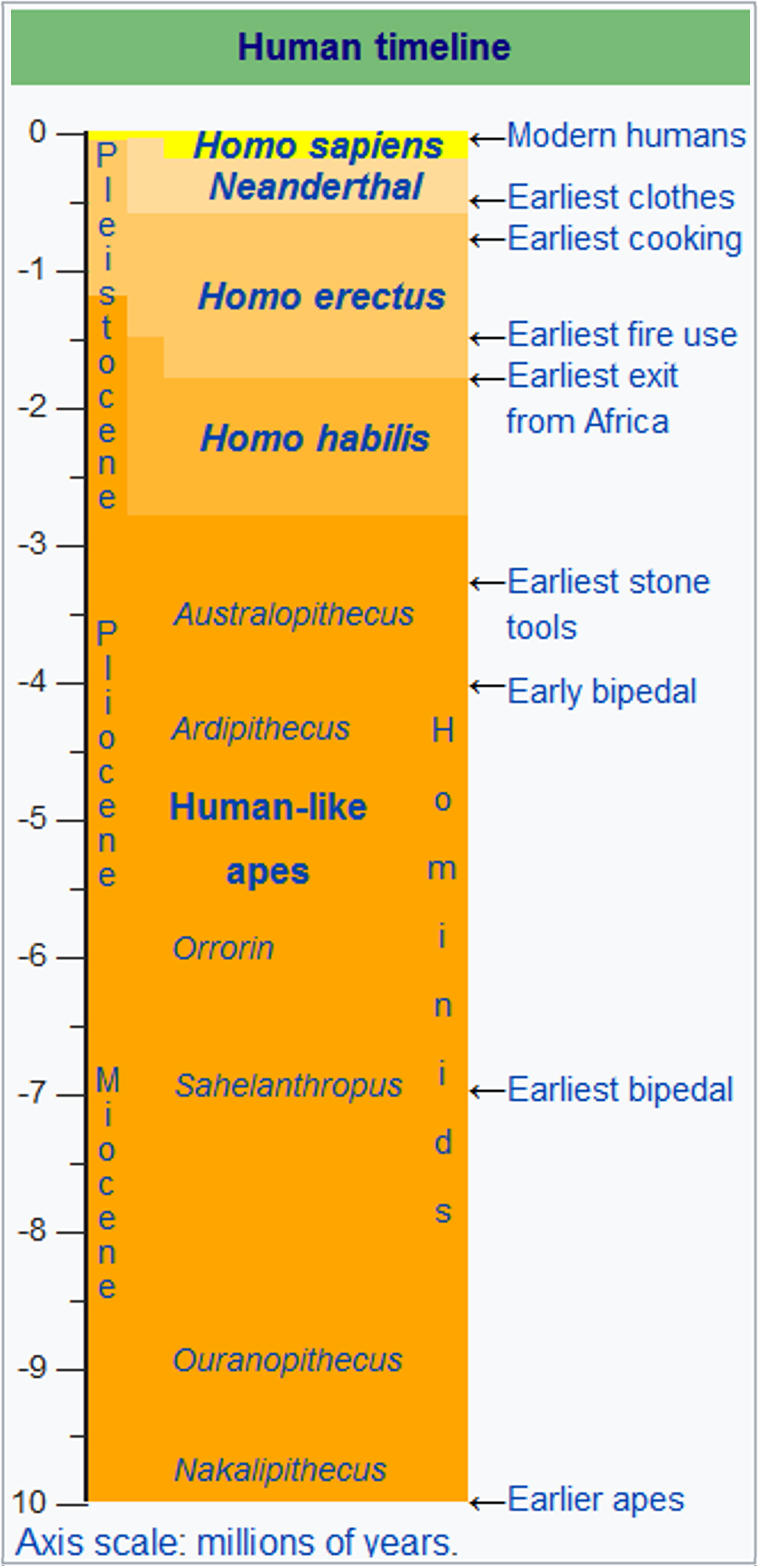
Between 2.5 million and 200,000 years ago, during the Lower Paleolithic era, our hominid ancestors — some now extinct, some direct predecessors of modern humans — began leaving marks. Carved ochre. Shaped stones. Then, more recently, the breathtaking cave paintings of Lascaux and Altamira, made by our own species. What drove this? What restlessness, what need, produced it?
One straightforward hypothesis is that prehistoric art, music, and ritual were symptoms of deeper cognitive adaptations. They were the outward expression of an inward problem that was just beginning to take shape in the evolving human mind: the dawning sense of being separate — from nature, from the whole, from whatever you want to call the seamless reality that existed before a mind evolved to divide its perceived world to enhance survival — and the tradeoff begins.
The mind that made the first painting was already a mind in trouble, experiencing cognitive stress from its perceptual disconnection from nature. Art was the mind’s way to soothe over its sense of disconnection.
The ON/OFF Problem
Every thought you have is built on a biological foundation that is, at its core, binary.
Neurons fire or they don’t. The electrochemical signals that constitute all perception, all memory, all feeling, all cognition — they are ON or OFF. This is not a limitation unique to humans; it is the operating system of all nervous systems, from a worm to a whale. But humans, with our vastly complex brains, have taken this binary biology to a place no other species has reached: complex name-based language.
Language grows directly from the ON/OFF nature of neural firing. To name something is to distinguish it from everything else — to say, in effect, this is ON, everything else is OFF. The word “tree” fires a category into existence and simultaneously creates its boundary. What’s inside the boundary is tree. What’s outside is not-tree.
This seems harmless, and it is certainly profoundly useful — up to a point. The ability to categorize, name, and communicate about the world is one of our greatest evolutionary advantages. But it comes with a hidden cost that compounds over time.
The moment you name something, you have split reality. Tree implies not-tree. Beautiful implies ugly. Good implies evil. Self implies other. Life implies death. These polar pairs feel like factual observations about the world, but they are actually artifacts of the mind doing the observing. Nature itself contains no such clean divisions. A forest doesn’t know where “tree” ends and “not-tree” begins. The categories are ours — what Paul Dirac, one of the founders of quantum mechanics, called “irrelevancies” that we introduce when we try to form a mental picture of reality.
In The Principles of Quantum Mechanics (1930), Dirac put it plainly: nature’s fundamental laws “do not govern the world as it appears in our mental picture in any direct way, but instead they control a substratum of which we cannot form a mental picture without introducing irrelevancies.” He was describing quantum physics, but he was also, without knowing it, restating something the Tao Te Ching had been saying for 2,500 years. Chapter 1: The way possible to think runs counter to the constant way.
To lessen the hold our “introduced irrelevancies” have on our mind, Chapter 71 advises: Realizing I don’t know is better; not knowing this knowing is disease. The “disease” is not ignorance. It is the opposite: the unshakeable certainty that our mental categories describe reality as it actually is. The irrelevancies we introduce feel real — more real, often, than the seamless world they replaced.
Subject Meets Object
Perhaps the deepest irrelevancy that language introduces is the one closest to home: the self.
When the human mind became capable of subject-versus-object perception — when some ancestor first experienced not just the world, but themselves experiencing the world — something irreversible happened. A boundary was drawn between self and everything else. The subject stood on one side; the object, all of nature, stood on the other.
This is the root of what Dirac calls the “introduced irrelevancy” and what Buddha called the “illusion of self.” Not that an innate sense of self, of agency, doesn’t exist in the practical sense — clearly it does in many, if not all, living things. But the sense of being a separate imagined self, sealed off from the rest of existence by the boundaries that language and imagination draw, creates a persistent background anxiety that no amount of experience or achievement can fully quiet. We feel cut off from something we can’t quite name. Enter art. Enter music. Enter spirituality.
The Paleolithic cave painter wasn’t simply decorating. The drummer in a prehistoric ceremony wasn’t simply entertaining. These were — and still are — attempts to dissolve the boundary for a moment, to feel the connection that the naming mind perpetually disrupts. The artist loses herself in the work. The dancer loses himself in the rhythm. For a moment, subject and object merge, and the background hum of disconnection goes quiet.
This tells us something important: the need to reconnect is as old as the capacity for disconnection. They arrived together. Art and existential anxiety are twins, born of the same cognitive leap.
The Sanskrit phrase Tat Tvam Asi — “Thou art that” — names this ancient intuition directly. You are not separate from what you observe. The boundary the naming mind draws between self and world is, from a deeper angle, an artifact. The Tao Te Ching’s chapter 56 points at the same thing: Knowing doesn’t speak; speaking doesn’t know. Subdue its sharpness, untie its tangles. Soften its brightness, be the same as dust. This is called profound sameness. Not a mystical claim. A description of what remains when the introduced irrelevancies are set aside.
How Our Ancestors Coped
Here is the crucial point, and it is easy to miss: our hominid ancestors had this problem, and they managed it.
Archaeological and anthropological evidence suggests that the deeply egalitarian social structure of hunter-gatherer life served as a natural counterbalance to the disconnection that language creates. Hunter-gatherer societies were not perfectly egalitarian — differences in skill and influence certainly existed. But strong cultural norms prevented individuals from converting those advantages into lasting dominance. When survival depends on total mutual reliance — where everyone’s fate is tied to everyone else’s — hierarchy is kept modest by necessity. The naming mind still makes its cuts, but the social fabric stitches them back together.
Our ancestors coped. Not perfectly, not without suffering — but well enough, and for long enough, that the cognitive disconnect did not derail them. Then came the tradeoff.
When Coping Got Harder
About 15,000 years ago, the conditions that had allowed humans to manage the disconnection problem began to change — slowly at first, then with accelerating speed. The domestication of animals, then plants, then the advent of grain agriculture, then permanent settlement, then hierarchy, then specialization, then literacy, then industry, then the world we inhabit now.
Each step added a new layer of abstraction between the human animal and the physical reality it evolved to inhabit. Each layer introduced new “irrelevancies” — new categories, rankings, identities, and ideals to cleave to. Each layer made the original egalitarian counterbalance harder to maintain.
The cave painter’s disconnection was real, but it was cushioned by a social world that instinctively pushed back against it. The modern person’s disconnection is real, and it is amplified at every turn by a civilization built, layer upon layer, on the very dynamics — hierarchy, specialization, ownership, competition — that make the self feel most separate and most exposed.
The problem didn’t begin with civilization. But civilization, as we will see in the essays that follow, made it dramatically, structurally, and increasingly worse, despite our ongoing efforts to find connection.
Understanding where it began — in the binary flicker of a neuron, in the first word a hominid mind formed, in the earliest painting on a cave wall — is the first step toward understanding why life so often feels the way it does, and toward managing our place in the world we’ve made.
Next: Part 2 — What We Lost: the hunter-gatherer life that kept the disconnection problem in check, and what archaeology and anthropology tell us about what we gave up.
Part 2 of 7 — What We Lost
In Part 1 we saw that the cognitive split — the sense of being a separate self in a world of objects — is not civilization’s invention. It is older than agriculture, older than cities, older than writing. It is built into the architecture of a brain that perceives in polarities and names what it perceives.
But our ancestors had something we have largely lost. And without understanding what that was, the tradeoff at the heart of this series makes little sense.
Still Hunter-Gatherers
Here is something worth sitting with: we are still hunter-gatherers.
Not metaphorically — biologically. The DNA that drives our behavior today is essentially the same DNA that drove our ancestors through the African savanna 100,000 years ago. Evolution moves slowly. Culture moves fast. The mismatch between the two is where most of our trouble lives.
The most obvious civilized expression of hunter-gatherer instincts is shopping. But that only scratches the surface. In fact, nearly everything we do is either a direct expression or an offshoot of that primordial drive — the restless, scanning, seeking energy of an animal built to find what it needs before it runs out. This is why we instinctively feel that “more is better.”
We no longer hunt food, so we hunt meaning, status, connection, certainty, entertainment, love. The cup-half-empty feeling that drives a hunter to go out in the cold morning is the same feeling that drives us to refresh our phone, apply for a better job, redecorate the house, or reach for another piece of cake.
The drive itself is not the problem. The problem is that the greatly increased comfortable and secure world we’ve built no longer gives it a clean, honest outlet.
What Egalitarian Life Actually Provided
For most of human prehistory, the hunter-gatherer band was the entire social world a person inhabited. Typically 20 to 50 people. Everyone known since birth. Survival utterly dependent on cooperation. No surplus to hoard, no hierarchy to climb, no niche to defend.
This is not a romantic picture — life was physically hard, often dangerous, and short by our standards. But within that difficulty lived something our hyper-connected, chronically lonely civilization has almost no equivalent for: unconditional belonging.
Anthropologist Lorna Marshall spent years in the 1950s, 60s, and 70s living among the !Kung people of the Kalahari Desert — one of the last hunter-gatherer peoples studied before contact with the modern world irrevocably changed their way of life. What she found illuminates what we gave up with the tradeoff. From her book The !Kung of Nyae Nyae:
“The [Ju/wasi] are extremely dependent emotionally on the sense of belonging and companionship. Separation and loneliness are unendurable to them. I believe their wanting to belong and be near is actually visible in the way families cluster together in an encampment and in the way they sit huddled together, often touching someone, shoulder against shoulder, ankle across ankle. Security and comfort for them lie in their belonging to their group free from the threat of rejection and hostility.
I believe that the importance of the group showed clearly in the way that the people made decisions. Women were as much a part of this as men. The people would talk together, for days if necessary, until every point of view had been considered. Our notions of secret ballots and majority rule would have seemed unpleasant to them — they preferred consensus, with everyone knowing the thoughts and feelings of everyone else, and everyone pleased with the decision. Our notions of individuality would also have seemed inappropriate to the Ju/wasi — they expected to function as group members.”
Read that again slowly. Separation and loneliness are unendurable. Not uncomfortable — unendurable. This was not weakness; it was the honest expression of a social animal living in the conditions it evolved for, where isolation genuinely meant death.
The !Kung also had no warrior heroes, no battle tales, no praise songs for the violent. Fighting was considered a failure of intelligence — “someone might get killed,” as one man put it plainly. They had no calendar, counted no years, made no effort to systematically record history. They lived, as Marshall observed, entirely in the here and now.
Taoist by Circumstance
Our hunter-gatherer ancestors were, in a meaningful sense, taoist — not by doctrine or choice, but by the natural pressure of their circumstances.
The Tao Te Ching’s vision of the ideal human life — present, unattached, egalitarian, moving with rather than against the flow of things — describes almost precisely the conditions under which our species spent most of its existence. The ancient sages weren’t inventing a new way of living. They were harkening back to an old one, and trying to articulate it to people who had already lost it.
The same is true of Buddhism’s core diagnosis. Buddha’s second Noble Truth — that suffering arises from clinging, from the illusion of a fixed self that must be defended and extended — describes a condition that the hunter-gatherer band made structurally difficult to develop. When you own nothing and move constantly, there is little to cling to. When your survival depends entirely on the group, the boundary between self and other is permeable by necessity. The “illusion of self” that Buddha’s teaching aims to weaken was, for our ancestors, simply less able to take root.
And “things” — what Buddha warned against clinging to — means far more than possessions. It also includes cultural identities, beliefs, ideals, heroes and villains. Such is the primary apparatus of civilization’s meaning-making machinery. Our ancestors had almost none of this. Their world was too immediate, too physical, too shared.
This is not sentimentality. It is an observation about the fit between a species and its environment — and about what happens when that fit becomes disrupted.
What We Actually Lost
We did not lose comfort. We did not lose safety. We did not lose knowledge, art, medicine, or the accumulated achievements of thousands of years of civilization. These are real gains, and this series is not an argument for abandoning them — even if we could, which we can’t.
What we lost was something harder to name, and therefore harder to mourn properly: a social fabric dense enough to absorb the cognitive disconnection that language creates. A belonging so unconditional that the self seldom felt it had to defend itself. A daily life physical and immediate enough that the naming, categorizing, dividing mind was constantly grounded in something larger than its own abstractions.
The !Kung did not need religion to feel connected. They did not need therapy, or meditation retreats, or political tribes, or any of the thousand ways modern people reach for the belonging their circumstances no longer automatically provide. Connection was simply the water they swam in.
We drained the water. We did it for good reasons — surplus, security, medicine, technology, the extraordinary achievements of organized civilization. But we drained it, and we have been trying to refill it ever since, with everything from cathedrals to social media, from nationalist movements to yoga studios.
Understanding this is not a counsel of despair. It is the beginning of an honest diagnosis.
Next: Part 3 — The Tradeoff Itself: how domestication, agriculture, and surplus set in motion the chain of events that replaced egalitarian belonging with hierarchical civilization — and why it was, in many ways, inevitable.
Part 3 of 7 — The Tradeoff Itself
In Part 2 we saw what our hunter-gatherer ancestors had — and what their way of life provided as a natural counterbalance to the cognitive disconnection that language creates. Unconditional belonging. Egalitarian social structure. A daily life too immediate and physical for the separate self to fully take root.
Now comes the question: how did we lose it? Not through malice. Not through stupidity. Through a series of steps that each made perfect sense at the time — and whose cumulative cost we are still paying.
The First Domestications
The tradeoff story begins earlier than most people assume — not with farming, but with fire.
The domestication of fire, roughly 400,000 years ago, was the first major step in what we might call human self-domestication. Fire meant warmth, cooked food, protection from predators, and — crucially — the ability to gather after dark. It extended the social world and gave early humans a new kind of control over their environment. It was also the first time our ancestors began meaningfully reshaping the natural world to suit themselves rather than simply moving through it.
Self-domestication is worth a closer look. When we domesticate an animal — a wolf into a dog, an aurochs into a cow — we selectively reinforce traits useful to us and suppress others. Aggression goes down. Docility goes up. The animal trades some wildness for a secure niche in the human world. Something similar happened to us, and keeps happening. Civilization’s hierarchical social structure is itself a form of self-domestication: we forfeit some personal egalitarian emotional security in order to conform to the hierarchical structure, and in return gain a secure niche in the social order.
About 15,000 years ago, the process accelerated dramatically. The domestication of dogs — then livestock, then plants — set in motion a chain of consequences no one planned and no one could have fully foreseen.
Surplus Changes Everything
The decisive turning point was grain agriculture.
In the wild, there is no such thing as reliable surplus. Animals eat what they find and move on. The cup is always at risk of being empty, which is precisely what keeps the hunt-and-gather drive alive and honest. Grain agriculture broke this ancient evolutionary constraint. For the first time in the history of life on earth, a species could produce more than it needed — reliably, seasonally, year after year.
Surplus sounds like an unambiguous good. In many ways it was. But it introduced something the human psyche had never encountered at scale before: the problem of having. Surplus invites storing. Storing invites ownership. Ownership invites defense. Defense requires organization. Organization produces hierarchy.
Fixed settlements like Jericho (9,000 BCE) and Çatalhöyük (7,500 BCE) mark the visible turning point — the moment when staying in one place became not just possible but necessary to produce, protect, and manage what had been accumulated. For the first time, people lived long enough in one location to accumulate things — and with accumulated things came an accumulated sense of self.
Buddha’s second Noble Truth describes exactly what surplus does to the psyche: “the illusion of self originates and manifests itself in a cleaving to things.” The hunter-gatherer self was thin and permeable by necessity. The settled self, surrounded by possessions and eventually civilizing ideals, grew thicker and more defended with each passing generation.
Hierarchy Takes Hold
The Neolithic Revolution — spreading globally between roughly 10,000 and 2,000 BCE — didn’t just change how people ate. It changed how they related to each other.
Larger populations require coordination. Coordination requires authority. Authority produces rank. And rank, once established, tends to perpetuate and elaborate itself. The flat, fluid social structure of the hunter-gatherer band gave way to something layered and fixed: gods, kings, priests, teachers, warriors, artisans, traders, farmers, slaves, beggars — each niche defined, each person located within it. A caste system, essentially, however the particular civilization chose to dress it up.
This is not simply an observation about politics. It is an observation about what hierarchy does to the individual psyche. In the hunter-gatherer band, belonging was unconditional — you were part of the group by virtue of being alive and present. In the hierarchical social order, belonging becomes conditional. You fit in because of what you do, what you own, what rank you hold, how well you perform your role. The self that once swam freely in a sea of connection now has to earn its place, defend its niche, and compete for position.
Civilization also permits, requires, and rewards specialization. The more sophisticated a society becomes, the more finely it divides its people into roles. A calendar-maker, a scribe, a soldier, a merchant, a priest — each serves a function, each inhabits a narrower slice of social reality than the generalist hunter-gatherer who could do everything the group needed. Specialization is efficient. It is also isolating. We are generalists by evolution, specialists by inclination — but civilization narrows and fixes what our inclinations become.
The irony — and it is a profound one — is that each of these developments was a solution to a real problem. Hierarchy manages large populations. Specialization increases productivity. Surplus prevents starvation. But solutions create their own problems. Every step that made civilization more viable also made the original human need for egalitarian connection harder to meet.
But Isn’t Hierarchy Everywhere in Nature?
A fair objection. Hierarchy is not civilization’s invention — it exists throughout the animal kingdom. Wolves have alphas. Chimpanzees have dominance hierarchies. All social animals have structure.
The difference is one of degree and kind. In the ancestral old way, hierarchy existed but was kept modest by the egalitarian pressures of small-group survival. Any individual who pushed hierarchical instincts too hard threatened group cohesion — and group cohesion was the only thing keeping everyone alive. The group corrected for excess.
Civilization doesn’t just permit hierarchy — it requires it and promotes it. Heroes, priests, ranks, wealth, competition, expertise, social class: all serve to advance the levels of better versus worse, high versus low. Civilization is hyper-hierarchical, built layer upon layer, niche upon niche. The degree of disconnection this produces is qualitatively different from anything our ancestors experienced. The quantity becomes a different quality.
Two Kinds of Security
At the heart of the tradeoff is a simple exchange: our ancestors traded social security for material security.
The old way provided social security organically — through the tight, unconditional bonds of the small group. Material security was precarious; the next meal was never guaranteed. Civilization reversed this. Material security became increasingly reliable — food stored, walls built, medicine developed, infrastructure laid. But social security, the felt sense of unconditional belonging, became increasingly difficult to find and maintain.
This is why civilization, from its earliest days, has generated the very institutions designed to compensate for what it destroys. Religion, ritual, festival, ceremony — all attempts to recreate, however briefly, the egalitarian connection that settled, hierarchical life systematically dismantles. The word religion comes from the Latin religare — to bind again, to reconnect. The need to reconnect is the shadow that civilization casts from its very first settlements.
We are not living through a new problem. We are living through an old one, massively amplified by ten thousand years of compounding.
The Accumulating Cost
It is important to be clear about what this account is and isn’t saying.
It is not saying civilization was a mistake. The gains are real: longer lives, reduced physical suffering, accumulated knowledge, art, science, medicine. No honest assessment of the tradeoff ignores these.
It is saying that civilization came with a structural cost that has never been honestly acknowledged — a cost paid not in money or labor but in the psycho-emotional currency of disconnection, anxiety, and the persistent sense that something essential is missing. Most of what we call social problems — addiction, depression, tribalism, status obsession, the hunger for meaning — are symptoms of this cost. Not individual failures, not moral weakness. Symptoms of a structural mismatch between what our biology requires and what our civilization provides.
The tradeoff was, in many ways, inevitable. Given the evolved cognitive tools of our species, and the pressures of growing populations, some version of what happened was always going to happen. Understanding that doesn’t make the cost smaller. But it does mean we can stop blaming ourselves — and each other — for symptoms that have structural causes.
That shift in understanding won’t fix the problem. But it is where fixing must begin.
Next: Part 4 — Free Will: Hierarchy’s Enforcement Tool: how the belief in free will gives civilization the mechanism it needs to assign blame, justify rank, and hold individuals responsible for where they land in the pecking order.
Part 4 of 7 — Free Will: Hierarchy’s Enforcement Tool
In Part 3 we saw how surplus, settlement, and specialization built the hierarchical world we inhabit — and how that world systematically dismantled the egalitarian belonging our biology requires. But hierarchy needs more than walls and grain stores to sustain itself. It needs a psychological mechanism. Something that makes the pecking order feel not just inevitable, but just.
That mechanism is the belief in free will.
What Free Will Actually Does
Free will is usually discussed as a philosophical puzzle — do we truly choose our actions, or are we driven by forces beyond our control? That debate has run for centuries and shows no sign of resolution. A more useful question, viewed from a symptoms point of view, is less often asked: what does the belief in free will do for us socially?
The answer is blunt. A belief in free will gives us the rationale we need to assign praise and blame. And praise and blame are the primary tools by which hierarchy maintains itself.
If you believe people freely choose their actions, then the person at the top of the hierarchy is there because they made the right choices — they are good, strong, deserving. The person at the bottom made the wrong choices — they are weak, bad, undeserving. The hierarchy feels fair. It feels like a reflection of moral reality rather than a structural imposition.
Remove the belief in free will, and the whole edifice wobbles. If behavior is the product of genetics, circumstance, neurological wiring, and the accumulated weight of forces no one fully controls — then no one fully deserves their position, high or low. The hierarchy can be questioned in ways that individuals cannot. This is why the belief in free will is not a neutral philosophical position. It is hierarchy’s enforcement tool.
The Illusion of Perfect
A related illusion compounds the problem. Hierarchy plus the cleaving-to-things that surplus enables produces something Buddha’s second truth points at but doesn’t name directly: the illusion of perfect.
To paraphrase Chapter 2 of the Tao Te Ching: All realizing perfect as perfect, no perfect already. The label “perfect” instantly conjures its opposite — imperfect, wrong, deficient. Perfect and nature are incongruous. Nature’s reality is not a duality. The duality we perceive is a symptom of introduced irrelevancies arising from our cognitive disconnection.
The illusion of perfection also serves hierarchy directly — it provides a measuring rod. With “perfect” at one end and “failure” at the other, every person, product, performance, and idea can be ranked. Combined with the belief in free will — the conviction that you could have done better if you’d chosen to — the illusion of perfect becomes one of civilization’s most reliable generators of shame, status anxiety, and chronic self-dissatisfaction. The cup-half-empty drive that once motivated the hunt now has an idealized standard to fall perpetually short of.
The Social Glue of Judgment
Consider what daily social life actually runs on: the constant, low-level assessment of other people. Did they do the right thing? Are they pulling their weight? Do they deserve what they have? Are they better or worse than me?
This scrutiny is ancient — the social monitoring behavior of a hierarchical primate species sizing up competitors and allies. What human cognition adds is the ability to sustain these judgments over time, to nurse a resentment, to rehearse a grievance, to build a case.
Animals judge each other too — they compete, display, defer. But they do it in the moment and move on. They cannot dwell. A dog that loses a dominance contest shakes it off. A human carries the story for years.
The belief in free will is what licenses that carrying. If you have free will, you could have chosen differently. Therefore I am justified in resenting you. Therefore my judgment stands.
Without that belief, the resentment loses its fuel. You obviously can’t help being you — and for that matter, I can’t help being me. Christ spoke directly to this on the cross: “Father, forgive them, for they know not what they do.” Whether or not you take the theology, the psychological observation is exact: people don’t fully know what they do, or why. The belief that they do is the belief that sustains blame — and the accumulated weight of blame is one of the heaviest things human beings carry.
Neuroscience Weighs In
The philosophical debate about free will has been running for millennia. The neuroscientific evidence has been accumulating for decades, and it points consistently in one direction.
Brain imaging research has shown that neural activity associated with a decision precedes the conscious awareness of making that decision — sometimes by several seconds. The brain, it appears, acts before the conscious self “decides.” What we experience as the moment of free choice may be the mind’s post-hoc narration of something that has already happened below the threshold of awareness.
This does not mean we are robots. It means the relationship between intention and action is more complex, more layered, and less under conscious control than the folk psychology of free will assumes. Our sense of will is real — it is part of how we and all animals navigate the world. But the leap from “I have a sense of will” to “my will is free from prior causes” is a large one, and the evidence does not support it.
What Loosening the Belief in Free Will Actually Does
None of this means we should stop making decisions, or stop holding people accountable for harmful behavior — social life requires accountability, and accountability requires some operative notion of responsibility.
What it means is something more personal and more immediately useful: loosening the grip of the free will belief loosens the grip of resentment of others and blame of oneself.
If you believe someone acted freely and wrongly, you can blame them indefinitely. But if you understand that their behavior emerged from a complex web of causes — their biology, their history, their circumstances, the structural pressures of the world they inhabit — the blame softens. Not because their actions didn’t matter, but because the story of pure personal culpability is harder to maintain.
This is not passivity. Understanding root causes is the precondition for addressing them effectively. Blame locates the problem in an individual and stops there. Understanding locates the problem in a system and opens the door to actually managing it better.
The same applies to self-blame. Most people carry a quiet conviction that their difficulties — their anxiety, their loneliness, their sense of not quite fitting — reflect personal failure. A deficiency of will, discipline, or virtue. The argument of this series is that these are largely structural symptoms with structural causes. Recognizing that is not an excuse. It is the beginning of an honest reckoning.
The Harder Question
If free will is largely an illusion serving hierarchical ends, why is the belief so universal and so tenacious? Because it is rooted in something real — something every living thing possesses.
All life has an innate sense of agency. A bacterium moves toward nutrients and away from toxins. A bird decides which branch to land on. A wolf sizes up its prey. Agency — the capacity to act, to seek, to avoid — is not a human invention. It is the operating system of life itself, shaped by billions of years of natural selection. Without it, nothing survives.
What human imagination does is take this universal, biological sense of agency and extend it into something far more elaborate: the concept of a self that chooses freely, outside prior causes, exempt from the causal web of nature. That concept is free will. And it is precisely as Buddha identified — a direct extension of the “illusion of self” that language and imagination construct. The illusion of self generates the illusion of free will. Same root. Different branch.
This is why the belief is so tenacious. It is not invented from nothing — it grows from something genuine and necessary. The problem is not agency. The problem is the overextension of agency into a claim of exemption from nature — a claim that civilization found enormously useful for assigning rank, praise, and blame.
We are not exempt. We are embedded. And the sooner we understand what we are embedded in — the biology, the evolutionary history, the structural forces of civilization laid out in this series — the better equipped we are to navigate it honestly.
Next: Part 5 — What Religion Sensed: how Genesis and the Tao Te Ching both recognized the knowledge problem at the root of human suffering — and why their prescriptions diverged so sharply.
Part 5 of 7 — What Religion Sensed
In Parts 1 through 4 we traced a chain: the binary brain generates disconnection; language deepens it; hunter-gatherer life cushioned it; civilization dismantled that cushion; hierarchy replaced egalitarian belonging with conditional belonging; and free will became the psychological mechanism that made the arrangement feel just.
But that’s not the whole picture. Long before any of this could be articulated in evolutionary or neurological terms, something else was noticing the same problem — and reaching for ways to address it. That something was religion.
What the Sages Noticed
To understand why the Iron Age brought the knowledge problem to a head — why Genesis and the Tao Te Ching both responded to it within centuries of each other — it helps to see the full sweep of what led there.
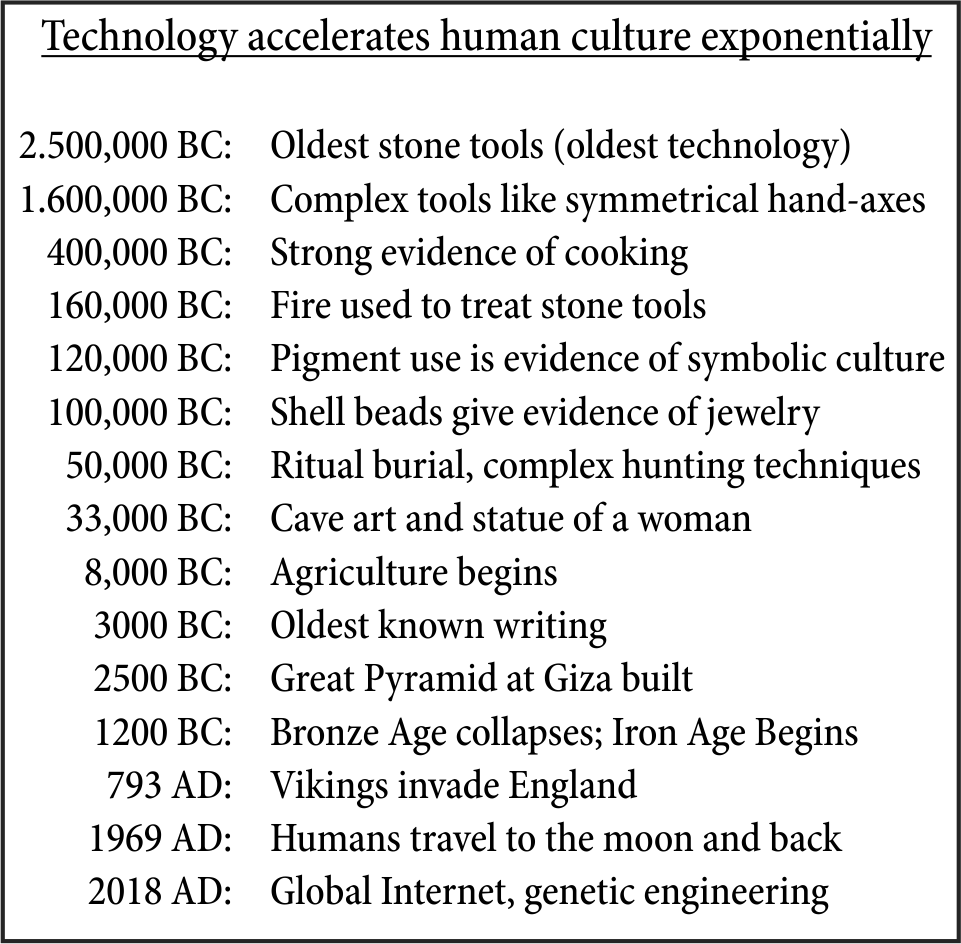 [See Technology Acceleration list] Read that list not for its individual entries but for what the intervals between them show. From the first stone tool to agriculture: over two and a half million years. From agriculture to writing: five thousand. From the Iron Age to the moon landing: three thousand. From the moon landing to the global internet: fifty years. The compression is the point. The same human biology — the same neural wiring, the same hunger for connection — is being carried through that acceleration at every step. By the Iron Age, the pace of change had become fast enough that the cognitive dissonance it produced could no longer be absorbed quietly. The sages noticed.
The world’s great spiritual traditions did not emerge in a vacuum. Their current forms emerged in the wake of the Iron Age — a period of accelerating social complexity, widening hierarchy, and deepening disconnection from the natural world. The sages who produced the Tao Te Ching, the Upanishads, the Buddhist sutras, and the Hebrew scriptures were not writing in comfortable times. They were writing in response to a world that had become, in recognizable ways, too much — too stratified, too anxious, too alienated from what had come before.
They didn’t have the language of evolutionary biology or cognitive neuroscience. But they had something else: the capacity to observe human suffering directly and ask what was causing it. And with remarkable consistency, across cultures that had no contact with each other, they identified the same root.
The problem was knowledge — not knowing, but the knowledge that the naming, dividing mind produces, and the certainty with which it is held.
Genesis and the Knowledge Problem
The Garden of Eden story is usually read as a story about disobedience. But read it again, more carefully.
The fruit that Adam and Eve are forbidden to eat is not the fruit of power, or pleasure, or pride. It is the fruit of the tree of the knowledge of good and evil. The transgression was the polar aspect of knowledge: acquiring the capacity to divide reality into opposing moral categories — good and evil, right and wrong, us and them.
Genesis 2:17: “But of the tree of the knowledge of good and evil, thou shalt not eat of it: for in the day that thou eatest thereof thou shalt surely die.”
The death threatened here is not simply physical. It is the death of the seamless connection with nature that preceded the knowledge. Once you can name good and evil as opposites, you have split reality. You are outside the garden. You cannot go back.
This is precisely the cognitive problem identified in Part 1 — the ON/OFF brain, the naming mind, the “introduced irrelevancies” of language. Genesis frames it as a moral fall. But strip away the theology and what remains is a strikingly accurate description of what happens when a mind becomes capable of categorical, oppositional thought: it loses its felt unity with the whole.
The Tao Te Ching and the Same Problem
Writing roughly contemporaneously with the later books of the Hebrew Bible, and from the other end of the Eurasian continent, the Tao Te Ching identified the same root problem — and stated it with characteristic directness.
Chapter 1: The way possible to think runs counter to the constant way. The moment you name the Tao, you have lost it.
Chapter 2 makes the logical consequence explicit: All realizing goodness as goodness, no goodness already. The label “good” instantly conjures its opposite. Good and evil are not features of reality — they are co-dependent artifacts of a categorizing mind. You cannot have one without the other. The tree of knowledge, once eaten from, cannot be uneaten.
Chapter 71 names the disease directly: Realizing I don’t know is better; not knowing this knowing is disease. The cure is not more knowledge. It is the loosening of knowing’s certainty — a return toward what chapter 56 calls profound sameness.
What the Tao Te Ching calls “disease,” Western religion calls “original sin.” The diagnosis is the same. The patient is the same. Only the prescription differs.
The Divergence
Here is where the two traditions part ways — and the parting matters.
The Biblical tradition’s response to the knowledge problem is essentially hierarchical. Sin is real; obedience to God’s law is the remedy; the individual must submit to divine authority to be redeemed. Free will is preserved — indeed, required — because without it, there can be no sin, no choice, no redemption. The entire architecture of religion depends on the reality of free will — explicit or implied. You must be able to choose good over evil, better over worse. Otherwise the story collapses.
The Taoist response is structurally different. It does not ask you to choose good over evil. It points out that the categories of good and evil are themselves the problem — co-dependent products of the very mind that generates suffering. The solution is not to choose correctly within the categories, but to loosen the grip of the categories themselves. As Chapter 38 puts it: Superior virtue never acts and never believes. Virtue that is conscious of itself as virtue is already compromised — it has awakened its opposite.
Both traditions sensed the same wound. They proposed opposite surgeries.
What Religion Got Right — and Why It Worked
It is easy, from a secular vantage point, to dismiss religion as superstition or social control. That dismissal misses something important.
Religion got the diagnosis substantially right. It identified the knowledge problem — the split mind, the fallen state, the felt separation from wholeness — earlier and more precisely than any secular tradition. It developed practices — prayer, meditation, ritual, community — that genuinely address the disconnection problem, however imperfectly.
But religion succeeded at a scale that Taoism never achieved for a more fundamental reason: it offered a simple, shared story.
The Taoist path requires serious internal self-inspection. It offers no congregation to join, no common enemy to unite against, no narrative of redemption to rally around. It is, at its core, a solitary practice — intellectually demanding, emotionally subtle, and resistant to institutionalization. Chapter 71’s realizing I don’t know is better is not a battle cry. It does not build cathedrals and temples, fill pews and monasteries.
A simple story, on the other hand, goes a very long way. “We are fallen, Heaven or Nirvana awaits us, duty redeems us” is accessible, emotionally powerful, and socially cohering. It gives people a shared identity, a shared purpose, and a shared experience of belonging — which is, after all, precisely what civilization’s tradeoff destroyed. Religion restored, however imperfectly and provisionally, the felt connection that hierarchy dismantled.
The sectarian strife and the holy wars — these are the shadow side of the same cohering power. A story that binds people together also defines who is outside it. That is not a flaw in religion’s execution. It is a structural consequence of how group identity works in a hierarchical, name-making species.
Religion arose because civilization had severed something that needed reconnecting. The word religion comes from the Latin religare — to bind again. That etymology is the whole story. It is an institutional response to the tradeoff — powerful, imperfect, and deeply human.
Next: Part 6 — Living With It: a personal account of navigating the tradeoff — what decades of practice, observation, and Taoist thought have actually changed, and what they haven’t.
Part 6 of 7 — Living With It
The first five parts of this series have been analytical — tracing a chain of causes from the binary firing of neurons to the hierarchical world we inhabit. That analysis is, I believe, accurate as far as it goes. But analysis alone doesn’t tell you what to do on a Tuesday morning when the weight of it all is pressing between your ears.
This part is more personal. It is about what actually changes — and what doesn’t — when you understand the tradeoff not just intellectually but in your bones.
Hunting and Gathering Reasons
I’ll be honest about my own situation first.
Most of what I do in life helps fill a void that would never have existed had I been born 10,000 years ago in the more balanced, egalitarian, and physically demanding circumstances of the old way. Like everyone else, I now just hunt and gather in other ways. My lifelong quest to figure out why life is the way it is — which produced this series, the book and website behind it — has certainly been a major part of that adaptation.
I hunt and gather explanations — ironically, explanations that soon revolve into deeper why’s. That is my particular form of the hunt and gather instinct.
This is not a confession of futility. It is an honest acknowledgment of what the drive looks like when it has no game to chase to survive. Understanding that my intellectual restlessness is the same restlessness that once kept our ancestors alive and scanning the horizon — that it is biology, not pathology — is itself a form of relief. Not a cure. Relief.
The cup-half-empty feeling doesn’t go away when you understand it. But it loses some of its power to deceive you into thinking that it is actually possible to fill the cup. The hunger is structural, as is the fleeting enjoyment of feeling sated.
The Constant Yoga
In the moment-to-moment, the most essential adaptation I have found is what I call constant yoga.
By yoga I don’t mean any particular posture or practice. The Sanskrit root of the word is yuj — to join, to unite. Any life action that genuinely fulfills that joining is yoga. But the joining only happens under one condition: the mind must be fully in what it is doing — not partly there and partly drifting toward desired results, or worrying over imperfections. Those two — wanting the outcome, judging the performance — are both civilized distortions of the same innate drive: the hunger for more, cut loose from survival and running without an honest target.
A bird building a nest is not monitoring its technique or worrying whether the nest will be admired. It is simply, completely, building the nest. That is the model. Not mindfulness as a cultivated mental stance — just the natural full immersion in the task that every creature in the wild brings to what it does. The Bhagavad Gita calls it a perfection in whatever one does — and the key word is perfection-in-the-doing, not perfection-of-the-result. Do it fully, without expecting perfection.
This applies to every form of action — not only physical movement but mental work, music, conversation, meditation, whatever occupies you in the present moment. Writing this very paragraph — if done without one eye on how it will be received or whether it measures up — is building the nest. Playing music from inside the music, not from outside monitoring it, is building the nest. The distinction is never between kinds of activity. It is always between doing something from the root — fully in it, the way an animal in the wild is fully in what it does — and doing it while partly elsewhere, in imagination’s virtual reality of desired outcomes and feared imperfections. That elsewhere is where meaning drains away. The return to here is where it comes back.
Chapter 16 of the Tao Te Ching points to what this kind of immersion is actually hunting for, beneath all the theories and practices: Devote effort to emptiness, sincerely watch stillness. Everything rises up, and I watch. Everything returns again to its root cause. Returning to the root cause is called stillness — this means answering to one’s destiny. Knowing the constant is called honest. The bird answering its destiny in the nest is not a lesser version of this. It may be the purest version of it. Full immersion in the task at hand is the path back to the root — what the naming mind severed, honest action begins, however briefly, to restore.
My Tao Te Ching paraphrase of Chapter 1 applies here too: The yoga possible to think runs counter to the constant yoga. Any yoga you can fully conceptualize and plan is not the constant yoga you need. The constant yoga is not a program. It is the ongoing, daily practice of returning — to what is actually in front of you, to what your hands and body know, to the root that was always there beneath the noise.
A candid footnote to all of the above. Even as I write this, and even after decades of practice, the mind is only at the root for part of the time — half, on a good day. Playing music, doing tai chi, sitting in meditation: the mind drifts. It always has. This is not failure. It is the biological condition. Humans live partly in the body of now and partly in imagination’s virtual reality — that split is the tradeoff itself, running inside every moment — the mind drifting, as it always has, toward the connection it lost and can no longer quite find. The irony is inevitable: the moment this series counsels against expecting perfection, it creates a new standard to fall short of. The yoga possible to think runs counter to the constant yoga. What Chapter 1 said at the outset applies here too — including to this paragraph. The honest practice is not achieving full immersion. It is returning, again and again from wherever the mind has gone, and if the mind knows this is the natural process, each return always comes without self-reproach.
The Struggle Is the Point
Nature shows us, without ambiguity, that struggle is an essential factor in life. Not an obstacle to meaning — the source of it.
Take a tree: it sends roots deep enough to fetch nutrients. The survival struggle lies at the root of its life’s meaning, for trees, for humans, for all living things. Everything nature does has intrinsic meaning precisely because it is always, at some level, in the service of survival.
All living things have evolved to struggle. In the wild this is obvious when you look closely at any life. Living things struggle in two primary ways. Internally: through the interplay between fear and need — essentially flight or fight — and through the immune system’s constant work to ward off invading threats. Externally: through the skeletal muscle system working to find and secure what survival requires.
Human biology evolved to meet the challenge of life in the wild, not in civilization’s realm of enhanced comfort and security. Civilization’s success at circumventing the grittier aspects of survival comes at a price. Survival energy ends up seeking other outlets — life energy must flow. Where and how it flows healthfully is the vital question.
A concrete example: in the 19th century we discovered microbes and, through proper sanitation, how to protect ourselves from them. In the 20th century, we perfected this defense further through antibiotics and ultra-sanitation. It now turns out that a lack of exposure to, and challenge by, the dirty natural world can cause the immune system to turn in on itself — allergies, autoimmune disorders, digestive dysfunction. Survival energy veers off course in unhealthy ways when it has no legitimate outlet.
The same dynamic applies to the physical realm. Without sufficient skeletal-muscle challenge, emotions take on the struggle instead, and we chase after life-meaning in ways that are more neurotic.
The simple lesson: hominids evolved a primal set of emotional and physical features over millions of years to promote their survival. Rampant innovation interferes with these primal needs, which throws life-meaning out of balance. Much of the dysfunction humanity experiences, at least in part, is a symptom of a fundamental life-meaning imbalance. The constant yoga — in whatever form — is a direct response to this. It is not optional wellness. It is biology insisting on its due.
Buddha’s last words were: “All things are impermanent. Work out your own salvation with diligence.” That word — diligence — is the key. In the wild, animals have no choice but to strive diligently. Civilization makes avoidance easy. The comfort and security we’ve built invite the path of least resistance. Stepping up to pay the price of your constant yoga, your duty, whatever that is in your life, is as essential as it is unavoidable. Nature enforces this, one way or another.
What the Symptoms Point of View Actually Does
The symptoms point of view — asking of any phenomenon, “what is this a symptom of?” rather than taking it at face value — has been the most useful shift in my thinking.
It means asking, when something troubles you: what is this a symptom of? Not “this is wrong?” but “what structural condition is this pointing to?” Any anxiety, loneliness, restless dissatisfaction, or resentment that flares and won’t quite die — these are not emotional signs of a reality gone “wrong.” They are symptoms of the mismatch between a biology shaped by 2.5 million years of hunter-gatherer life and a civilization that is, by evolutionary standards, brand new.
This is not an excuse for anything. It is a diagnostic tool. And like any good diagnostic tool, it points toward causes rather than assigning blame — which is exactly where the work of better management, if not real change, has to begin.
I’ll give a personal example. Around age ten, I found myself preoccupied with things most children weren’t thinking about — how a city manages its waste, where growth leads, how did it all manage to work? I had no framework for any of it. Just a persistent, unresolved why. Over the decades, following each “why” backward — past civilization, past language, into what has always been true of life on earth — is what eventually quieted that particular haunting. Not by answering it. By making it legible. The deeper I looked, the less fearsome the unknown became.
What Changes, What Doesn’t
I want to be clear about what decades of this practice have and haven’t produced, because false advertising helps no one.
What changes: the aftereffects. The emotional weather still passes through — frustration, anxiety, the occasional sharp resentment, the persistent undercurrent of cup-half-empty. But when I am not adding the fuel of free will thinking — the story that someone chose to do what I don’t approve of, that someone should have known better, that life is failing to deliver what I want — the storms pass faster. They still arrive. They leave sooner.
What doesn’t change: the underlying biology. The wiring is the wiring. The cognitive disconnection identified in Part 1, the social hunger of Part 2, the structural mismatch of Part 3 — none of this gets dissolved by understanding it. Chapter 71’s disease is not cured by diagnosing it. It is just managed better.
That word — managed — is important. This series never promises liberation. It promises something more modest and more honest: that understanding the root causes of our condition gives us a better chance of navigating it without making matters worse. That is not nothing. For most people, most of the time, it is quite a lot.
The Mysterious Sameness
The closest I have come to something resembling felt relief — not just intellectual relief — is what Chapter 56 of the Tao Te Ching calls profound sameness.
The more I can see similarity in all things — between myself and other people, between humans and other animals, between my own restlessness and the restlessness of every living thing that has ever had to feed itself and stay alive — the softer my certainty becomes about the apparent differences between words, names, beliefs, and ideals. The categories lose their hard edges. The self feels much less sealed.
This is not a mystical experience. It is a perceptual shift that comes from sustained attention to what things actually have in common beneath the names we give them. A human being refreshing their phone and a foraging animal scanning for food are running the same program. Seeing that clearly — not as a metaphor but as a biological fact — changes something.
The naming mind doesn’t stop naming. But it holds its names much more lightly. And in that lightness, something of what was lost becomes, briefly, recoverable.
Next: Part 7 — The Long View: what the rising median age of humanity’s population suggests about where the tradeoff is taking us — and why there may be reason, across a very long horizon, for something that resembles hope.
Part 7 of 7 — The Long View
This series has traced a chain of causes — from the binary firing of neurons, through language and hierarchy, to the civilizational mismatch we inhabit today. It has not promised liberation. It has promised something more modest: that understanding root causes improves the odds of managing their effects.
But there is one more thing to say. And it requires stepping back — past the urgency of the now, past the scale of a single life — to a longer horizon.
The Whack-a-Mole Problem
History is largely a record of civilizations addressing their problems without understanding their causes. New laws for old grievances — and more deeply, laws are only a symptom of a failure to manage a new problem organically, naturally. We passed laws against theft when ownership made theft possible. We passed laws against pollution when industry made pollution inevitable. For humans, “new” problems arise from “new” technologies, going back to the harnessing of fire and the stone axe.
The result is a Whack-a-Mole dynamic: address one symptom here, another appears there. The underlying cause — the mismatch between a universal hunter-gatherer biology and a hierarchical civilization — goes unexamined, because it is not the kind of cause that fits the story any civilization tells about itself.
Buddha’s first step on the Eightfold Path — Right Comprehension — points at exactly this. Before any effective action, there must be accurate understanding of what is actually happening. Not the story we prefer. What is actually happening — deep causes.
The gap between preferred story and actual causes is where much of human suffering gets manufactured and sustained.
What Median Age Has to Do With It
Civilization reflects the median inclinations of its population. And a population’s median inclinations track, more closely than we usually acknowledge, its median age.
This is not a sophisticated observation. It is almost obvious once stated. The longer a person lives, the more humbling losses and failures they accumulate, the more they are forced to confront their own ignorance and mortality. Wisdom — or at least the loosening of certainty — tends to come not from insight but from experience, and experience takes life’s time.
A civilization dominated by young populations is, structurally, an impulsive civilization. Not because young people are foolish, but because they haven’t yet been educated and humbled by failure at the scale that softens the grip of ideology, resentment, and certainty.
The data is straightforward. Life expectancy at birth was roughly 25 years during the Roman Empire, reached 33 by the Middle Ages, and rose to 55 in the early twentieth century. The world’s median age was estimated at 23 in 1950. It is projected to reach 37 by 2050. With ongoing advances in medicine, the trajectory continues.
The Anthropocene Chart
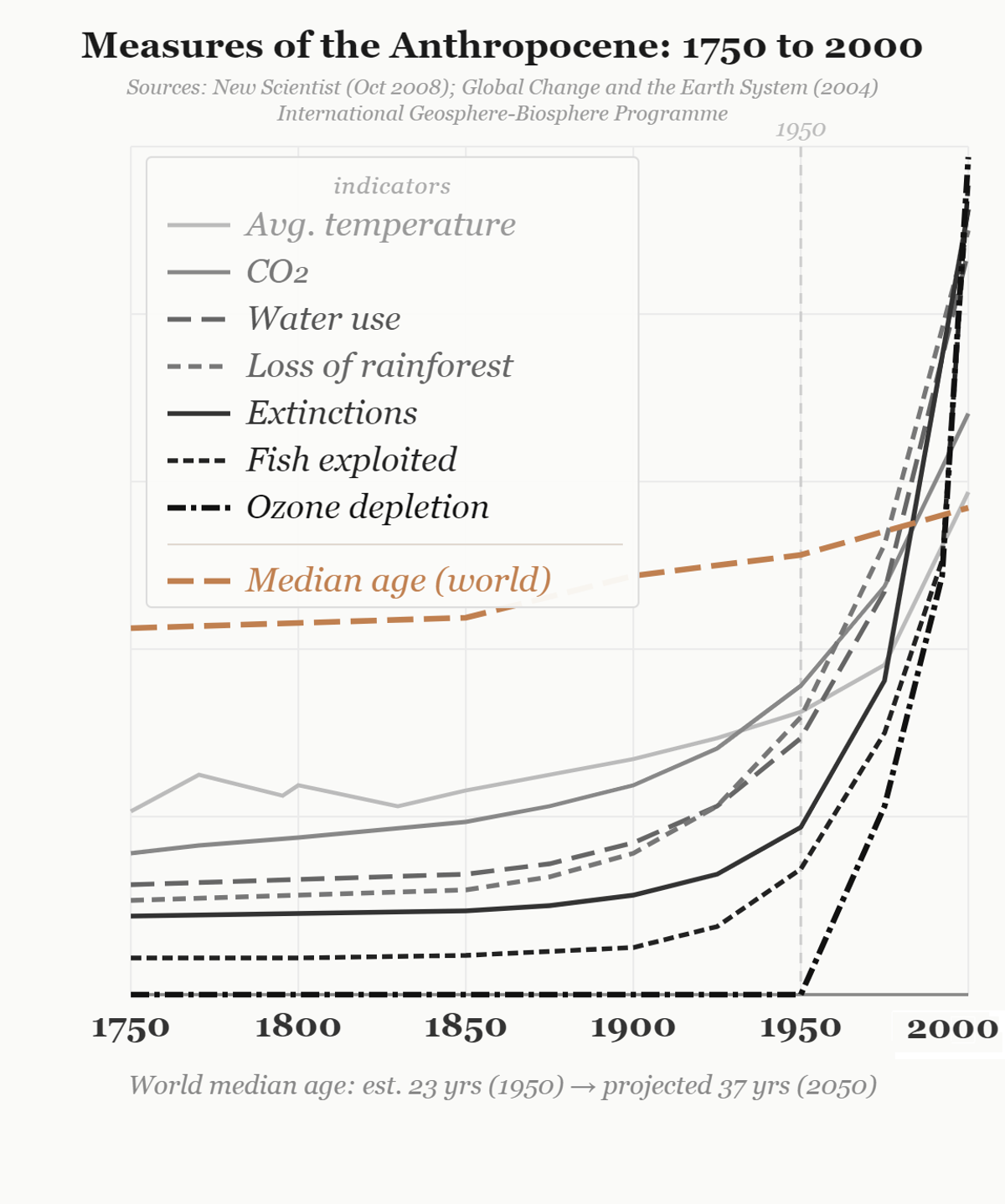 [See Anthropocene chart] Every measure of human activity — population, water use, energy consumption, species loss, atmospheric carbon — moves in roughly the same pattern: flat or gradual for most of recorded history, then a near-vertical climb after 1950.
The short-term picture this paints is ominous. There is no point pretending otherwise. The Anthropocene data represents the accumulated consequence of the tradeoff played out at civilizational scale: material security purchased at the cost of ecological and social stability, now compounding at a rate that exceeds any previous moment in human history.
But the median age curve is also rising. Not exponentially, at least yet, but following the same upward trajectory as the Anthropocene measures themselves. That parallel is not coincidence. It is the same engine — advancing technological civilization with its rising median age — driving both curves simultaneously.
The question is which curve proves more consequential over the long run.
Onward to 12,000 A.D.
Wealthier populations have declining birth rates. Declining birth rates push median age upward. The process is self-reinforcing, slow, and, by the standards of a single human life, almost imperceptibly gradual.
Don’t hold your breath. This may take hundreds or thousands of years. But it is, by the logic of the trends themselves, inevitable.
Even if it takes another ten thousand years — we are already halfway there from the first grain surplus. And the rate of change, as the Anthropocene chart shows, is accelerating. What took millennia in the past is now taking centuries. What took centuries is now taking decades.
A population whose median age is eighty will not be a population that wages war over ideology, so stridently mistakes its categories for reality, or sustains the illusion of free will with the same “cleaving” conviction. It will be a population that has been educated and humbled, at scale, by loss — by the repeated experience of certainty failing, of plans unraveling, of the self turning out to be less fixed and less sovereign than it believed as a teenager.
That is not utopia. It is just old age, applied civilization-wide.
The Chain of Causation
Before closing, it is worth naming explicitly the underlying chain that has been running through this entire series. This was touched on before in the Constant Yoga section. It applies to all living things, from bacteria to humans, and it is the structural reason why none of what this series describes can simply be wished away.
Fear → Need → Movement → Meaning → “Happiness”.
This is where the Taoist concept of wei wu wei enters — Chapter 3’s “doing without doing, following without exception rules.” Animals live this naturally. A hunting wolf does not think about hunting — it hunts. Need flows directly into movement, unmediated by imagination. For humans, the mind inserts itself between need and movement, and the insertion corrupts the chain in two directions. Need plus thinking becomes desire — an imagined future result that rushes and distorts the movement toward it. Fear plus thinking becomes worry — an imagined future threat that tightens and inhibits movement away from it. In both cases the mind gets ahead of the body, and the clean biological sequence — need driving movement, movement generating meaning — breaks down. The stress we experience is largely this: the gap between where the mind already is and where the body actually is. Wei wu wei is not passivity. It is the practice of closing that gap — moving from need directly, without the imagined result pulling the movement out of shape.
Fear is the organism’s fundamental response to the threat of entropy — of dissolution, loss, death. Need arises from fear — the desire, hunger, or purpose that propels action. Movement is the action itself — the pursuit, the work, the effort. Movement generates meaning — the felt sense of being alive and purposefully engaged. What culture loosely calls “happiness” is, more precisely, this: meaning experienced in the body, in real time.
This shows directly why ideas, achievements, pleasures, objects, or money can only bring fleeting satisfaction, at best. They are only meaningful when they are an integral part of the flow above. If a fear of poverty drives your need to work hard, you will feel life meaningful — and probably end up with money as well. But it is the need driving the movement that creates the meaning, not any resulting wealth. “Happiness” as a destination to be reached and held is the naming mind’s distortion of what is actually a process.
This also explains why civilization’s removal of the gritty survival struggle is not an unambiguous good. The moment the chain is severed — the moment need is satisfied before it can drive movement — life loses its axis. The drive persists; the legitimate outlet is gone. We become restless, anxious, unfocused — hunting and gathering without a territory to range across. The constant yoga is, at root, a deliberate way of keeping the chain honest: giving fear and need a real outlet, so movement remains genuine and meaning remains available.
Buddha’s summation — strive on diligently — is just this chain stated plainly. The diligence is not optional. It is biology insisting, as it always has, on being met honestly.
Nature Is Always in Command
There is a Taoist frame for all of this that resists the temptation to be either optimistic or pessimistic.
The tradeoff was not chosen. It was not designed. It emerged from the same natural processes that produced every other feature of life on earth. The hierarchy and the disconnection — these are not failures of humanity. They are consequences of being the particular kind of animal we are, at this particular moment in a very long evolutionary trajectory.
Nature is always in command. That is not a comforting thought in the way that religious consolation is comforting. It does not promise that things will work out for the best. It says something colder and, in the end, more stabilizing: that the process is larger than any individual’s — or any civilization’s — ability to derail it.
The sense that the cup is always half empty is not because things are going poorly, but because all living creatures must have a cup-half-empty instinct to keep them motivated to hunt and gather. No living creature is consciously aware of this pressure. After all, “full,” “half-full,” and “empty” are categories the naming mind invented. The process itself has no preference. It simply continues.
That, in the end, is what this series has been pointing toward. Not a solution. A way of seeing — clearly enough, and from far enough back, that the weight of it presses down on us less heavily.
One practical note in closing. I find it genuinely useful to keep this perspective — the tradeoff story held in the back of my mind, the illusion of free will seen for what it is — as a way of keeping the chaos of daily life in proportion. But it fades. The naming mind reasserts itself, the categories harden again, the weight returns. This is not failure. It is, as the series has argued throughout, the biological condition. If you have found this series helpful, reread it occasionally to refresh the view. The big picture has to be re-seen, the way the constant yoga has to be returned to. That returning, as Chapter 16 suggests, is itself the practice.