Superior virtue is not virtuous, and so has virtue.
Inferior virtue never deviates from virtue and so is without virtue.
Superior virtue never acts and never believes.
Inferior virtue never acts yet believes.
Superior benevolence acts yet never believes.
Superior justice acts and believes.
Superior etiquette acts but when none respond,
Normally roles up its sleeves and throws away.
Hence, Virtue follows loss of way.
Benevolence follows loss of virtue.
Justice follows loss of benevolence.
Ritual follows loss of justice.
Ways of chaos follow loss of loyalty and thinning faith in ritual.
Foreknowledge of the way, magnificent yet a beginning of folly.
The great man dwells in the thick, not in the thin.
Dwells in the true, not in the magnificent.
Hence, he leaves that and takes this.
~~~~~~~~~~~~~~~~~~~~~~~~~~~~~~~~~~~~~~

Word for Word
Limits: Translations, even the nearly literal one above, lose some of the original meaning due to the cultural context of contemporary words. Studying the numerous synonym-like meanings of the Chinese characters in the Word-for-Word translation mitigates this. (Click graphic at right for on-line Word-for-Word.)
Third Pass: Chapter of the Month
Archive: Characters and past commentary
Corrections?
None this time.
YouTube Recordings:
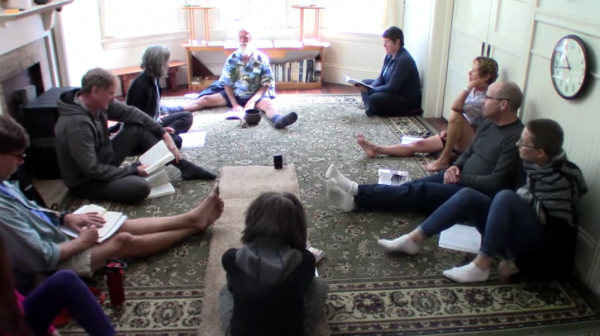 https://youtu.be/LuyVIP-0yf0 is the link to the complete video recording of our monthly Sunday meeting. For the nicely edited version, go to Kirk Garber’s YouTube channel. The edited version comes in two parts: The first and shorter Commentary part begins with a chapter reading followed by attendees’ commentary, if any. The second and longer Open Discussion part offers attendees’ observations on how the chapter relates to their personal experience.
Reflections:
Superior virtue is not virtuous, and so has virtue.
The last line of chapter 78, Straight and honest words seem inside out, sheds light on the first line of this chapter. I assume this literal wording is a bit obscure as it should be. D.C. Lau’s wording is clearer: Straightforward words seem paradoxical. Saying that Superior virtue is not virtuous, and so has virtue challenges the very meaning of virtue… and rightfully so!
Much of our existential difficulty stems from taking the words we use to think about life at face value. We trust that words mean what they mean, and fail at the most fundamental level to challenge such meaning. As chapter 71 bluntly states, Realizing I don’t’ know is better; not knowing this knowing is disease. On the surface, “know” applies to the knowledge we think we know, but more fundamentally, it applies to the underlying blind trust we place in the discrete words themselves. After all, we build our structures of belief out of the word ‘bricks’ instilled in us from infancy. To top it off, emotion intimately influences word meaning. That means, ultimate meaning is essentially irrational. Correlations can help turn this around somewhat. See Tools of Taoist Thought: Correlations.
Inferior virtue never deviates from virtue and so is without virtue.
Superior virtue never acts and never believes.
Inferior virtue never acts yet believes.
Superior benevolence acts yet never believes.
Superior justice acts and believes.
Superior etiquette acts but when none respond,
Normally roles up its sleeves and throws away.
I read these lines as all attempting to soften the hard meaning we ascribe to these key words: virtue, benevolence, justice, etiquette. For example, Superior virtue never acts and never believes. This describes the natural behaviors that exist apart from any belief held to back them up, i.e., never believes. All animals, including human, experience this natural, intuitive action. Conversely, Inferior virtue never acts yet believes. This outlines the nature of hypocrisy. We believe in certain virtues, yet our actions never fully conform to those virtues. It is akin to living a lie, I suppose. Without belief there is no lie.
Hence, Virtue follows loss of way.
Benevolence follows loss of virtue.
Justice follows loss of benevolence.
Ritual follows loss of justice.
Ways of chaos follow loss of loyalty and thinning faith in ritual.
These middle lines (9 to 13) succinctly describe the way nature actually works. Nature abhors a vacuum sums it up. When the way is lost, virtue fills the ensuing vacuum. Simple examples of this are the laws that govern society. Stop signs are set up when drivers become careless. Traffic lights are set up when stop signs lose effectiveness. Police forces are set up when people lose social cohesion and mutual respect.
Instinct tends to make us approach life in a more pro-active way. Our eyes look ahead… literally and figuratively. We look forward to goals and seek to achieve them. Thus, by the same token, we fear loss and failure. We trust and believe in the ‘future’. Not surprisingly, nature works just the opposite of how we assume it does. Chapter 40 gives us a wonderful clue as to what is actually happening.
All living creatures, including us, react to loss. Our actions and behaviors are symptoms of what we deeply feel missing. The simplest form of this is how we react to feeling hunger… we seek food. The emptiness we feel within pushes us to ‘hunt and gather’… Having is born in nothing, as chapter 40 concludes. This is why I strive to view every angle of life from a symptoms point of view. What I observe ‘out there’ is only the tip of the iceberg—a symptom of a much deeper underlying reality. This point of view connects me much closer to life than I would otherwise be. (See Symptoms Point Of View)
Foreknowledge of the way, magnificent yet a beginning of folly.
The great man dwells in the thick, not in the thin.
Dwells in the true, not in the magnificent.
Hence, he leaves that and takes this.
It can help to think of foreknowledge as any moment beyond the eternal present moment of now. We are innately forward leaning and out to survive, ‘hunt and gather’ so to speak. Thus, we fail to live life totally in the present. While this is probably true of all living things, it is profoundly true for humans because we think and so are capable of foreknowledge. And as chapter 71 observes, our certainty in our knowledge is our disease. We are lured toward our magnificent visions of our life’s next attraction. We look forward, expect, hope, wish, desire… all aimed at future outcomes.
Dwelling in the thick and true is maintaining a deep connection to the eternal present, and whatever sense of the previous ‘presents’ that can inform our life’s direction. I always say, stupid is not the mistakes I make, it is continually repeating those mistakes. The more I Dwell in the thick and true the less stupid I am. That means always keeping one eye on where I’ve been, as it were.
Hence, he leaves that and takes this.
This is right here, right now. That is over there, later somewhere.
Video archive: https://youtu.be/PTXb9qHvbv4