The superior student hearing the way, diligently travels it.
The average student hearing the way, seems to live it, seems to lose it.
The inferior student hearing the way, really ridicules it.
Without this ridicule, it could not be the way.Hence, we advocate saying,
The bright way seems hazy and hidden.
Entering the way seems like moving backwards.
The smooth way seems knotty.
Superior virtue seems like a valley.
Great purity seems disgraceful.
Vast virtue seems insufficient.
Established virtue seems stolen.
Truthful promises seem capricious.
Great honesty is without whispers.
Great capacity is a long time coming.
Great sound is scarce sound.
Great appearance is without form.
The way hides from view without name.
The way alone masters perfect forgiveness and accomplishment.
~~~~~~~~~~~~~~~~~~~~~~~~~~~~~~~~~~~~~~
Word for Word
Limits: Translations, even the nearly literal one above, lose some of the original meaning due to the cultural context of contemporary words. Studying the numerous synonym-like meanings of the Chinese characters in the Word-for-Word translation mitigates this. (Click graphic at right for on-line Word-for-Word.)
Third Pass: Chapter of the Month
Archive: Characters and past commentary
YouTube Recordings:
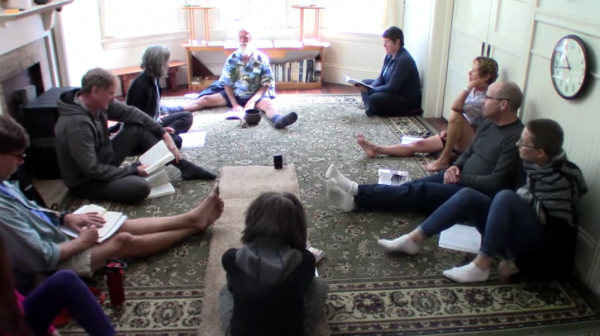 https://youtu.be/nJFmZGq1qaQ is the link to the complete video recording of our monthly Sunday meeting. For the nicely edited version, go to Kirk Garber’s YouTube channel. The edited version comes in two parts: The first and shorter Commentary part begins with a chapter reading followed by attendees’ commentary, if any. The second and longer Open Discussion part offers attendees’ observations on how the chapter relates to their personal experience.
Corrections?
I need to add an ‘s’ to seem on line 2, and replace the word really ridicules it to greatly ridicules it. Then line 3 reads as, The inferior student hearing the way, greatly ridicules it. Greatly is much more in line with the character here, i.e., 大笑. The first meaning of the second character 笑 means smile. However, ridicule captures how an inferior student might really respond when hearing of the way.
A larger correction is in order for line 14 and 15. These should be more paradoxical like the line above. Saying, Great honesty is without whispers and Great capacity is a long time coming are not paradoxical enough I feel. In my experience, these lines hint more at how nature works. That’s fine, but this chapter is challenging word meaning by throwing us paradoxical curve balls.
A simple ‘word by word’ version of these two lines would read, big square nothing corner (大方无隅) and big utensil evening accomplish (大器晚成). The former now reads paradoxical enough. The latter requires some poetic license. Actually, all four ‘Great’ lines could use an upgrade, and so…
The great square is without corners
The great talent belatedly accomplishes
The great sound is scarce sound.
The great shape is without form.
Replaces this…
Great honesty is without whispers.
Great capacity is a long time coming.
Great sound is scarce sound.
Great appearance is without form.
Reflections:
The superior student hearing the way, diligently travels it.
The average student hearing the way, seems to live it, seems to lose it.
The inferior student hearing the way, really ridicules it.
Without this ridicule, it could not be the way.
When I first read the Tao Te Ching, I wondered which student I was. Of course, my wish was to be the superior student, but my ego just couldn’t reach that level of self-deception. As it happens, now that I’m approaching the ripe old age of 80, looking back I see my life has been an evolution towards diligently travels it. Let me be clear, it hasn’t been a matter of choice.
It seems to boil down to the fact that once I’ve seen or learned something significant, I can’t un-see or un-learn it. Moving from infancy through young adulthood and on has been a journey of an ever-deepening awareness of the full spectrum of life, but especially the sorrow and loss side of life. As chapter 40 says, Loss through death, of the way uses. This life journey is not unique to people. Indeed, all living things experience this in their own way and time.
When I first considered, The superior student hearing the way, diligently travels it I had the sense that I was in charge of my life… that I could choose whether or not I was diligently traveling it. In short, I believed in free will, and thus felt it was my responsibility to be diligently traveling it if I was going to be a superior student. The notion of free will also makes it easy to be very unforgiving vis-à-vis the life struggle of others. You can glibly tell yourself, “I’m responsible for my life, so they should be too”.
I finally realized that no living thing has a choice in this journey, especially in matters so deeply significant. It happens to us naturally. In other words, the deeper I know ‘this’ the more I diligently travel it… I have utterly no choice in the matter, nor did I ever. Thus, these first sentences are actually statements of natural reality and not options that an individual has any choice over. This actuality is true for most, if not all, of the Tao Te Ching. However, this fact won’t be evident to anyone who believes people have free will and real choice in life.
In our younger days, we are in competition with ourselves… who we are vs. who we imagine ourselves to be. As death looms larger, the ego and such competitive urges recede. In my case, I viscerally know that life and death are one… chapter 56’s , This is called profound sameness. And, this is why The inferior student hearing the way, greatly ridicules it. Naturally enough, it feels ridiculous to say that life and death are intrinsically, mysteriously, the same.
Diligently traveling it with a continuous sense of profound sameness tends to make life a constantly poignant experience. “I” becomes a “we” that encompasses all the elements of my awareness. My suffering becomes our suffering; your suffering becomes our suffering. Mind you, not in a harsh way. That’s why “poignant experience” may describe it best. In other words, I can’t escape the full breath of reality because I am in the flow of reality. In short, complete connection can’t help but be a serious matter. I guess that’s why they say, “Ignorance is bliss”. I say ignorance is also blindness and I’ve already been there, done that!
Hence, we advocate saying,
The bright way seems hazy and hidden.
Entering the way seems like moving backwards.
The smooth way seems knotty.
Superior virtue seems like a valley.
Great purity seems disgraceful.
Vast virtue seems insufficient.
Established virtue seems stolen.
Truthful promises seem capricious.
Great honesty is without whispers.
Great capacity is a long time coming.
Great sound is scarce sound.
Great appearance is without form.
The purpose of these paradoxical lines is to throw a monkey wrench into our rigid, rational, dialectic cognition. We are far more adept at noticing differences than similarities, and then making mountains out of those molehills. This self-centered certainty of thought is humanity’s Achilles Heel — our disease as chapter 71 puts it, Realizing I don’t’ know is better; not knowing this knowing is disease. To push back further on your ingrained habituated sense of word meaning, try out the Tools of Taoist Thought: Correlations
The way hides from view without name.
The way alone masters perfect forgiveness and accomplishment.
As I come to realize more of the ‘big picture’, my ego can’t help but shrink in the process. The more I feel a profound sameness with all that is, the ego reverts to its original visceral sense of self. There is no place in cognition for an illusion of self to reside. In other words, as ego is simply the emergent property (See Tao As Emergent Property) of the natural sense of self-integrity, it retreats to its home in emotional instinct. The end of chapter 16 captures this part of our journey well…
As I come to know that I am a drop in the river of life, and fully in the flow of that river, I know that I inherently accomplish my part regardless of what I have or haven’t done. In this flow, there is no ‘choice’ other than perfect forgiveness and accomplishment. When the competitive forces of ‘self vs. ideal self’ and ‘self vs. other’ subside, all that remains is vanishing into the way, so to speak. Truly, as chapter 40 says, Loss through death, of the way uses.
Video archive https://youtu.be/-85lGWz3ym4