The way gave birth to the whole.
The whole gave birth to difference.
Difference gave birth to the many.
The many gave birth to all things.All things suffer the negative and embrace the positive;
Clashing spirits considered harmonious.
People actually loathe solitude, scarcity, and not of the valley,
Yet Kings and princes consider this a suitable match.Hence, things perhaps lose as well as benefit, and benefit as well as lose.
Of people’s religious teaching, I also teach,
The backbone of effort seldom results in one’s death.
I will take this teaching of my ancestors just so.
~~~~~~~~~~~~~~~~~~~~~~~~~~~~~~~~~~~~~~
Word for Word
Limits: Translations, even the nearly literal one above, lose some of the original meaning due to the cultural context of contemporary words. Studying the numerous synonym-like meanings of the Chinese characters in the Word-for-Word translation mitigates this. (Click graphic at right for on-line Word-for-Word.)
Third Pass: Chapter of the Month
Archive: Characters and past commentary
YouTube Recordings:
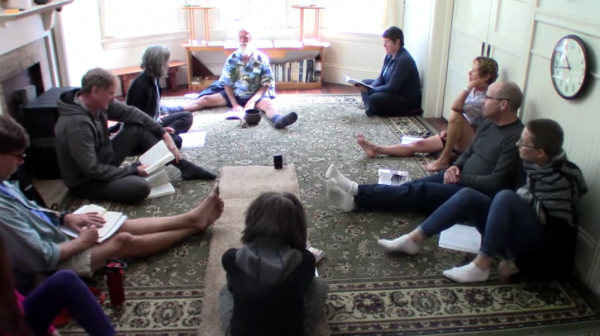 https://youtu.be/WIeD7vDVp_w is the link to the complete video recording of our monthly Sunday meeting. For the nicely edited version, go to Kirk Garber’s YouTube channel. The edited version comes in two parts: The first and shorter Commentary part begins with a chapter reading followed by attendees’ commentary, if any. The second and longer Open Discussion part offers attendees’ observations on how the chapter relates to their personal experience.
Corrections?
None this time
Reflections
The way gave birth to the whole.
The whole gave birth to difference.
Difference gave birth to the many.
The many gave birth to all things.
These four lines set the existential stage of reality beautifully… a poetic version of the Big Bang. They harken back to chapter 1’s, These two are the same coming out, yet differ in name. These lines also speak to the misguided trust we place in names, as chapter 1 points out… The name possible to express runs counter to the constant name.
When I reverse the order here, I see the direction in which greater sanity lies. Thus, I begin my journey back to sanity at perceiving things, take a step backward to many, then to difference, then to the whole, and finally to the way. Chapter 52 speaks to this returning journey for me…
The last part of chapter 16 highlights this journey from temporal bias to eternal impartiality nicely …
Knowing the constant allows, allowing therefore impartial,
Impartial therefore whole, whole therefore natural,
Natural therefore the way.
The way therefore long enduring, nearly rising beyond oneself.
Innate instinctive bias drives us to make much ado about the differences we perceive. Indeed, perception is the process of sensing difference. That is what I refer to as the Bio-Hoodwink. Living organisms must pay more attention to differences than to similarities for survival sake. For example, in seeing a long thin shape on the ground, differentiating a stick from a snake serves survival more than perceiving these two objects as a matter of profound sameness. For us, this ability has become too much of a good thing, as it were. We utterly believe in and trust the cognitive differences we perceive. Thus, chapter 71 reminds us, Realizing I don’t’ know is better; not knowing this knowing is disease.
We institutionalize difference with names, and this locks perception into a life-long narrative. This is like an information cancer… a uniquely human disease. The first part of chapter 16 points to a way out of this disease. Peace lies in returning to notice the root cause, as chapter 16 puts it…
The last line above, Knowing the constant allows, allowing therefore impartial, brings me to chapter 56…
Knowing doesn’t speak; speaking doesn’t know.
Subdue its sharpness, untie its tangles,
Soften its brightness, be the same as dust,
This is called profound sameness.
If you look around you carefully, you’ll notice the universal tendency to not only identify differences, but to make mountains out of molehills of difference. This naming of differences seems to be growing exponentially in the modern age. Knowledge is the compounding nature of identifying and assigning names to perceived difference, and there appears to be no end in sight, thanks in large part to computerization!
Difference gave birth to the many. The many gave birth to all things. And the human brain’s mind doesn’t know when to stop adding to the catalog of things, and the naming therein. Chapter 30 reminds us, Those most adept have results, yet stop, not daring to seek better.
Chapter 32 strikes even closer to home…
Only when restricted, are there names.
Names already exist,
Man handles the realization to stop.
Knowing to stop [he] can be without danger.
Analogy: of the way’s existence under heaven,
Liken this to the river of the valley flowing to the great river and the sea.
All things suffer the negative and embrace the positive.
Clashing spirits considered harmonious.
The actual characters for negative and positive are, 阴 and 阳. Within those characters are principle radicals for moon and sun. In order to understand these two lines fully, it helps to consider these two clashing spirits — 阴 and 阳. Briefly:
阳 = yang = the sun; south of a hill or north of a river; in relief; open; overt; belonging to this world; concerned with living beings; positive; (in Chinese philosophy, medicine, etc.) yang, the masculine or positive principle in nature.
日= rì = sun; daytime; day; daily; every day; with each passing day; time.
阴 = yīn = the moon; overcast; shade; north of a hill or south of a river; back; in intaglio; hidden; secret; sinister; of the nether world; negative; (in Chinese philosophy, medicine, etc.) the feminine or negative principle in nature.
月 = yuè = the moon; month; full-moon shaped; round.
What does all things suffer really mean? First, I feel it is initially better to limit all things as to refer to all living things. Living is the struggle to maintain order in an organism’s biological systems, which means constantly coping with the negative ‘forces’ of entropy. Simply put, life is a struggle; however, only when viewed impartially, are we able to appreciate truly the natural balance of this Clashing spirits considered harmonious.
Living things are naturally biased toward that which offers comfort and security. Quite naturally then this next line tells it like it is…
People actually loathe solitude, scarcity, and not of the valley,
Yet Kings and princes consider this a suitable match.
So why do Kings and princes consider this a suitable match. If you interpret Kings and princes as separate realities — individual people — this can’t perhaps be truly understood. I think of Kings and princes as referring to the pinnacle of my own comprehension… the extent of my own impartiality. Chapter 39 parallels this Kings and princes line.
Here are other references that offer context to Yet Kings and princes consider this a suitable match:
Hence, things perhaps lose as well as benefit, and benefit as well as lose. Gain and loss are integral to life. However, living things naturally prefer gain to loss, and thus are constantly at war with loss. After all, loss is one face of entropy. I find greater peace when I embrace that fact and go with that flow as honestly as I can. Chapter 58 also speaks to this Clashing spirits considered harmonious…
Of people’s religious teaching, I also teach,
The backbone of effort seldom results in one’s death.
I will take this teaching of my ancestors just so.
I find the essence Of people’s religious teaching to point to the same universal, constant, truth. I admit, this requires plunging beneath the surface of the particular names that individual religions rely upon to differentiate (the illusion of difference again!) their group’s ‘truth’ from those misguided fools of those other groups 😉 Such is our tribal nature made all the more extreme by the tradeoff we made a while ago. (See The Tradeoff).
The backbone of effort here reminds me of Buddha’s last words, “All created things must pass, strive on diligently” . The end of chapter 33 also parallels this natural striving of living things…
I will take this teaching of my ancestors just so. Everything that I think and say has a connection to all that came before me. This begins with the very names and words I use to formulate this or any other narrative. I can claim no credit for anything. It is all just so.
Video Archive https://youtu.be/EGtoeZ0TnUk