The valley’s spirit never dies; this is called the profound female.
Of the profound female entrance; this is called the origin of the universe.
Continuous, like it exists; in usefulness, not diligent.
~~~~~~~~~~~~~~~~~~~~~~~~~~~~~~~~~~~~~~

Word for Word
Limits: Translations, even the nearly literal one above, lose some of the original meaning due to the cultural context of contemporary words. Studying the numerous synonym-like meanings of the Chinese characters in the Word-for-Word translation mitigates this. (Click graphic at right for on-line Word-for-Word.)
Fourth Pass: Chapter of the Month
(pandemic era)
Archive: Characters and past commentary
Zoom on YouTube Recordings:
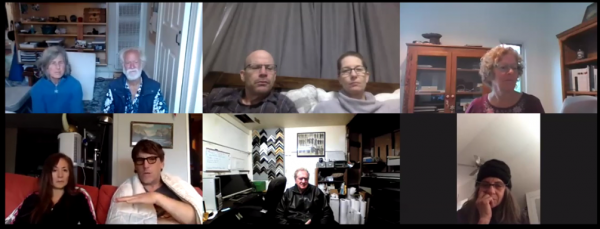
https://youtu.be/XKpa0IdAgbM is a link to unedited Zoom video of this month’s Sunday meeting. The shorter first part of the meeting begins with a chapter reading followed by attendees’ commentary, if any. A little later on begins the longer open discussion part of the meeting when those who wish to discuss how the chapter relates to their personal experience.
Corrections?
None this time
Reflections
The valley’s spirit never dies; this is called the profound female.
What is special about a valley? Most obvious is its emptiness. Yet, this ‘nothing-ness’ is subtle. It really takes its shape by the higher hills surrounding it. Of course, you could say the hills take their shape by the presence of the valley’s ‘nothing-ness’. Which is more fundamental, the ‘nothing-ness’ of the valley or the ‘something-ness’ of the surrounding hills? Which is more profound?
This first line helps underscore the deeper meaning of profound. Namely, what is most obvious to the senses is not as real as our senses lead us to feel. Thus, I find discounting the obvious helps me notice obscure possibilities. Chapter 14 coaches me on what to look for,
Of the profound female entrance; this is called the origin of the universe.
This reminds me of the big bang. You could say, out of the spirit of emptiness popped the universe in one big BANG. Basically, nothing is the entrance (doorway 之门) to something. As chapter 40 has it, Having is born in nothing. I feel this dives deeper than how chapter 2 frames this origin issue, i.e., Hence existence and nothing give birth to one another.
This chapter and the Tao Te Ching in general, indicate the existence of a deep intuitive sense of how nature works independent of, and predating, scientific knowledge. Nature reveals itself each moment. While I’m referring to a human intuitive sense, for all I know this deep intuitive sense is profoundly universal. Indeed, this subtle and profound quality may even be trickier for a thinking mind to perceive due to the incessant human need to name the unnamable. This along with our need to control nature blinds us deeply.
I find noticing this profound female entrance requires a mind as impartial as possible… truly keeping to the middle, as the last chapter put it. Of course, our daily fears and needs keep us swinging through that balanced middle as we move back and forth between gain and loss, success and failure, something and nothing, and a mind that seeks to know, label, and control life.
A telling aspect here is the contrast between the emptiness of nothing-ness and the existence of something-ness. That ancient people symbolized female with nothing (yin) and male with existence (yang) makes sense. The female tends to be less aggressive, more social, and gives birth, while men are just the opposite. The error we easily make is applying this stereotype to all women. I suspect this is largely a result of civilization’s need for a hierarchical story, as this pigeonholing was mostly nonexistent in hunter-gatherer social structures. (See, The Tradeoff)
Continuous, like it exists; in usefulness, not diligent.
The light of consciousness, stripped away of contemporaneous fear and need is ephemeral, subtle yet profound. Indeed, profound sameness and the rest of chapter 56 describe this well, e.g., Unobtainable and intimate, etc. Void of any fear, it’s like it exists. Yet, consciousness only feels solid when experienced as its light shines on something. In usefulness, not diligent fits the empty nature of pure consciousness nicely; its nothing-ness unexploited by any diligent agenda.
Now, in living life, we are driven to diligently strive on as Buddha put it. And naturally so. Living, survival, demands involvement, and fear (of loss, failure, discomfort, pain, death, etc.) drives involvement. The spiritual challenge we all face is keeping to the middle as best we can. After all, survival is ultimately about maintaining balance in life overall. Too far this way, or to its opposite is bound to end badly. As a few chapters note: Those most adept have results, yet stop, not daring to seek better,#30; Knowing to stop [he] can be without danger, #32; Knowing when to stop, never dangerous,#44.
Society generally defines fear by the objects of fear, not by the underlying instinct that drives us to act… or refrain from action. When we say someone has few fears, or is even fearless, we are describing the absence of any obvious signs of fear we are familiar with, e.g., fear of heights, snakes, even death. What we fail to recognize is how fear also drives one to be fearless of heights, snakes or death. It all comes down to the survival of one’s self-identity. If being true to your self-identity is deeper than your fear of death, you can’t help but die for the cause you identify with. This applies to anything from a mother saving her baby to a terrorist dying for his cause.
Fear is an emotion in higher animals that we all recognize, but too subtle and mysterious to notice in the rest of creation. You might say that fear is simply the light of consciousness shinning on one’s agenda, purpose, ‘dharma’. Loss, failure, decay and death—entropy in a word—is a profound sameness way of pondering this. Here, in the flow of time, each moment without an underlying agenda is simply the light of consciousness. The moment the light of consciousness shines on a purpose, fear and need drive its beholder to, as Buddha said, “Strive diligently” toward achieving that purpose.
Finally, what is the benefit of seeing how this all plays out if we ultimately have no control over it? That is difficult to answer directly, other than the calming effect of more deeply knowing how nature works. The answer may only become evident as one seeks to comprehend it. I guess that is a little like a Catch-22. In an odd way, the question becomes the answer, which becomes the question… or as the last line puts it, Continuous, like it exists; in usefulness, not diligent. Obviously, this suggests that such an endeavor will not be calming for anyone still seeking to control life.
Video Archive https://youtu.be/XKpa0IdAgbM