Grasping and yet full of, not in harmony with oneself;
Surmising and yet of keen spirit, cannot long protect.
Treasures fill a room, none can keep;
Wealth and pride, one’s gift to one’s blame.
Meritorious deeds that satisfy oneself recede;
This is the way of nature.
~~~~~~~~~~~~~~~~~~~~~~~~~~~~~~~~~~~~~~

Word for Word
Limits: Translations, even the nearly literal one above, lose some of the original meaning due to the cultural context of contemporary words. Studying the numerous synonym-like meanings of the Chinese characters in the Word-for-Word translation mitigates this. (Click graphic at right for on-line Word-for-Word.)
Fourth Pass: Chapter of the Month
(pandemic era)
Archive: Characters and past commentary
Zoom on YouTube Recordings:
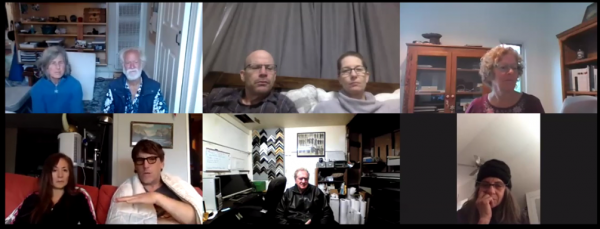
https://youtu.be/Ha_ZtrdaHs0 is a link to unedited Zoom video of this month’s Sunday meeting. The shorter first part of the meeting begins with a chapter reading followed by attendees’ commentary, if any. A little later on begins the longer open discussion part of the meeting when those who wish to discuss how the chapter relates to their personal experience.
Corrections?
None this time
Reflections
Grasping and yet full of, not in harmony with oneself;
This touches on our natural absence of an appreciation instinct. Unable to be innately content with what we have, we can’t help but grasp for more. The instinct “more is better” pushes us to grasp. Much of this is obvious. What may be less obvious is how natural it all is. Nature has no need for an animal to feel so called ‘appreciation’. On the other hand, feeling contentment at-the-moment is an utterly natural respite from the hunt-and-gather needs of survival. However, feelings of contentment are fleeting as life’s ‘just do it’ hunt-and-gather instincts rebound. Any ongoing sense of appreciation depends largely upon wisdom’s ability to see beyond oneself interest, or as chapter 52 puts it, Nearly rising beyond oneself.
What sets us apart from other animals is our ability to imagine myriad matters over which to grasp. Imagination stimulates desire and urges us to grasp to the point of becoming too much of a good thing. It is useful here to note that desire = need + thought. Other animals have little to no ability to imagine, and so live very much in the present moment. Need moves both humans and other animals, but thought allows us to add a kind of ongoing virtual sense of need, i.e., desire. This makes moments of contentment even more fleeting than would otherwise be the case without imagination stirring the mind’s pot. This leaves us very much with a sense of not in harmony with oneself.
The first few lines of Buddha’s Fourth Truth offers the most succinct solution to this uniquely human predicament: “There is salvation for him whose self disappears before truth, whose will is bent on what he ought to do, whose sole desire is the performance of his duty”. To grasp this fully, one needs to deepen and broaden the meaning of duty. For example, a squirrel’s ‘duty’ is to gather nuts for the winter. A birds ‘duty’ is to migrate south for the winter. The need is instinctive, and transcends any ‘personal’ agenda those animals may have at the moment. Their “will is bent on what they ought to do”, which incidentally is not dictated by another squirrel or bird.
Civilization bombards us with notions of what we ought to do. These so-called duties are a projection arising from other people’s needs and fears… their agendas. To tap into one’s duty, one’s dharma, requires taking these external pressures with as many grains of salt as possible in order to look within one self for their truth. Frankly, this calls on one’s deepest reserves of honesty and courage. It is no wonder that people frequently take the ‘easy way’ and—somewhat grudgingly—conform to the current social norms of their ‘outside world’.
The Bhagavad Gita sheds egalitarian ‘inside world’ light on duty. “And do thy duty, even if it be humble, rather than another’s, even if it be great. To die in one’s duty is life: to live in another’s is death”. 3:35
Surmising and yet of keen spirit, cannot long protect.
When we are uncertain, we surmise—we take our best guess. That’s fine so far. However, when we are also of keen spirit, the chances of danger increase exponentially. As chapter 16 cautions, Not knowing the constant, rash actions lead to ominous results. Not knowing the constant is tantamount to surmising, and of keen spirit propels rash actions.
Treasures fill a room, none can keep;
Ah yes, we can’t take it with us. As Jesus put it,
“Lay not up for yourselves treasures upon earth, where moth and rust doth corrupt, and where thieves break through and steal. But lay up for yourselves treasures in heaven, where neither moth nor rust doth corrupt, and where thieves do not break through nor steal. For where your treasure is, there will your heart be also”.
To have any chance at succeeding with this, I find I need to constantly… and I mean constantly… remind myself of where I wish my heart to be. That goes back to Buddha’s point, “There is salvation for him whose self disappears before truth…”.
I must first ask myself, “What part of my life is the most timeless?” After determining this truth, “all” I need to do is offer myself to that. This became significantly easier once I realized that I never regretted doing my duty; I only regretted it when I didn’t. Remembering that helps me keep duty in the forefront of the mind’s eye.
The nature of duty I’m talking about is not only of action. Obviously, any action can qualify as one’s duty. Here, one’s approach to life is what distinguishes common action from duty. In other words, self-honesty is my duty, listening is my duty, and so on. Sure, I fail at times, but having this to be my aim, my life’s goal, works well. In other words, it is not about being perfect in duty, or anything else for that matter. It is the march towards perfection—the journey—that works. After all, perfection is simply another illusion the mind conjures up to whip itself. As the first line of chapter 45 puts it, Great accomplishment seems incomplete, its use doesn’t harm.
The Bhagavad Gita describes the path well, albeit, from a mythical “many lives” point of view. Simply combine all the references to “many lives” as actually referring to your one life span, here and now. You begin stumbling as a child to walk and talk. Then, you stumble on in numerous other ways throughout life, moving closer and closer to perfection. Note: “merely yearns for Yoga” means simply yearning for connection—natural balance.
And he begins his new life with the wisdom of a former life; and he begins to strive again, ever onwards towards perfection. 6:43
Because his former yearning and struggle irresistibly carries him onwards, and even he who merely yearns for Yoga goes beyond the words of books. 6:44
And thus the Yogi ever‑striving and with soul pure from sin, attains perfection through many lives and reaches the End Supreme. 6:45
The “attains perfection through many lives” is an aspirational ideal, not rational and real. Reading between the lines, I see this as saying that with diligence I move closer to whatever my ideal of perfection is, but never achieving it, i.e., it is the journey, not the destination, that soothes!
The Bhagavad Gita 6:17 is a good model for living moment-to-moment.
A harmony in eating and resting, in sleeping and keeping awake: a perfection in whatever one does. This is the Yoga that gives peace from all pain.
I interpret “a perfection in whatever one does” as saying something like ‘work with perfection without expecting perfection’. Nothing is more insane, more diseased, than thinking perfection is real. Perfection is the antithesis of nature’s way. As chapter 40 observes,
Wealth and pride, one’s gift to one’s blame.
It is easy to regard wealth and pride from a moral standpoint. That is the normal “judge a book by its cover” way of viewing life for any animal. Due to our disease, this surface approach is problematic for humans, i.e., Realizing I don’t know is better; not knowing this knowing is disease. A great deal of sanity can be recovered by viewing life from a profoundly deeper Symptoms Point Of View. Naturally that is difficult simply because viewing life this deeply requires effort, i.e., no animal evolves to choose the more effortful, energy wasting, way of doing anything.
The effort I refer to is the work watchfulness takes. This dynamic gives competitors and predators an edge, i.e., the wavering of a prey’s watchfulness increases a predator’s chances of thinning the herd and having dinner. Now, it is not necessary to follow a long trail of symptoms back to ultimate sources, although doing so somewhat will illuminate the natural balancing process. What process you ask? Put simply, the external characteristics we can see are actually counterbalancing deeper realities. Here are simple examples: empty -> eat; bored -> stimulate; lonely -> companionship; insecure -> brag. This last example fits wealth and pride, one’s gift to one’s blame. One’s blame is a sense of insecurity, failure, guilt, weakness. Such inner feelings urge one to compensate by grasping for wealth and pride. Of course, it is much more profound, subtle and multilayered than this, but then all we need to know is that the “cover” we see is not the “book” we think we know.
Meritorious deeds that satisfy oneself recede;
This is another way of saying how contentment is fleeting, and life throws us back into the game of survival. The only ‘choice’ we have is how we’re going to play the game. And, the ‘choice’ we have is solely dependent on how fully we know the rules of the game. In other words, knowing, and more importantly remembering, how life plays out is critical. For example, if I truly know driving fast on a slick rain soaked street is dangerous, I can easily ‘choose’ to slow down. In fact, I won’t actually choose to slow down because truly knowing that it is dangerous makes it virtually impossible for me to drive fast. Survival instinct is always in charge. Thus, deeply knowing the truth of life makes it virtually impossible not to conform to that truth.
This is the way of nature.
Knowing—and more importantly remembering—the way of nature is the only way to stop repeating the same mistakes. As chapter 30 suggests, Those most adept have results, yet stop, not daring to seek better. Again, in chapter 32, Man handles the realization to stop. Knowing to stop [he] can be without danger.
Finally, chapter 65 sums it all up, To the outside world, contrary indeed. Then, and only then, reaching great conformity. As I see this, reaching great conformity can only mean becoming one with your personal truth, your duty, your dharma, your original self (see Taoist Thought: Returning to Original Self). Again, as Buddha said, “There is salvation for him whose self disappears before truth, whose will is bent on what he ought to do, whose sole desire is the performance of his duty”.
Video Archive https://youtu.be/Ha_ZtrdaHs0