Without going out the door, we can know all under heaven.
Without looking out the window, we can see nature’s way.
He goes out farther, he realizes less,
Accordingly, the wise person goes nowhere, yet knows.
Sees nothing, yet understands.
Refrains from acting, yet accomplishes.
~~~~~~~~~~~~~~~~~~~~~~~~~~~~~~~~~~~~~~

Word for Word
Limits: Translations, even the nearly literal one above, lose some of the original meaning due to the cultural context of contemporary words. Studying the numerous synonym-like meanings of the Chinese characters in the Word-for-Word translation mitigates this. (Click graphic at right for on-line Word-for-Word.)
Third Pass: Chapter of the Month
(pandemic era)
Archive: Characters and past commentary
Zoom on YouTube Recordings:
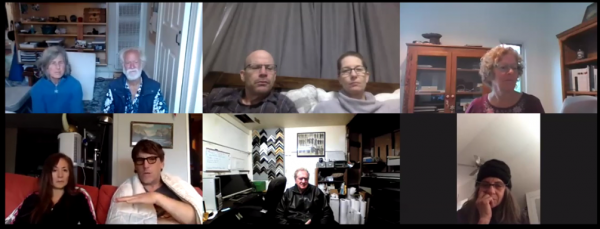
https://youtu.be/C0wyo3fVB8w is a link to unedited Zoom video of this month’s Sunday meeting. The shorter first part of the meeting begins with a chapter reading followed by attendees’ commentary, if any. A little later on begins the longer open discussion part of the meeting when those who wish to discuss how the chapter relates to their personal experience.
Corrections?
None this time
Reflections
Without going out the door, we can know all under heaven.
Without looking out the window, we can see nature’s way.
I have considered this from various angles for nearly 60 years now. My latest and perhaps ultimately simple and down to earth view is this:
Biology pre-determines how any living thing perceives the all under heaven and nature’s way it witnesses. Take a fly for example. Their “eyes” are thousands of individual visual receptors. Their position and spherical shape give the fly an almost 360-degree view of its surroundings. If we could see the world the way a fly does, we would have quite a different view of existence than we do. So, if we could see all under heaven and nature the way a fly does, would we be any more or less capable of knowing all under heaven or of seeing nature’s way?
The fly and we are in the same boat. Neither can know all under heaven by going out the door and observing, i.e., finding an objective answer outside ourselves. Nor can the fly or we see nature’s way by looking out the window, i.e., empirical observation.
Clearly, the only possible way to know all under heaven and see nature’s way is through an inward looking journey. The more impartially we are able to notice our own biological hoodwinks (see Peeking in on Nature’s Hoodwink, How the Hoodwink Hooks and He Who Conquers Self) the closer we come to perceiving what is naturally so without affectation, or “self so”, (自然 zìrán) rather than the learned preconception (stories) instilled in us from childhood.
It is important to note that what we can realize through looking inward is that any answer we can name is not the answer. That means what we intuitively realize will always remain a silent secret within us. Pleasantly, this is the same silent secret (profound sameness) that all other living creatures are capable of intuitively sensing. The key is to realize that we can’t cram this true knowing into tidy labels (names and words) and weave them into a coherent story.
Our fundamental disconnection from all under heaven and nature’s way is the disease we have of thinking that we know. As chapter 71 begins, Realizing I don’t know is better; not knowing this knowing is disease. Alas, this is an incurable disease. The mere act of cognition, of thought, is the de facto experience of thinking we know. I guess you’d call this a Catch-22. The Tao Te Ching, and chapter 71 in particular, offer us a means to mitigate this predicament…
When one admits they have a problem, their journey toward a “solution” gets under way. That’s not to say a “solution” will ever be realized—not while we can think—but that at least we’re headed that way.
Indeed, human awareness, unlike the awareness of other life forms, is dominated by the dipolar illusion of thought (see Yin Yang, Nature’s Hoodwink). The reality we ‘think’ feels generally more real than the reality our lives experience… at least until a bee stings us (or any other visceral experience). This sets up a conflict between how we think things should be and how they actually are. Of course, all animals struggle with the challenges of life at the visceral level. We also get to struggle at the cognitive level. Essentially, we double our suffering.
He goes out farther, he realizes less,
Accordingly, the wise person goes nowhere, yet knows.
Certainly, going out farther really opens your eye. Well… yes and no. Going our father tells you what you don’t know, whereas a deep dive inward tells you what you genuinely know—nature’s way.
The reason we go out farther is that we’re attempting to ‘get it together’, understand, and eliminate our uncertainty, worry, fear. Our whole sense of the world is rooted in the illusion of labels, words, names. We naturally expect that the “answer” to our concerns lies somewhere out there in the “real world”, that is in fact only a confident belief in what we think, never realizing this is but a figment of our imagination.
The irony here is that the drive to go out farther is a symptom of not being able to trust the intuitive knowing we are all born with. We are culturally conditioned to think and believe the answer lies out there, usually by someone who “genuinely” knows. Of course, this hierarchical based illusion serves as a necessary adhesive to hold civilization together. (See The Tradeoff)
Once you realize there is no solution ‘out there’, you become wise enough to know there is nowhere to go for the answer. And, wherever you go, you take yourself there, and what you observes will be mostly just a reflection of who you are. When you go here or there, you are merely going here or there due to pressing circumstances. For example, I need to pee so I go to the toilet. Necessity serves as the mother of all action. (See Necessity, the Mother and Necessity is the Mother) The only realm that remains to scrutinize is within.
Scrutinize within is easier said than done! First, what you’re looking for has no name or shape to define it. I find it works to approach this sideways, so to speak. Noticing fears and needs as impartially as possible makes for a decent beginning. Need and fear are the emotions that drown out knowing all under heaven the most. Only when those waters are calm can I begin seeing nothing. Chapter 14 tells me what I’m looking for…
The last line, The ability to know the ancient beginning; this is called the way’s discipline reveals a little more of what I’m looking for as I face up to my fears and needs. Namely, these emotions are an integral part of the ancient beginning. Considering these emotions as symptoms of deeper issues directs the view inward (see Symptoms Point Of View). It is all part of the bio-hoodwink playing out in our life.
Sees nothing, yet understands.
Consider the fact that all that exists has its root origins in the big bang… or better yet, the nothing that preceded (and gave birth to?) the big bang. Nothing is the seed, the root, of all existence. The deeper I perceive that nothingness within, the deeper my understanding of existence. Again, this is an intuitive beyond words understanding. The same knowing, for example, of which an “ignorant” ant would be capable.
Of course, biology has the perceptions of all creatures skewed toward noticing differences over similarities. A keen awareness of differences serves survival best. For example, a snake and a stick are different yet can look similar. Seeing the difference, I avoid the snake. This serves survival best.
Yet, in the deepest view, the similarities far outweigh the difference. Just think, with shared genes, we share around 99% with rats, and with working DNA we share around 97.5% with rats and mice. Perhaps more telling is how outwardly, fruit flies and humans have little in common. Yet, roughly 60 percent of the fly’s genes can also be found in humans in a similar form. Even bananas share about 60% of the same DNA as humans! And yet, all our senses tell us we are utterly different!
Poking even deeper I feel all creation, from Higgs bosons to a Human beings, have an innate imperative to maintain “self-integrity”. At the same time, all creation has an innate sense (“consciousness”) of its origin… Nothing and the shared oneness-in-nothingness, so to speak. Thus, creation is a “dance” playing out between these two qualities—self-integrity and oneness-in-nothingness. Each dance ends in nothingness… you could say, entropy rules. This dance is especially poignant, particularly the death’s ‘grand finale’, as it plays out in living creatures, from a virus on “up”.
Refrains from acting, yet accomplishes.
This is only possible to grasp after you realize free will is an illusion arising from the more fundamental illusion of self. In this context, refrains from acting will never sound like a proscription from acting. Rather, refrains from acting is a natural result of realizing how letting nature play out is nature’s way. Again, refrains from acting is not to say that one shouldn’t act on issues. Necessity impels us to do what we feel needs doing. In this way, we are no different from any other creature on earth. Note: feels, not thinks! (See also, A final word on need at the end of Postscript)
Video Archive https://youtu.be/C0wyo3fVB8w