Were I mindful yet had knowledge,
Going in the great way, alone bestow this respect.
The great way is very smooth, yet people are fond of paths.
The government is very removed, the fields very overgrown,
. . . the storehouses very empty.
Colorful clothes, culture, belted swords, satisfied of drink,
. . . food, wealth and goods to spare.
This is called in praise of robbery.
This does not conform to the way either!
~~~~~~~~~~~~~~~~~~~~~~~~~~~~~~~~~~~~~~
Word for Word
Limits: Translations, even the nearly literal one above, lose some of the original meaning due to the cultural context of contemporary words. Studying the numerous synonym-like meanings of the Chinese characters in the Word-for-Word translation mitigates this. (Click graphic at right for on-line Word-for-Word.)
Third Pass: Chapter of the Month
(pandemic era)
Archive: Characters and past commentary
Zoom on YouTube Recordings:
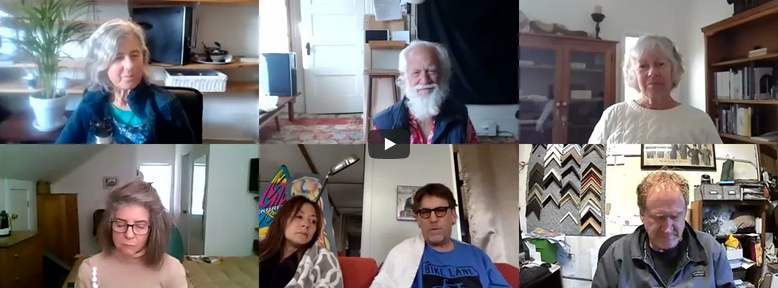
https://youtu.be/XXEd2SfByow is the link to the Zoom video of this month’s Sunday meeting. The shorter first part of the meeting begins with a chapter reading followed by attendees’ commentary, if any. A little later on begins the longer open discussion part of the meeting when those who wish to discuss how the chapter relates to their personal experience.
Corrections?
None this time
Reflections
Were I mindful yet had knowledge,
I see all living creatures as being mindful, yet only humans have knowledge. First, I need to emphasis the have aspect of this. Knowledge is to have knowing, i.e., 有知 = have + know; realize; be aware of. Next, I chose the word mindful to represent the literal: 使我介然 = use + I + take seriously + like that).
All sentient (aware, awake, mindful) creatures feel attraction and aversion (a.k.a, need and fear). However, except for humans, they don’t have the cognitive capacity to have a tangible memory of such feelings… at least to the extent we do. They are spontaneous, in the moment, and after the moment passes, they move onto their next moment, by and large.
Our ability to have life experience stored in memory long term, bestows on us a powerful ability to manipulate our environment. The downside of this, is an ability to dwell on our past experiences and any judgments we make. We carry our past with us like so much baggage. We appear to be too intelligent for our own good, at least since the advent of civilization and the need to “govern the country”. As chapter 65 suggests.
Chapter 47 nicely identifies one difference between know and knowledge born of intelligence.
Going in the great way, alone bestow this respect.
While we are loaded down with our knowledge, we are also capable of being mindful. The blending of these two facets enables us at our most tranquil moments to alone bestow this respect… a respect for the way. As chapter 34 says, The great way flows, such as it may left and right. All things on earth depend on it for existence, yet it never declines. Humanity obviously has a deep-seated respect for the great way going back to humanity’s earliest days of language and memory (cognition). These excerpts from chapter 21, 51, and 62 paint a picture of this respect…
The great way is very smooth, yet people are fond of paths.
If the great way is very smooth, why is it that life can be so uneven? It is only possible to feel that the great way is very smooth when you are wholly impartial, “rising nearly beyond yourself”. As chapter 16 concludes,
Rising nearly beyond yourself is not the norm in life. Life is work, striving diligently to survive. Emotions—need and fear—permeate our every waking moment, to one degree or another. How can one perceive the great way as being very smooth? As we are walking on the fires of life, the way feels anything but smooth. (See https://youtu.be/_o5OxgCIlKk)
This is where respect enters the picture. One can respect and value a reality even if one does not personally experience or participate in such. I suppose mirror neurons are at play here. Personally, I find it helps to imagine my death. Only after I’m dead will the great way ‘feel’ very smooth. I can vicariously appreciate that time coming to pass, as it has for countless generations… and now at my age, all the more so.
D.C. Lau translated paths as by-paths. I long agreed with that and judged others and myself for foolishly taking by-paths. Translating it correctly, 徑 = jìng = footpath; path; track; way; means, says nothing about “by”, and so avoids that bias. View more deeply, all living things are fond of paths! For example, animals gradually form and then follow paths to water holes and food sources. The paths any animal (including humans) follows is a result of their needs and fears… their process of living life as they intuitively know how.
The notion of people taking by-paths implicitly implies we have free will and are in control of our lives overall. This notion is contrary to all the evidence. We believe in free will because belief “proves” we have the control over life we desperately yearn for. I suppose this is a type of self-fulfilling prophesy that only fulfills the initial illusion. Belief doesn’t make it real, it just makes it feel real. This is what makes religious myth so compelling… yet, unlike free will, there is no evidence to the contrary. (See Free Will: Fact or Wishful Thinking?)
The government is very removed, the fields very overgrown,
. . . the storehouses very empty.
Colorful clothes, culture, belted swords, satisfied of drink,
. . . food, wealth and goods to spare.
This is called in praise of robbery.
This harsh judgment is another example implicitly suggesting that people have free will and are in control of life overall. Truth be told, this situation would never exist in hunter-gatherer times. This is a result of the unintended consequences of civilization. (See The Tradeoff).
Perceiving nature—the way—in its ruthless reality is extremely humbling. The illusion of self (ego?) can’t tolerate this view and so seeks scapegoats (causes) to blame for the injustices it perceives. Examined closely, I notice the judgments we make, the faults we see, are simply a projection of our personal agenda, which in turn, arises from our innate needs and fears. That is why we slaughter one form of life without blinking an eye, yet decry the slaughter of those forms of life we value. Robbery for one person is just hunting and gathering for another. “It all depends on whose ox is being gored” as they say. Such hypocritical self-serving points of view are “not of the way” as chapter 18 suggests When intelligence increases, there exists great falseness. Such hypocrisy is the certain price we pay for believing that humans have the capability of free choice.
The only way to avoid paying the heavy price of hypocrisy is through taking the lower position chapter 61 refers to, Of all under heaven, The female normally uses stillness to overcome the male. Using stillness she supports the lower position. From this humblest vantage point, it becomes possible to accept and own the failing we perceive instead of seeking scapegoats. I suppose this parallels the notion of “Christ dying for our sins”. However, here it comes down to each one of us taking on the humiliation, and not just placing it all on the back of an individual Christ. As chapter 78 observes…
Chapter 28 hints at how taking the lower position is the path to ultimate simplicity. Of course, the exceedingly hierarchical social nature of civilization makes this path quite emotionally challenging to embody. However, just knowing this is the way only then sufficient certainly motivates me to at least remember this verity…
Ultimately, this chapter speaks to us personally—our inner world. The government is very removed would correspond to the body, or perhaps more specifically to the mind—thoughts and emotions. Our attention is easily distracted by our passion for colorful clothes, culture, belted swords, drink, food, wealth and goods, at times when we might more wisely pay sincere attention to important matters, like our body’s well being… the fields very overgrown, the storehouses very empty. As individuals, we take so much for granted just like the government. We commonly regard the body as precious only after illness strikes.
The failing of society’s governments are simply an extension of the failings we encompass in our personal lives. Yet, ironically, we expect the government to be better. That is truly passing the buck.
This does not conform to the way either!
Today I saw this very differently than previously and perhaps more honestly as well. Up to now, I took this to say that robbery and the like were not of the way. That moral judgment never sat well with me, but I just attributed it to ‘human error’. Today I saw this as perhaps saying that this critical judgment, born of knowledge, was the deeper issue that didn’t conform to the way either. The word either (too, also) is telling.
In other words, if the intention of a ‘Lao Tzu’ was to clearly state that robbery, does not conform to the way, I don’t see the reason for ending the last line with 也 (also; too; as well; either). If anything, the literal Tao Te Ching is ultra succinct, wasting no words. To me this is the true beauty of the Tao Te Ching. Great pithiness leaves much open for interpretation and/or misinterpretation, i.e., our interpretation can only reflect our own degree of self-honesty and self-understanding, both of which continue to deepen over our lifetime.
The value in great pithiness lies in the fact that we can only understand what we already intuitively know (see We only understand what we already know). The brevity of the Tao Te Ching permits a readers’ interpretation to match his/her intuitive sense of life… unlike these commentaries that I ‘must’ write. 🙂
Anyway, I now am confident that either way of interpreting it is fine, because the reality we perceive is simply a reflection of ourselves. Indeed, to paraphrase chapter 1’s opening lines the way possible to think, or the name possible to express runs counter to the constant [reality]. This is why chapter 71 warns us, Realizing I don’t know is better; not knowing this knowing is disease. Of course, this viewpoint is not how I began this journey 60+ years ago, but rather where I’m ending up.
Chapter Archive https://youtu.be/gv4-J83StTk
This is the complete video. It begins with blowing Zen followed by the meeting