Knowing not speak; speaking not know.
Squeeze exchange, shut the gates,
Subdue its sharpness, untie its tangles,
Soften its brightness, be the same as dust,
This is called profound sameness.
For this reason,
Unobtainable yet intimate,
Unobtainable yet distant
Unobtainable yet favorable
Unobtainable yet fearful
Unobtainable yet precious
Unobtainable yet cheap.
For this reason all under heaven value it.
~~~~~~~~~~~~~~~~~~~~~~~~~~~~~~~~~~~~~~

Word for Word
Limits: Translations, even the nearly literal one above, lose some of the original meaning due to the cultural context of contemporary words. Studying the numerous synonym-like meanings of the Chinese characters in the Word-for-Word translation mitigates this.
Third Pass: Chapter of the Month
(pandemic era)
Archive: Characters and past commentary
Zoom on YouTube Recordings:
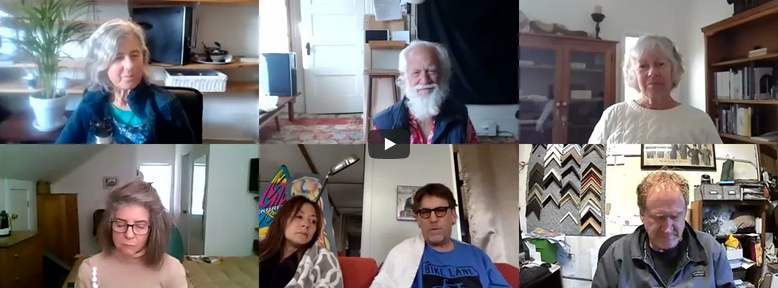
https://youtu.be/k0ddmqaC7_4 is the link to the Zoom video of this month’s Sunday meeting. The shorter first part of the meeting begins with a chapter reading followed by attendees’ commentary, if any. A little later on begins the longer open discussion part of the meeting when those who wish to discuss how the chapter relates to their personal experience.
Corrections?
I initially encountered the first two lines of this chapter when I read D.C. Lau’s translation, i.e., One who knows does not speak; One who speaks does not know.
Years later, as I deeply mulled over the actual Chinese characters, 知者不言,言者不知, I rephrased these D.C. Lau’s lines to match the literal more closely, i.e., Knower not speak; speaker not know. Here are the main literal meanings for these four characters: (言)
zhī (知) = know (know; realize; be aware of; inform; notify; tell; knowledge; administer; be in charge of)
zhě (者) is used after an adjective or verb as a substitute for a person or a thing.
bù (不) = no (not)
yán (言) = speech (speech; word; say; talk; speak; character).
The character, 者 (zhě) suggests that knower is correct. However, is it the only way to interpret it?
I now feel knowing is also at least loosely correct. Speaking and Knowing are ‘things’, although the common translation for knowing is 会心 (huìxīn). Poking deeper, these two characters break down like so: 会 (huì) get together; assemble; meet; 心 (xīn) the heart; heart; mind; feeling; intention; centre; core. This may be more akin to “meeting of the minds”, as we say. This makes knowing feel a little more suitable here.
Knowing not speak; speaking not know. This corresponds with my actual experience. When my mouth or even my thinking mind is moving, I’m retrieving experience from memory, be that from an immediate few seconds ago, to as far back as memory can take me. It’s not truly spontaneous. I assume that makes this first line applicable only to humans.
I also realize the lower section following For this reason requires updating. First, I’ll change and to yet [ and (yet, but) 而 ér ]. Somehow, Yet makes the two aspects feel more closely linked, e.g., Unobtainable and intimate, vs. Unobtainable yet intimate.
Finally and more importantly are changes in the 11th and 12th lines. The literal of these two are: expensive (precious; noble).贵 guì and inexpensive (cheap; lowly; humble) 贱 jiàn. Precious and cheap offer a better contrast than the previous noble and humble.
Reflections
Knowing not speak; speaking not know.
Over the years, I’ve interpreted this in various ways. As I recall, this line just puzzled me initially. I do remember it feeling humbling. It seemed to say every word I, or anybody else uttered was B.S. Even worse, did it mean that no one who truly knew could speak on what they knew? My understanding has evolved, yet my first sense of it may not have been far off. I’ll elaborate.
Knowing not speak because deep knowing is so much larger than any words can depict. Words bottle up reality by identifying distinctions we perceive. Perception of distinctions depends upon contrast. Any “reality” that is beyond such classification or contrast becomes extremely difficult—impossible—to speak about. This limitation applies universally to all humanity. It is certainly not a myopic description of the ‘sage’.
Speaking not know because speech (words and language) is an after-the-fact summary of the deeper, albeit partial, memory of spontaneous intuitive first-hand experience. Speech transmits knowledge, not contemporaneous intuitive knowing, i.e., that which is beyond words, beyond definable contrast.
Squeeze exchange, shut the gates,
Subdue its sharpness, untie its tangles,
Soften its brightness, be the same as dust,
Survival requires an innate inclination to perceive distinctions, to focus on differences, in order to carry out life’s mission of survival in a largely dog eat dog world. Perceiving difference serves competitive interest, and each species on Earth is in competition with all the rest, any and all symbiotic relationships notwithstanding. Living things are primarily cued up to ‘shoot first and ask questions later’. “Shoot first” can mean either fight or flight.
The meditative ideal, Squeeze exchange, shut the gates, would not serve the requirements of survival in the wild. Only when one is safe and secure, can one indulge such a luxury… and yet…
Subdue its sharpness, untie its tangles, Soften its brightness, be the same as dust. All this speaks to taking the edge off—de-stressing. This is only advantageous when one is in an environment of abundance, safe and secure. This is rare, if not unheard of, in the wild. Only in civilization do we “enjoy” an abundance of security and comfort.
Ironically, biology rules out any actual intuitive ability to feel appreciation, to feel safe and secure, or to feel abundance… for more than fleeting moments. Any status quo, even one of abundance, diffuses contrast and blends into nothingness. Life is innately set up to flee such nothingness by feeling ‘more is better’ and to be wary. This is because in the wild scarcity and uncertainty are often the rule.
Only in civilization do we have the ability to let our ‘more is better’ instincts drive us off balance. Consequently, we are able to ‘hone the sharpness’, ‘tangle life in knots’, ‘increase life’s intensity’ and ‘feel ourselves as unique individuals’. Thus, chapter 46’s advice, Therefore, in being contented with one’s lot, enough is usually enough indeed must apply to humans alone. Only life in the wild is naturally free to relax and feel this “enough is usually enough indeed”, at least when it’s not fighting or fleeing, hunting or gathering.
RE: Be the same as dust: I would add, be the same as bubbles. Ponder bubbles awhile. Feel how fleeting they are… now here, now gone. By the way, the eukaryote cell—the building blocks of most life on earth—is essentially a bubble enclosing the DNA and other organules that perform specific functions critical to the cell’s survival. Life itself probably began as a bubble enclosed by lipids around 4 billion years ago. These prokaryotic cells, archaea and bacteria, converged in a symbiotic relationship to form the prototype for the eukaryotic cell a few billion years later. So seeing yourself the same as a bubble is deeper than just a metaphor. This is one way noticing sameness can be enlighteningly profound.
This is called profound sameness.
Profound sameness is the reality that underlies all the macro worldly differences we notice and utilize. The closest real world representation of this is the quantum theory, which describes a reality ruled by probabilities. Briefly, this is a phenomenon by which one particle can effectively “know” something about another particle instantaneously, even if those two particles are separated by a great distance.
This theory teaches anyone listening that reality isn’t what it seems. It is striking how closely this 20th century theory parallels Taoist overall view of reality. Perhaps this revolutionary view of primal uncertainty influences more of modern human life than we imagine. Certainly, quantum theory has made many recent technological innovations possible. These changes alone have made ‘reality’ a more uncertain affair for humanity. Consider this quote in Science News by Sean M. Carroll (a theoretical physicist who specializes in quantum mechanics). (see https://www.sciencenews.org/…/quantum-theory-history…)
“The fundamental nature of reality could be radically different from our familiar world of objects moving around in space and interacting with each other,” physicist Sean Carroll suggested in a recent tweet. “We shouldn’t fool ourselves into mistaking the world as we experience it for the world as it really is.”
Carroll notes that quantum theory consists of equations that describe mathematical entities roaming through an abstract realm of possible natural events. It’s plausible, Carroll argues, that this quantum realm of mathematical possibilities represents the true, fundamental nature of reality. If so, all the physical phenomena we perceive are just a “higher-level emergent description” of what’s really going on.
“Emergent” events in ordinary space are real in their own way, just not fundamental, Carroll allows. Belief that the “spatial arena” is fundamental “is more a matter of convenience and convention than one of principle,” he says.
Einstein disturbed by this phenomenon called it ‘spooky action at a distance’ because it is totally opposite to our innate perception of separation and differentiation. Ironically, actual reality flies in the face of how evolution has set us up to perceive and interact with the environment. As chapter 40 begins, In the opposite direction, of the way moves.
Tat Tvam Asi (That Thou Art) closely parallels profound sameness. Briefly, it is one of “The Great Sayings” of the Upanishads. That Thou Art expresses the sense that the individual self (jiva) which appears as a separate existence, is in essence (atman) part and manifestation of the whole (Brahman).
Clearly, appreciating this viscerally is possible only when we’re not stressed by life, or indeed, just living life normally. And yet, simply remembering That Thou Art and the deep reality of profound sameness can help calm the turbulent waters of life, and foster a deeper sense of acceptance.
Honestly, this means our perception of difference is a biological illusion. In other words, “you” are actually immortal in an eternal now. (See You are Immortal!). Of course, you must live the biology of daily life. Unlike ‘spooky’ subatomic particles, we can’t be both mortal and immortal at the same time. However, any momentary experience of profound sameness, however fleeting, feeds awareness a new paradigm to embrace. This can help ease some of the worries and desires which otherwise dominate a relentlessly distracted and differentiating awareness.
One final question remains. Other than lucky happenstance, is there any way to experience profound sameness? Continually striving to view life from a Symptoms Point Of View does seem to deepen intuitive understanding and awaken knowing. Seeing things as symptoms of deeper underlying causes subdues and softens surface distinctions. As you sense the root cause/origin of things, acceptance (forgiveness, tolerance, impartiality, etc.) becomes inevitable and unavoidable.
For this reason,
Unobtainable yet intimate,
Unobtainable yet distant
Unobtainable yet favorable
Unobtainable yet fearful
Unobtainable yet precious
Unobtainable yet cheap
This last part of the chapter really struck me today. Up until now, I’ve focus more on the first half and the deep vision of profound sameness. This morning I realized this chapter applies to all life on Earth, even perhaps the universe (heaven and Earth) as a whole. Notice the ‘two sides of the same coin’ of reality here… intimate yet distant; favorable yet fearful; precious yet cheap. Such is the unobtainable spooky reality of profound sameness.
For this reason all under heaven value it.
I feel this chapter attempts to describe the ‘magic’ of reality. All creation is pushed and pulled through existence. Thus, all creation ‘knows’ this existence, it is pushed or pulled, with the ‘goal’ of returning home to its counterpart. This depth of profound sameness is truly indescribable, yet there I went attempting to point my finger in its direction. Ah yes, I am the ‘knowing that does not speak’ yet I am the ‘speaking that does not know’. Aren’t you also?
I’ve no doubt that all sentient beings sense this ‘magic’, yet worldly pressures overpower working awareness of this and direct attention instead toward survival. That’s why we are advised to Squeeze exchange, shut the gates, Subdue its sharpness, untie its tangles, Soften its brightness, be the same as dust.
No wonder, For this reason all under heaven value it.
Chapter Archive https://youtu.be/-xJnYJvApMc
This is the complete video. It begins with blowing Zen followed by the meeting