Use honesty to govern the country,
Use surprise when using weapons,
Use non responsibility when seeking all under heaven.
How do I know so? Because of this.
The wider spread the taboos, the poorer the people.
The sharper their tools, the more a country’s confusion grows.
The more clever they are, the more strange things appear.
The more laws multiply, the more conspicuous the robbers.
For this reason, the holy person says,
I do nothing and the people change themselves.
I love stillness and the people straighten themselves.
I am without responsibility and the people thrive themselves.
I am without desire and the people simplify themselves.
~~~~~~~~~~~~~~~~~~~~~~~~~~~~~~~~~~~~~~
Word for Word
Limits: Translations, even the nearly literal one above, lose some of the original meaning due to the cultural context of contemporary words. Studying the numerous synonym-like meanings of the Chinese characters in the Word-for-Word translation mitigates this.
Fourth Pass: Chapter of the Month
(pandemic era)
Archive: Characters and past commentary
Zoom on YouTube Recordings:
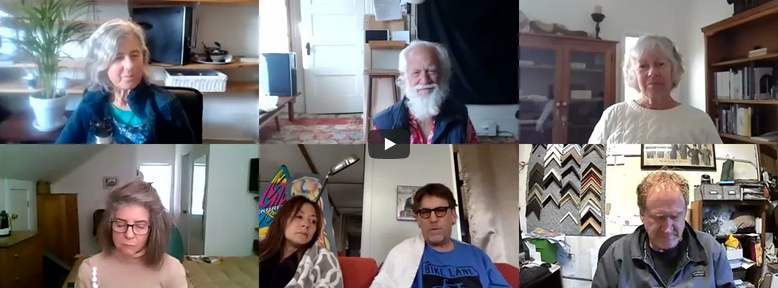
https://youtu.be/WenGVfRYJfA is the link to the Zoom video of this month’s Sunday meeting. The shorter first part of the meeting begins with a chapter reading followed by attendees’ commentary, if any. A little later on begins the longer open discussion part of the meeting when those who wish to discuss how the chapter relates to their personal experience.
Corrections?
None this time.
Reflections
Use honesty to govern the country,
Use surprise when using weapons,
Use non responsibility when seeking all under heaven.
How do I know so? Because of this.
I suppose the only approach here that seems obvious is Use surprise when using weapons. At least it is obvious to warriors. On the other hand, Use honesty to govern the country fall far outside the way life usually unfolds. Those who govern are fearfully compelled to hide the embarrassing sides of their activities. Seen at a personal level, fear induces us to lie not only to others but also to ourselves. Indeed, self-honesty is the final stage of maturity.
The notion to Use non responsibility when seeking all under heaven falls even further outside the norm. It goes directly opposite to the cultural belief that one should be responsible. Of course, we feel it’s particularly imperative for others to be responsible. Our own lack of self-honesty often allows us to let ourselves off the hook. Certainly, the cultural myth of free will helps us pull this hypocritical self-deception off smoothly (see Free Will: Fact or Wishful Thinking?).
However, once one sees through the illusion of free will, all that is left for one to do is simply Use non responsibility when seeking all under heaven. The only way forward is the natural path suggested in the last line of chapter 3 and followed by all other animals on this planet… Doing without doing, following without exception rules.
We each feel the powerful urge to be responsible in regards to that which we personally hold important. Moreover, we need others to feel likewise. This entire responsibility urge is driven by fear. Fear drives our need and our agenda to make reality conform to our imagined ideal. All the conflict we see in the world arises out of this ‘I want it my way’ approach to life. Honestly, this fear driven urge drives all life on the planet; although, only in human thinking does it become a serious handicap (see the disease reference in chapter 71). Simply put, the urge to act is the ‘puppet master’ behind the never-ending ebb and flow of creation. Note how the third ‘treasure’ in chapter 67 counterbalanced this urge
Somewhat ironically, the only way to “escape” this battle of life is to Use non responsibility when seeking all under heaven. Naturally, complete escape is not possible for any living being. However, escaping many of the ways human cognition aggravates this battle is possible. Escape from our mind induced chaos hinges on how well we can see the world as it is rather than how we want it to be. This chapter’s concluding four lines point the way.
Use non responsibility when seeking all under heaven certainly sounds great on paper. However, it’s vital to know that this ideal is impossible to maintain. Biology sets all animals up to respond. Responding to the fear and need we viscerally feel is baked into life’s survival process. Even so, merely accepting the ideal of non responsibility offers some freedom from the tyranny of your expectations, and from that can blossom a deeper peace of mind.
The next four lines of this chapter reveal a few of the natural consequences of playing the “game of life”.
The wider spread the taboos, the poorer the people.
The sharper their tools, the more a country’s confusion grows.
The more clever they are, the more strange things appear.
The more laws multiply, the more conspicuous the robbers.
Intuitively grasping some, or all, of these views is extremely difficult impossible because we are indoctrinated from birth—by dint of natural instinct and cultural narrative—to spread taboos, sharpen tools, be clever, abide laws. To see life as it is requires resisting the cultural tide pushing everyone to see life as the cultural story imagines it. Moreover, it takes decades of living before life experience can deeply confirm this cause and effect relationship. Indeed, we only graduate ‘The school of life’ at our death, and not a moment before.
For this reason, the holy person says,
I do nothing and the people change themselves.
I love stillness and the people straighten themselves.
I am without responsibility and the people thrive themselves.
I am without desire and the people simplify themselves.
Some may view these lines as advising us to be passive and merely ‘stare at our navel’, as people sometime say. This view is actually a symptom of the fear (see Symptoms Point Of View) that people can feel when they imagine people being passive and doing nothing. Let’s face it, we innately want everyone to take responsibility rather than think about seeking all under heaven. The social contract stipulates that people ‘should’ be responsible. Doing otherwise is unfair and abnormal. As chapter 39 observes at the end,
Perhaps chapter 40 is even more to the point …
On the other hand, these last lines can sound like a call to ‘just accept’. ‘Just accept’ is a call to a kind of passive action akin to I do nothing (wú wéi). Here, free will is raising its idealistic head again. (see Free Will: Fact or Wishful Thinking?)
In fact, one can’t actually ‘just accept’ anything that one does not already intuitively know to be so. Only that deep knowing is capable of driving action. This parallels my observation that we can only truly understand what we already know intuitively (see We only understand what we already know). Of course, that is a heretical notion as it threatens the very foundations of cultural education and progress.
Importantly, in my experience, when I intuitively know, it becomes impossible for me to do anything other than conform to that deep knowing. Life is really quite simple and straightforward. It is our conflicting fears and expectations that make it feel so complex and bewildering at times. Chapter 23 may offer insight into how life truly plays out. Note the emphasis on following.
In biological terms, we are merely following the natural commands arising from our biology. What we think is so is more often than not a reflection of what we imagine to be or want to be, not what is. As chapter 71 reminds,
Chapter Archive https://youtu.be/mbztNWaOj6w
This is the complete video. It begins with blowing Zen followed by the meeting