The way of all things is profound and difficult to understand.
Of the perfect person, it is precious; of the imperfect person, it is protective.
Beautiful speech can bring worldly honor.
Beautiful behavior can augment people.
For people imperfect, why abandon them?
Hence, the son of heaven establishes three commonalities,
Even though surrounded by jade and presented with horses,
Not equal to receiving the way.
Of old, why was this way so valued?
Was it not said that by using it one got what one sought.
By using it, one avoids the evils of hardship.
Hence, all under heaven value it.
~~~~~~~~~~~~~~~~~~~~~~~~~~~~~~~~~~~~~~
Word for Word
Limits: Translations, even the nearly literal one above, lose some of the original meaning due to the cultural context of contemporary words. Studying the numerous synonym-like meanings of the Chinese characters in the Word-for-Word translation mitigates this.
Fourth Pass: Chapter of the Month
(pandemic era)
Archive: Characters and past commentary
Zoom on YouTube Recordings:
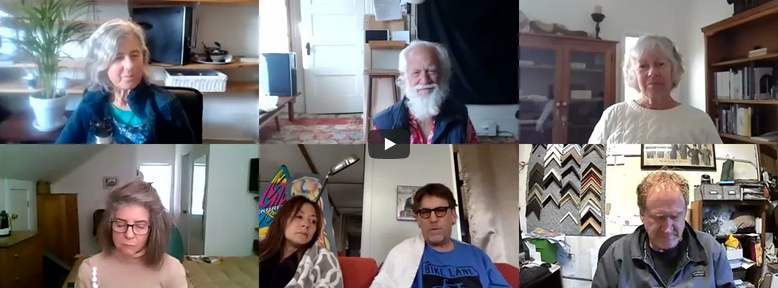
https://youtu.be/Kf8BBPMiipQ is the link to the Zoom video of this month’s Sunday meeting. The shorter first part of the meeting begins with a chapter reading followed by attendees’ commentary, if any. A little later on begins the longer open discussion part of the meeting when those who wish to discuss how the chapter relates to their personal experience.
Corrections?
None this time.
Reflections
The way of all things is profound and difficult to understand.
Today this chapter struck me as oddly different from the other 81. Was it actually different, or was it just in my mind? Well, of course, “what is” is always in the mind of the beholder. I just wonder if the next time I read this chapter I’ll see it as odd as I did today. I really doubt it.
Anyway, it begins by telling me that The way of all things is profound and difficult to understand. Then the remainder says nothing specific about the way, which is reasonable given that the way of all things is profound and difficult to understand. This unique aspect sets the Tao Te Ching apart from most every other human story, in that it leaves the readers to fill in the understanding from their own experience. Typically, culture goes to great lengths to “educate”—indoctrinate—the people. Undoubtedly, this is what most people desperately crave. Put simply, certainty of belief instills security whereas uncertainly stirs up fear. Our fear driven need to know leads to our disease, i.e., Realizing I don’t know is better; not knowing this knowing is disease.
Taking this first part, the way of all things, literally—and I mean very literally—does make the last part, is profound and difficult to understand, entirely understandable. Viewed this way, I see less “oddly different” about this chapter. The way of all things, taken literally implies the existence of a common denominator between literally all things in the universe. That is a very big and diverse basket of ‘stuff’! Right away, I think of profound sameness as the only way to crack this nut. As chapter 56 points out…
This also makes the first line of chapter 56 obvious and easily understandable. When awareness expands to take in reality’s big and diverse basket of ‘stuff’, our words, speech, and thought fail completely. The inherent profound sameness between all things is beyond the ability of thought to parse out. I found the way to cultivate this intuitive knowing is to seek out the similarities hidden in that which appears to be very different. Gradually the ‘big picture’ comes into view.
Of the perfect person, it is precious; of the imperfect person, it is protective.
Beautiful speech can bring worldly honor.
Beautiful behavior can augment people.
For people imperfect, why abandon them?
One exceptional feature of the Tao Te Ching lies in how nothing is abandoned. There is no threat of a Hell to punish miscreants who run afoul of the way. Chapter 27 describes this protective aspect superbly …
How could it be otherwise given the core view of Taoist thought? Simply put, differences are illusionary whereas similarities are reality. Knowledge requires the demarcation of reality (i.e., names), which makes any perception of singular unity impossible. Or as chapter 1 concludes…
Chapter 56 also spells out this profound equivalence called profound sameness as you saw in the commentary earlier.
Hence, the son of heaven establishes three commonalities,
It is helpful to note that the son of heaven (emperor) would have the Mandate of Heaven as long as he ruled for the good of his people. If he failed that, he would lose the Mandate of Heaven and eventually be tossed aside. Signs that an emperor had lost the Mandate of Heaven included peasant uprisings, invasions by foreign troops, drought, famine, floods, and earthquakes.
Of course, this Mandate of Heaven could also be called the Mandate of Nature for this is exactly how nature operates, although not on the schedule we invariably desire. We all—saints and sinners alike—want what we want, and we want it now. We seldom have the patience or wisdom to allow nature to play out. Thus, as chapter 29 reminds us, With desire choosing anything, of doing I see no satisfied end. Then chapter 37 adds,
Note how chapter 64’s advice here gets quite practical…
The point here is that desire is an emotion that pressures a person to rush forward. This makes being patient and careful at the end of any moment very difficult. Note how Buddha’s Fourth Noble Truth echoes this practicality…
Of course, this is a tall order because biology drives our core need and fear, which when transitioning through our mind’s imagination and memory, become desire and worry, i.e., need + thinking = Desire and fear + thinking = Worry. Nonetheless, sincerely acknowledging the actual source of your problems goes along way to managing any true causes.
Now on to the three commonalities…
(1) Even though surrounded by jade and presented with horses,
Not equal to receiving the way.
Or as Jesus put it,
19 Lay not up for yourselves treasures upon earth, where moth and rust doth corrupt, and where thieves break through and steal:
20 But lay up for yourselves treasures in heaven, where neither moth nor rust doth corrupt, and where thieves do not break through nor steal:
21 For where your treasure is, there will your heart be also.
(2) Of old, why was this way so valued?
Was it not said that by using it one got what one sought.
We all find ourselves seeking something in life. When we find ‘it’, we begin almost immediately seeking the next ‘something’, and so on throughout life. It is clear from this, that we never actually get what we seek. If we truly did, the seeking would stop. Of course, simple biology drives us to seek the basics for survival. However, we have no innate (biological) sense of when to stop. Sure, we stop eating when we’re full, but as soon as hunger returns we eat. This natural process works well for animals in the wild obviously. For the human animal with its profound ability to imagine and remember, we never stop ‘eating’, metaphorically speaking. Chapter 30 describes the situation well, Those most adept have results, yet stop, not daring to seek better. Certainly, the ‘more is better’ urge is a necessary survival instinct in all animals and this works perfectly in the wild. Human imagination and memory warp this urge into what is too much of a good thing… especially following the Neolithic Revolution—also referred to as the Agricultural Revolution—that began around 12,000 years ago. (For a brief overview, see The Tradeoff) Indeed, chapter 32 gets right to our core problem: names, which are among the building blocks of thought and imagination.
(3) By using it, one avoids the evils of hardship.
Hence, all under heaven value it.
What is the universal driver of the hardship we face in life? Certainly, all life on Earth faces survival hardship throughout life. This is the work of living, as it were. The human cognitive ability (imagination, language, memory) enables us to invent myriad clever ways to avoid the survival hardship animals in the wild face. Yet, have we managed to avoids the evils of hardship? Hardly! If anything, we experience ever-increasing hardship… not the survival type of hardship mind you. Ironically, the hardship we face is a direct result of our clever ability to escape natural survival hardship.
By using it, one avoids the evils of hardship begs the question, what is “it” that we need to use. Obviously, we’re not using “it” because we keep trying to avoid hardship through innovation and legislation, among other things.
When I ponder the rest of life on Earth, I see one quality that all under heaven value, but that we can’t get our heads around… literally. Our imagination and thought, set in our memory of past, present, and future, go a long way to hiding the eternal moment from our awareness. Sure, it is still there as the root of consciousness itself. However, on top of this, we live in a virtual reality that takes place in our mind. Essentially, we’ve become disconnected from “it”—the eternal moment that all under heaven value. Again, this is one outcome of the disease chapter 71 describes.
When you can bring yourself to sincerely realize you genuinely don’t know, the disease becomes much more manageable, i.e., The sacred person is not ill, taking his disease as illness. This means tossing all certainty of belief—any belief—out of the mind’s window. The difficulty here lies in how we derive much of our illusion of self from the thoughts and beliefs we cleave onto. Buddha nailed this problem in his Second Noble Truth, The illusion of self originates and manifests itself in a cleaving to things. Things being both material and certainty of thought (ideals, beliefs).
Chapter Archive https://youtu.be/GNEpEwIjQZo
This is the complete video. It begins with blowing Zen followed by the meeting