Those who use weapons have a saying:
We dare not act as hosts, but act as visitors.
We dare not advance an inch, but withdraw a foot.
This is called going without going.
Grabbing without an arm.
Casting aside without opposing.
Taking charge without weapons.
Of misfortunes, none is greater than rashly opposing.
Rashly opposing nearly lost me treasure.
Therefore contending militantly, adds sorrow to victory.
~~~~~~~~~~~~~~~~~~~~~~~~~~~~~~~~~~~~~~

Word for Word
Limits: Translations, even the nearly literal one above, lose some of the original meaning due to the cultural context of contemporary words. Studying the numerous synonym-like meanings of the Chinese characters in the Word-for-Word translation mitigates this.
Fourth Pass: Chapter of the Month
(pandemic era) 3
Archive: Characters and past commentary
Zoom on YouTube Recordings:
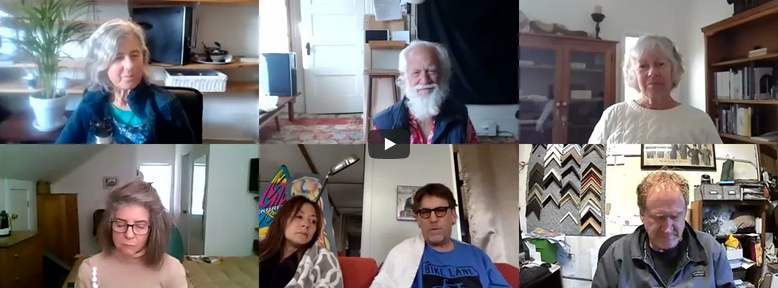
https://youtu.be/JhT5CyVcn0Q is the link to the Zoom video of this month’s Sunday meeting. The shorter first part of the meeting begins with a chapter reading followed by attendees’ commentary, if any. A little later on begins the longer open discussion part of the meeting when those who wish to discuss how the chapter relates to their personal experience.
Corrections?
Nothing this time.
Reflections:
Those who use weapons have a saying:
We dare not act as hosts, but act as visitors.
Line 2 reminds me of the last line of chapter 3, Doing without doing, following without exception rules. Hosts are the people who take the initiative, invite visitors, and set up circumstances. In short, hosts lead the way. Visitors are those invited and feel the need to follow and adapt to the circumstances set.
Broadly speaking, I feel that Earth, Nature, and time overall, are the hosts. I am merely a visitor passing through the circumstances these hosts have set up. When I am following without exception, my life runs very smoothly… even during difficult challenging times. Sure, I may experience exhaustion or pain, but by acting as visitor, it is never an overwhelming suffering. As a visitor, my expectations are naturally lower, and the lower they are, the less I suffer. Conversely, when I jump ahead and attempt to control circumstances, life can easily feel overwhelming, chaotic and ultimately full of missed opportunity.
Of course, our cognitive disease revealed in chapter 71 plays a large role here. It allows me to expect results, “predict” (imagine) outcomes and confidently advance toward my “envisioned solution”, or conversely, perceive (imagine) the cup utterly half empty and give up. Either way, I lose sense of the constant. As chapter 16 cautions, Not knowing the constant, rash actions lead to ominous results.
We dare not advance an inch, but withdraw a foot.
This is called going without going.
Grabbing without an arm.
Casting aside without opposing.
Taking charge without weapons.
Having these five lines offered all at once challenges the mind to intuit any possible deeper ‘hidden’ meaning. Now, of course, nothing in these lines is truly hidden. They feel paradoxical with hidden meaning because our thoughts are so habituated to being linearly proactive. We imagine the outcomes we need or fear and proceed accordingly, making the approach presented here so counterintuitive.
If you’ve not notice already, these lines are simply saying doing without doing (wéi wú wéi 为无为) by using other words. Think of a wild goose heading south for its winter migration. It is merely, flying without flying. It’s not imagining where it’s going or where it’s coming from. It’s not anticipating success or attempting to outwit its intrinsic nature. It’s doing without doing.
The only difference between the goose’s actions and that of a human lies in how easily we get ahead of ourselves—our reality. Instead of just doing the task at hand, we are able to either think we are doing the task great and continue the status quo, or think we’re failing miserably and quit altogether. Either belief easily blinds us to what would otherwise be an opportune moment to change course. Believing what we think blinds us to anything outside the belief.
Besides these two scenarios, we can also become lost in thought “doing” something entirely different in our imagination. The capability of our imagination to either flutter about or myopically focus is a superb survival asset, but this ability also creates our imbalance with nature—our disease. Clearly, chapter 71’s observation, Realizing I don’t know is better; not knowing this knowing is disease, applies to each of these scenarios.
It helps to know that our hyper proactive linear approach to life is a consequence of civilization. Civilization requires the societal value of taking responsibility to make the ‘bee hive’ function. Without this hyper-moral value of responsibility, civilization’s hierarchical social system would collapse (see The Tradeoff). Conversely, our ancestral hunter-gatherer way of life could afford to be much more forgiving and extemporaneous. The question becomes, what is natural and what is an artifact of civilization? Is taking responsibility an intrinsic quality— a natural virtue? Chapter 63 suggests not so much.
The obvious question then becomes how can we manage this disease, our disconnect from Nature, as it were. Clearly, knowing that we don’t know is the “cure”, i.e., Realizing I don’t know is better. Holding this realization in awareness through out daily life is the true challenge, even when we are sober enough to accept the fact we don’t know. Emotion (fear and need) always pull us back into cognitive certainty.
The presence of mind required to maintain physical balance when standing on one leg is not particularly different from that mindfulness required for realizing I don’t know is better. The fact that maintaining physical balance demands an active genuine intention makes that task ‘easy’ compared to continually realizing I don’t know is better.
Being present in either situation hinges on intention, but there is no innate push to be present unless forced into a state of alertness by circumstance. Losing balance and falling over serves as powerful motivation and immediate feedback. Losing the realization that I don’t know comes with little to no immediate feedback, which means that motivation here depends solely on ‘wisdom’ (for lack of a better word). Here alas, if anything, I’m more emotionally motivated to believe that I know what I know. As they say, knowledge is power. How can my ego resist that? In actual fact, motivation here relies on how sincerely I truly want (need) to remember that I don’t know. This “truly want” aspect comes down to a matter of survival. Once I feel my overall survival truly benefits from realizing I don’t know, the required “truly want” motivation comes naturally.
Of misfortunes, none is greater than rashly opposing.
Rashly opposing nearly lost me treasure.
These lines are reiterating the rash actions issue raised in chapter 16, i.e., Answering to one’s destiny is called the constant; knowing the constant is called honest. Not knowing the constant, rash actions lead to ominous results. Note the connection between honest and knowing the constant. I feel when I am present within the moment and discounting the reality of my thoughts, I am capable of being most honest. When thought cloaked in the guise of reality dominates my awareness, I’m much less honest. Here, I can only see what I want to see. Emotions (need and fear) and the thoughts those emotion stimulate influence overall perception greatly.
Therefore contending militantly, adds sorrow to victory.
This line hints at the difference between contending and contending militantly. It is important to know that contending by itself is a primary function of all life on Earth. Life without contending would be impossible… as would life without cooperation. These are the yang and the yin poles of life. I addressed the error of seeing contending as a moral problem in chapter 68’s, This is called the moral character of not contending.
This chapter offers a more balance view of contending. The militant problematic side of contending is a direct result of the interplay between imagination and emotion. Emotion provides the ‘blind energy’ to action. The imagination provides the obsessive direction for the action to take. In other words, the certainty of imagination permits natural forces of contention to snowball way more than circumstances require. It is this militant part of contending that’s problematic.
Chapter Archive https://youtu.be/3eWqIbt-ZbA
This is the complete video. It begins with blowing Zen followed by the meeting