When people don’t respect death, why use the fear of death?
If we could cause people to always respect death and be in wonder,
And we caught and killed them, who would dare?
Always have the killer manage the killing,
A man taking the place of the killer killing,
Is said to be taking the place of the great craftsman chopping.
A man taking the place of the great craftsman chopping rarely never hurts his own hands.
~~~~~~~~~~~~~~~~~~~~~~~~~~~~~~~~~~~~~~

Word for Word
Limits: Translations, even the nearly literal one above, lose some of the original meaning due to the cultural context of contemporary words. Studying the numerous synonym-like meanings of the Chinese characters in the Word-for-Word translation mitigates this.
Fourth Pass: Chapter of the Month
(pandemic era)
Archive: Characters and past commentary
Zoom on YouTube Recordings:
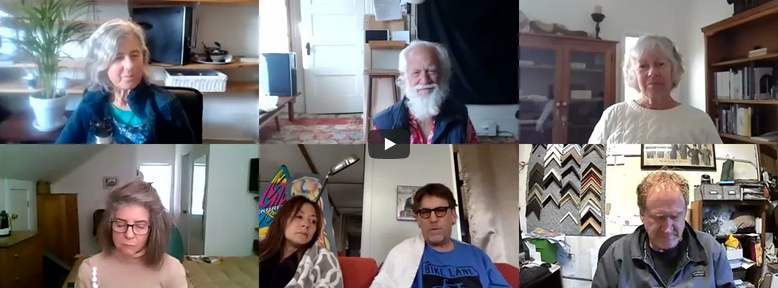
https://youtu.be/gDSV266JXMc is the link to the Zoom video of this month’s Sunday meeting. The shorter first part of the meeting begins with a chapter reading followed by attendees’ commentary, if any. A little later on begins the longer open discussion part of the meeting when those who wish to discuss how the chapter relates to their personal experience.
Corrections?
None this time.
Reflections:
When people don’t respect death, why use the fear of death?
If we could cause people to always respect death and be in wonder,
And we caught and killed them, who would dare?
This is a round about way of saying the human animal doesn’t always respect death and be in wonder. Indeed, the fact that we are able to respect death and be in wonder as much as we can is an odd quirk of natural evolution. I assume the innate neurological awareness of contrast along with the polarized characteristic of human cognition makes this possible. It helps to think of the polarized aspect of human cognition as an emergent property of the more fundamental and universal awareness of contrast—the on/off nature of neural signaling. (See Tao As Emergent Property)
Our foreknowledge and subsequent fear of loss, especially death, is one survival concern that pulls people into civilized behavior (see The Tradeoff ). This attempt to ameliorate our fears is “artificial” (i.e., not an evolved innate adaptation) and thus always bound to fail. Indeed, evolution can only proceed because organisms—from virus to human—don’t respect death. Nature’s flow needs the spontaneity that can only occur within that ignorance.
Chapter 16 rephrases the natural ignorance in terms of the constant, i.e., Not knowing the constant, rash actions lead to ominous results. Knowing the constant allows, allowing therefore impartial. While an individual striving to know the constant is uplifting advice, does such advice actually work? I think not, if as I observe, We only understand what we already know. Only through life experience can an individual, whether an old dog or an old human, intuitively become more aware of the constant, respect death and be in wonder. Certainly not always, but more frequently and more deeply than in youth. This is essentially a microcosm of how evolution plays out, i.e., act without fear, suffer the consequences and adapt (“learn”).
Chapter 70 lines up with this aspect of nature, Our words are very easy to know, very easy to do. Under heaven none can know, none can do. This natural ignorance is what makes the world go round, as it were. The curious aspect of our species is that we can objectify life’s struggle and imagine solutions that promise to ease that struggle. Ignorant of the constant, we naturally innovate wholly oblivious to the consequences. Again, that is how evolution works! Not surprisingly, we are largely dissatisfied with evolution because it doesn’t offer what we want here and now. Evolution is the price of admission to life; yet we don’t realize that, nor do we want to pay the price. Of course, in seeking to avoid evolution through innovation our rash actions lead to ominous results… eventually. And that is as it should be… yet again, that is evolution! Simply put, evolution is a marvelous and eventually self-correcting process. I find my deepest peace of mind when I set my personal wishes aside and simply respect evolution.
Always have the killer manage the killing,
A man taking the place of the killer killing,
Is said to be taking the place of the great craftsman chopping.
A man taking the place of the great craftsman chopping rarely never hurts his own hands.
I see the great craftsman as another word for evolution… for Mother Nature. Nature is the killer managing the killing. Nature does so without favor. These lines from chapter 79 offer a parallel view,
The wiser mind can behold, respect, and empathize with the misfortunes of life—hold this queer contract— but not attempt to resolve the problem— Yet doesn’t punish the people. The wiser mind having kindness takes charge of the contract. Nature in not having kindness, takes charge of the penetration. Nature’s way is without match because it doesn’t take a side—any side. Chapter 5 sums this ultra impartiality up well:
Much of human stress is a result of our ability to imagine better outcomes that correspond to what serves our needs and accommodates our fears best. These stories can easily dominate our thoughts, which then feed back into and stir up deeper emotional realms. The more one trusts and believes their thought to model reality—to be true—the more intense the stress becomes. Thus, chapter 71 counsels,
Essentially, this comes down to realizing how greatly awareness is a result of contrast. The contrasting aspects are like opponents in a game. They play off each other. To align oneself to one side is exceptionally easy to do emotionally, and by doing so traps us and turns the game into a serious matter of life or death. When the game turns serious enough, winning becomes everything.
Of course, this is completely natural and playing out as it should. The main issue for our species is that much of the stress this brings on is of our own imagination’s making. Once one intuitively knows they don’t know, much of this kind of added stress vanishes. Then all we have to deal with is the normal stresses of life that all living organisms face. Chapter 22 seems to sum all of this up somewhat,
Chapter Archive https://youtu.be/nE7AXHdrTME
This is the complete video. It begins with blowing Zen followed by the meeting