Of people, existence weak and delicate,
Their death hard and unyielding.
Of plants, existence soft and yielding,
Their death withered and haggard.
Therefore the hard and unyielding, of death only,
The weak and fragile, of life only.
The use of powerful weapons, normally destroys,
The strong tree normally breaks.
The big and powerful dwell below,
The weak and fragile dwell above.
~~~~~~~~~~~~~~~~~~~~~~~~~~~~~~~~~~~~~~
Word for Word
Limits: Translations, even the nearly literal one above, lose some of the original meaning due to the cultural context of contemporary words. Studying the numerous synonym-like meanings of the Chinese characters in the Word-for-Word translation mitigates this.
Fourth Pass: Chapter of the Month
(pandemic era)
Archive: Characters and past commentary
Zoom on YouTube Recordings:
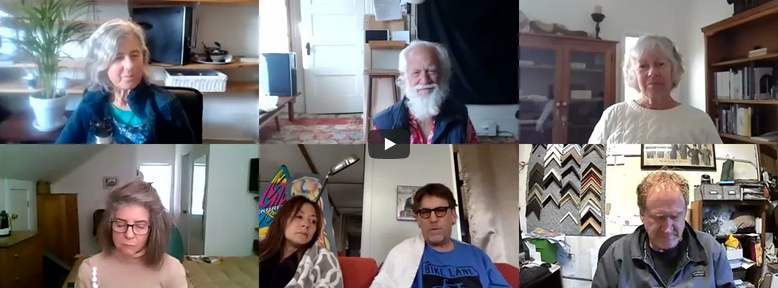
https://youtu.be/r84DB6HLEnQ is the link to the Zoom video of this month’s Sunday meeting. The shorter first part of the meeting begins with a chapter reading followed by attendees’ commentary, if any. A little later on begins the longer open discussion part of the meeting when those who wish to discuss how the chapter relates to their personal experience.
Corrections?
None this time.
Reflections:
Of people, existence weak and delicate,
Their death hard and unyielding.
Of plants, existence soft and yielding,
Their death withered and haggard.
This chapter brings us home to the essential life and death reality we experience, although the death side of this experience is actually more some figment of our imagination. I’ve encounter many that see a ‘better’ vs. ‘worse’ lesson here and seek through it a prescription for living life well. I see none of this, but rather simply a straightforward reminder of existence. All living things are weak and delicate. The only difference is in degree. A moth lives for hours, a sea turtle lives for over a century. Yet both are weak and delicate compared to stones (inorganic matter).
Last month’s chapter 75’s The people take death lightly because they seek life’s flavor, That is why they take death lightly observed how easily people fail to appreciate life’s existence weak and delicate. For one thing, we are innately striving to survive, and see ourselves in the most flattering light we can imagine. Seeing our existence as fleeting, weak and delicate is not what the ego wishes to entertain. It threatens the illusion of self. Survival instinct brightens our perceptions and sharpens our expectations of life, which drowns out life and death’s profound connection.
Life and death are two sides of the same coin, but instinct impels us to favor the life side of this profound connection. I find I can only minimize the tension this creates by intuitively closing this difference gap. Intuitive knowing is inexplicable, so an early step to take is putting far less trust in what we think we know (i.e., Chapter 71). The less trust I put in thought the more receptive I am to beyond-words knowing.
Therefore the hard and unyielding, of death only,
The weak and fragile, of life only.
It can help to think of this in the context of time—‘past’ and the ‘instantaneous present’. (Note: The future is more a figment of our imagination than a reality, although the past and present do influence future outcomes). The ‘past’ is hard and unyielding, of death only is it not? You might say the past is the death and graveyard of time. Conversely, the ‘instantaneous present’—NOW!—is weak and fragile, of life only. The fragile impermanence and changeability of ‘now’ is not possible to behold or measure without considering the hard and unyielding past. It is the apparent contrast we see and feel that makes both stand out in our imagination. As you begin to see the biological forces at play here (the Bio-Hoodwink), the relative distinction between life and death softens. In other words, you cannot have one without the other—two sides of the same singularity. Seeing it otherwise—sharp, bright, tangled, exchange,—is a natural and sometimes stressful neurological illusion that drives living creatures to act and react.
Naturally then, one cannot totally transcend this illusion; it is intrinsic to life. However, fully trusting that contrast and difference is an illusion does offer a way to sidestep much of its influence. You can observe the tornado without getting totally swept up by it.
The use of powerful weapons, normally destroys,
The strong tree normally breaks.
These two lines, while relatively true, don’t really fit here for me. Were they inserted here at some point to facilitate a moral interpretation? For example, “Avoid powerful weapons that destroy weak and fragile life, and be flexible like bamboo rather than stiff like a strong tree to avoid breaking”.
The big and powerful dwell below,
The weak and fragile dwell above.
Contrary to what may be popular perception, big and powerful are yin qualities. Weak and fragile are yang qualities. Yin dwells below; yang dwells above. Chapter 40 puts forth a very succinct view of this…
The Taoist recognition that loss through death, of the way uses, and that having is born in nothing, really goes against much of what passes for human ‘common sense’. That’s not surprising considering how our fundamental outlook on life is instinctively skewed toward survival, toward life. We innately hold on to what we cherish which easily blinds us to the actual forces at work. Again, simply put, the people take death lightly because they seek life’s flavor.
Chapter Archive https://youtu.be/zTfdab3z2YE
This is the complete video. It begins with blowing Zen followed by the meeting