The way of nature is like a stretching bow.
The high restrains, the lower lifts.
The surplus decreases, the insufficient benefits.
The way of nature decreases surplus yet benefits the insufficient.
The way of man, as a rule however, decreases the insufficient so as to give to the surplus.
Who can have a surplus and give to all under heaven?
Only those who have the way.
The holy person uses this to serve, yet does not rely on,
Meritorious deeds result, yet not dwelled within.
Such absence of desire appears able and virtuous – how odd!
~~~~~~~~~~~~~~~~~~~~~~~~~~~~~~~~~~~~~~

Word for Word
Limits: Translations, even the nearly literal one above, lose some of the original meaning due to the cultural context of contemporary words. Studying the numerous synonym-like meanings of the Chinese characters in the Word-for-Word translation mitigates this.
Fourth Pass: Chapter of the Month
(pandemic era)
Archive: Characters and past commentary
Zoom on YouTube Recordings:
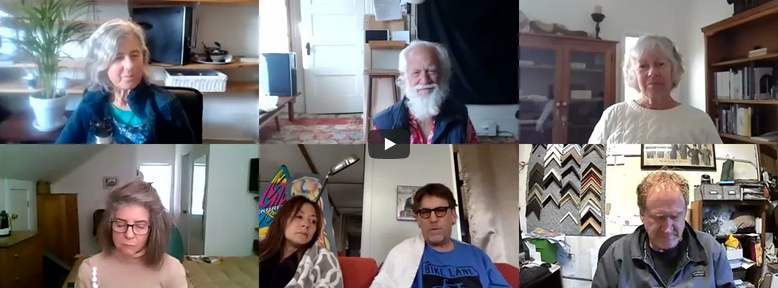
https://youtu.be/vmCChY-8DHY is the link to the Zoom video of this month’s Sunday meeting. The shorter first part of the meeting begins with a chapter reading followed by attendees’ commentary, if any. A little later on begins the longer open discussion part of the meeting when those who wish to discuss how the chapter relates to their personal experience.
Corrections?
None this time.
Reflections:
The way of nature is like a stretching bow.
The high restrains, the lower lifts.
The surplus decreases, the insufficient benefits.
The way of nature decreases surplus yet benefits the insufficient.
These first four lines convey a balanced, albeit subtle, picture of nature. As the fourth line concludes, The way of nature decreases surplus yet benefits the insufficient. This is the fundamental nature of entropy—taking from a surplus to give to the insufficient. Essentially, this is the essence of death of both organic and non-organic existences. As chapter 40 put it, Loss through death, of the way uses.
We can apply this facet of nature—decreases surplus yet benefits the insufficient—to any practical matter. A useful and straightforward example that applies to everyone is sarcopenia, a natural age-related progressive loss of muscle mass and strength. Overall, sarcopenia is associated with a significantly higher risk of mortality, so this way of nature is relevant for anyone wishing to improve their health span and life span as much as possible.
Your body must biologically know you are serious before it will begin to decrease surplus of protein to benefit the insufficiency of muscle. This also applies to bone density and joint flexibility, but the muscle side of this is most clear-cut.
Youthful energy (fear, need) is serious enough to drive muscle growth and its maintenance. As you age into midlife and beyond, this innate energy (fear, need) gradually decreases. During this time, you just maintain your life’s mellower routine, which sounds comfortable at first glance.
However, the progressive mellowing down as you age initiates gradual muscle loss. The body senses you no longer seriously need as much muscle as you did in youth, and so begins decreasing surplus, and uses the recycled proteins in other ways. This can happen so gradually over years that it is comparatively unnoticeable.
Once we realize this decline in health span, most of us would probably wish to reverse course. Here lies the hitch: Our wish must be backed up with raw will—a visceral Striving to be current is will, as chapter 33 puts it. Resistance exercise and braving the elements is the only way to reverse or at least slow down this process. However, as we age we become more mellow and more sensitive to discomfort (heat, cold), which together make it difficult to be serious enough to make the necessary effort.
The body (i.e., biology) must know you are deadly serious and not just indulging in wishful thinking. True recovery is driven by a genuine sense of necessity, not desire (i.e., desire = need + thought). This way of nature is the foundation underpinning all life functions, not just muscle. (See Fear & Need Born in Nothing and Necessity, the Mother.)
Finally, one may wonder why natural evolution set us up for this age-induced decline. It actually didn’t, at least to the extent humanity experiences it. All animals evolved to live in balance with nature’s demands, and so for our distant ancestors, many of humanity’s current problems were usually non-existent. We humans arrogantly, albeit naively, sidestepped nature’s more uncomfortable wild side. This unavoidably brought about the deep-seated imbalances we see throughout civilization. (See The Tradeoff). Undoubtedly, rebalance can only occur by welcoming more discomfort into life. As I like to say, “Short-term pain nurtures long-term pleasure”.
From here on this chapter comes across with a somewhat moralistic slant. The end of the last line how odd! sums this up, at least for me.
The way of man, as a rule however, decreases the insufficient so as to give to the surplus.
Who can have a surplus and give to all under heaven?
The way of man is actually no different from the way of nature, despite our stories that consistently bury that reality. Such idealistic moral stories like the fifth line, The way of man, as a rule however, decreases the insufficient so as to give to the surplus, are undoubtedly an attempt to compensate for the lopsided consequences of civilization (again, see The Tradeoff). The simple truth is this: if one is content, one’s actions naturally reflect contentment, and thus never would decrease the insufficient so as to give to the surplus. Conversely, when we feel discontent, we are feeling insufficient and so scurry around to fill that inner void with whatever surplus we feel will do the trick, which is the natural process for all life!
We notice the imbalances in society and ourselves and feel a strong need to correct them. Our belief that we have a uniquely human ability to control circumstances plays right into this urge to fix the problem. Interestingly, our belief in this ability to control becomes the irrefutable “proof” that we have control. This is one of the ironic aspects of belief; belief in something becomes the “proof” of that something—no evidence required. Blinding faith is all the “evidence” we need. (See Free Will: Fact or Wishful Thinking?) The sixth line, Who can have a surplus and give to all under heaven is the perfect example of our ‘cart before the horse’ view of nature. Only when we feel an inner surplus are we able to give to all under heaven, as it were. Simply put, natural processes operate throughout all species, including our own.
It is easy to notice how some people have great surplus. It is also easy to be oblivious to the underlying forces at play here. I’d call this an illusion of “objectivity”. This chapter is saying that those with an ostensible surplus, as a rule however, decrease the insufficient so as to give to the surplus. This demonstrates the very misleading characteristic of so-called “objective perception”. Indeed, objectivity is rooted in subjectivity. What we feel and think are simply inner biological/psychological forces skewing our judgments on reality. Essentially, all we perceive is but a mirror of our own inner reality—our needs and fears. Considering the goings on in life from a symptoms point of view (see Symptoms Point Of View) helps step back from our own emotional agenda and see what may lie beneath the surface.
In this case, anyone who decreases the insufficient so as to give to the surplus is actually feeling the insufficient—the void—within. Feeling insufficient (loss, empty, insecure, hunger, etc.) they can’t help but grasp after their treasured ‘something’ until they viscerally feel they have reached the surplus. Of course, that doesn’t end this cyclic process of nature. Indeed, adding more on to life can’t nullify the entropic void within. Yet, the emotions (fear and need) will always shout out otherwise. Chapter 46 pulls us back to the simple truth… Therefore, in being contented with one’s lot, enough is usually enough indeed. Thus, those who decrease the insufficient so as to give to the surplus are actually experiencing the insufficient within. The grasping after only ceases when one feels more inner sufficiency—the inner cup spilleth over!
Only those who have the way.
This is a blatantly shallow and hierarchical view of the way, and goes against the spirit of chapter 73’s Nature’s net is vast and thin, yet never misses. In other words, what in all of creation does not ‘have the way’? Such hierarchical and moralistic viewpoints creep into the Tao Te Ching quite rarely—fortunately. This is a sobering reminder that being as impartial as nature is virtually impossible for any living organism. As chapter 16 ends,
Life does not permit us to be totally impartial, and so even approaching impartiality is truly nearly rising beyond oneself. I find it more than sufficient to face up to and accept my impartiality, and bravely admit I am simply a fragile and fleeting artifact of nature. As chapter 76 put it, Of people, existence weak and delicate.
The holy person uses this to serve, yet does not rely on,
Meritorious deeds result, yet not dwelled within.
Here again, these two lines put the cart somewhat before the horse. The need to rely on ‘something’ is simply a symptom of the insufficiency of that ‘something’. These lines imply that those who have the way have no insufficiency. In reality, feeling insufficiency is the baseline for all living creatures. Thus, the whole idea of any living thing as not having the way as moralistic and absurd. Take chapter 34’s The great way flows, such as it may left and right. All things on earth depend on it for existence, yet it never declines or chapter 73’s Nature’s net is vast and thin, yet never misses. This is rather a simple case of internal imbalance—the lack of homeostasis—with the deficit driving a need to rely on ‘something’ missing. This is natural, no different from how hunger drives living things to seek out nourishment. Life is a pendulum, swinging between sufficiency and insufficiency.
Thus, the only time one dwells within their so-called meritorious deeds is when they feel a deficit, i.e., social insecurity and in need of self-affirmation or increased higher status in the social hierarchy. Any claims made about one’s virtue or meritorious deeds are a symptom of their need to bolster their self-image. Fear (entropy, loss, insecurity) drives us to compensate in myriad ways in our pursuit of inner psychological homeostasis—balance.
Such absence of desire appears able and virtuous – how odd!
I find it quite true that the more absent my desire, the more able I am to deal with circumstances in the most balanced, graceful, and virtuous way. Indeed, desires and expectations are the main roadblocks to virtuous action. Clearly, this means that virtuous action is not a reality, but rather an ideality. Fear and need (desire) are the motivation forces that propel life to live and act. Chapter 38 puts virtue in perspective, although it still ends from a somewhat ‘cart before the horse’ point of view.
Chapter Archive https://youtu.be/I75py_zxBos
This is the complete video. It begins with blowing Zen followed by the meeting