Under heaven, nothing is more yielding and weak than water.
Yet for attacking the hard and strong nothing can surpass,
Because of its nothing-ness and ease.
Of weakness and loss through death, superior to strength.
Of flexible, superior to firm
Under heaven, none do not know; none can do.
Because of this, the holy person says,
Receiving the humiliation of the country means mastering the country.
Receiving the country’s misfortune serves all under heaven great.
Straight and honest words seem inside out.
~~~~~~~~~~~~~~~~~~~~~~~~~~~~~~~~~~~~~~
Word for Word
Limits: Translations, even the nearly literal one above, lose some of the original meaning due to the cultural context of contemporary words. Studying the numerous synonym-like meanings of the Chinese characters in the Word-for-Word translation mitigates this.
Fourth Pass: Chapter of the Month
(pandemic era)
Archive: Characters and past commentary
Zoom on YouTube Recordings:
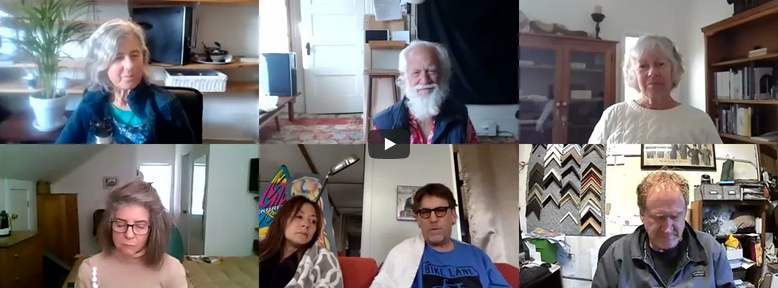
https://youtu.be/OZeJ3CqBD_M is the link to the Zoom video of this month’s Sunday meeting. The shorter first part of the meeting begins with a chapter reading followed by attendees’ commentary, if any. A little later on begins the longer open discussion part of the meeting when those who wish to discuss how the chapter relates to their personal experience.
Corrections?
None this time.
Reflections:
Under heaven, nothing is more yielding and weak than water.
Yet for attacking the hard and strong nothing can surpass,
Because of its nothing-ness and ease.
Water is the go-to metaphor for something that is completely yielding yet also able to attack the hard and strong. Considered more closely, we see that it is not so much water per se that has this ability, but the underlying conditions, i.e., the momentum of it’s weight when moving and its ability to carry abrasives (sand) that over time wear down the hardest material.
This need for a metaphor reveals the impossibility we face of attempting to describe the counter-intuitive power of nothing-ness. This shows the profound limitation of words and the language and the stories we weave by the use of them. We are somewhat stuck in this word-based illusion. The mind desperately needs to feel words are real, even though experience constantly reminds us of their utter inadequacy. Our belief in words as being an accurate reflection of reality boxes us into a never-ending illusion. Why do we cling on so tightly to something as arbitrary as word meaning?
Personal, deep-seated insecurity drives us to hold on tightly to whatever ‘something’ we feel is real. Belief is a ‘something’ that becomes its own proof of the reality of that ‘something’. Human history is chock full of empirical proof of this process at play, especially in religion and politics.
Buddha’s 2nd Noble Truth speaks to this cognitive trap we find ourselves in, albeit, from a ‘cart before the horse’ position… “The illusion of self originates and manifests itself in a cleaving to things” would appear to say the cleaving to things (material and thoughts) creates the illusion of self. However, observed more deeply, it is clear that our level of insecurity drives us to our cleaving in the first place, and from there, the illusion of self is created and maintained by cleaving to all the particulars we feel important. On the other hand, the more inwardly secure a person feels, the less adamant—the less cleaving—they will naturally be on any particular line of thought. Belief loses its power of persuasion.
Of weakness and loss through death, superior to strength.
Of flexible, superior to firm
Under heaven, none do not know; none can do.
That weakness and loss through death are superior to strength are innately hard to swallow. This brings the metaphor of the power of nothing-ness down to an even more personal and dare I say threatening level. It threatens every biologically based “yang” instinct. Living beings are biased, leaning toward the survival side of natures pendulum. So why does the sixth line point out, Under heaven, none do not know; none can do?
If nothing-ness is the foundation of “existence”, surely all aspects of “existence” both organic and inorganic must by definition be influence by ‘sensing’ that foundation. On one hand influenced, but on the other hand delimited within its individual form of existence. Thus, all existence inhabits what feels to be a contradictory reality. This feels as surreal as quantum-nonlocality. And both are challenging for anyone (or anything) to get their head around. In short, Under heaven, none do not know yet simultaneously none can do.
It should be easy to find a metaphorical example of this quandary when you look back on personal experience. I assume that we have all faced times when we knew a more yielding approach would be the wiser more effective way forward, but our emotions irresistibly resorted to strength and firm anyway.
Note how yielding and weak, and weakness and loss are some corresponding properties of patience. Patience is an incredibly powerful quality that wins the day, nine times out of ten. Yet, when emotions run high, patience will be the first casualty.
Because of this, the holy person says,
Receiving the humiliation of the country means mastering the country.
Receiving the country’s misfortune serves all under heaven great.
It can help to consider the line ‘receiving the humiliation of the country means mastering the country’ in a more personal way, i.e., receiving the humiliation of [one’s life] means mastering [one’s life]. We spend much of life attempting to survive, achieve and succeed, which is a natural imperative that all living things embody. This journey is ultimately futile and always ends in “failure”. At the tiptop of success, the only left is to fall, fail, or begin pursuing another way to achieve. In the end, loss through death will be the ultimate end of the line. As chapter 40 notes, Loss through death, of the way uses.
Ironically then, the only way to master one’s life is by coming to terms with its ultimate failure. In this way, we have an opportunity to nearly bring true closure to our life—nearly completing the circle. Note the limitation, as chapter 52 puts it, Nearly rising beyond oneself. Thus, as line six tells us, Under heaven, none do not know; none can do. In other words, no one (or thing) can willfully bring about such humility and closure. The most we can do is recognize this is the way of nature, and do the work of life. I will say that over my life’s journey (now at the age of 80) I have gradually received my life’s misfortune. It is not any particular misfortune mind you, but rather that Of weakness and loss through death, superior to strength.
Straight and honest words seem inside out.
One reason why Straight and honest words seem inside out is that we desperately need to have our words reflect our secure, albeit inaccurate, innate sense of nature—reality. The truth is not the comforting story we’ve grown accustomed to throughout life. As chapter 5 bluntly reveals, The universe is not benevolent, and all things serve as grass dogs (‘sacrificial lambs’).
Chapter Archive https://youtu.be/3jQql7d0qao
This is the complete video. It begins with blowing Zen followed by the meeting