With great resentment must exist lingering resentment.
Such peace, passable, serves perfectly.
That is because the wise person holds this queer contract,
Yet doesn’t punish the people.
Having kindness takes charge of the contract,
Not having kindness takes charge of the penetration.
Nature’s way is without match,
Constantly helping the charitable person.
~~~~~~~~~~~~~~~~~~~~~~~~~~~~~~~~~~~~~~

Word for Word
Limits: Translations, even the nearly literal one above, lose some of the original meaning due to the cultural context of contemporary words. Studying the numerous synonym-like meanings of the Chinese characters in the Word-for-Word translation mitigates this.
Fourth Pass: Chapter of the Month
(pandemic era)
Archive: Characters and past commentary
Zoom on YouTube Recordings:
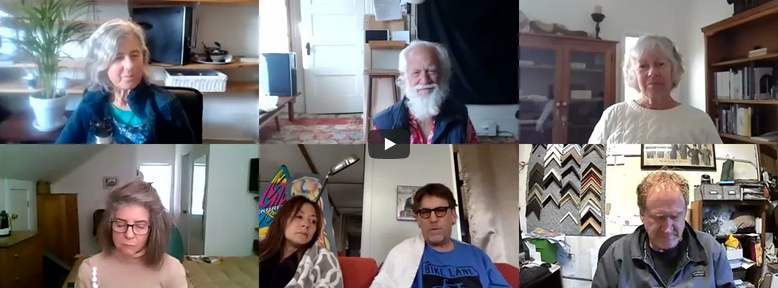
https://youtu.be/pEkK6oHT9Kk is the link to the Zoom video of this month’s Sunday meeting. The shorter first part of the meeting begins with a chapter reading followed by attendees’ commentary, if any. A little later on begins the longer open discussion part of the meeting when those who wish to discuss how the chapter relates to their personal experience.
Corrections?
None this time.
Reflections:
With great resentment must exist lingering resentment.
Such peace, passable, serves perfectly.
With great resentment must exist lingering resentment reminds us that nature discards not one thing. All extremes exist, and so resentment must include lingering resentment. It is an acceptance of reality in contrast to the ideality trap we are often ensnarled within. Stress becomes inevitable whenever we buy into any story of perfection, like the idea that it is possible to ‘choose’ to let go of lingering resentment, self-blame or regret. Such peace, passable, serves perfectly makes it clear that in the real world, lingering resentment is natural and unavoidable. Two paths arise from this de facto reality, as it were. One uses kindness to blunt any lingering resentment, the other just succumbs to the negative emotion, often seeking “justice”.
That is because the wise person holds this queer contract,
Yet doesn’t punish the people.
This describes the utility of empathy and kindness in the face of resentment. The wise person can’t help but feel lingering resentment at times, but is able to avoid having those emotions drive him/her to punish the people associated with the resentment. To hold both emotions—kindness and resentment— simultaneously is what make this [a] queer contract.
Emotions tend to run away with themselves. Thus, when feeling resentment, it is easy—“delicious” even—when such emotions consume awareness. Conversely, feeling kindness easily pushes emotion to the other extreme—benevolence. Extremes of resentment or kindness are both stressful, and left unchecked lead to unintended consequences. Staying in the balanced middle between these extremes is a tall order. Note how chapter 5 depicts the problematic side of benevolence…
The reference to ‘sacrificial lambs’ correlates with respect. Respecting the diverse and uneven nature of all creation is impossible when one is bestowing favor on any aspect of creation. As D.C. Lau translates, It is the way of heaven to show no favoritism. Clearly, showing favoritism sets up the emotional conditions for resentment, lingering or otherwise.
How can a person hold this queer contract of feeling kindness on one hand and yet harbor the lingering resentments that accompany everyone through life somewhat?
It can help to consider the cause of resentment first, and then how other animals deal with it. First, resentment is a natural result of not getting what one wants. In non-thinking animals, resentment is felt in the moment but soon passes as this moment passes on to the next. In humans, resentment emotions easily feed into a story that lingers in memory. Subsequent dwelling upon the story reignites the resentment emotions. This process can easily span generations as the story becomes part of a cultural narrative (e.g., Jews and Arabs vis-à-vis their claims to land).
Comparing humans to all other animals on Earth reveals the principle reason for our difficulty. Chapter 71 lays this out clearly, Realizing I don’t’ know is better; not knowing this knowing is disease. We believe what we think. This naive trust we have in our beliefs becomes the very proof of the belief itself. Our very self-identity and ego soon becomes entwined with our belief. This is a uniquely human disease.
Examined more closely, I can see how this trust in words begins in infancy as we begin to learn our native tongue. We can’t help but place trust in the meaning of the words we learn to use to communicate, both externally with others and internally with our selves. Placing such absolute trust in names and words unconsciously locks us into any story that garners our belief. In the end, we place more trust in our words and thoughts than in nature’s messy landscape—and hence our disease.
Chapter 56 suggests one way out of this word trap…
The word-trust problem begins with our innate bias on the side of differences over similarities. Differences feel more real, which in the wild would be a survival advantage, i.e., “Is that long narrow thing as stick or a snake?” It is safer to note the difference! However, that bias causes a persistence state of cognitive imbalance in us thinking animals. Overall, profound sameness strikes closer to the reality of nature. The clear difficulty for us lies in how deeply the perceptions of difference hold us. Simply put: words are creations of perceptual difference (hot vs. cold, old vs. new, open vs. closed, etc.), and when we build our beliefs out of words, the trust in differences become part and parcel of our beliefs.
The only way I find to mitigate this trust in word and thought is to challenge it at every turn… “Is it really hot? How hot? How cold? Truly cold, or just cool, or cooler than before?” Any way I can discount the certainty of word-meaning helps to Squeeze exchange, shut the gates, Subdue its sharpness, untie its tangles, Soften its brightness, be the same as dust. This is the prerequisite for perceiving profound sameness. See Tools of Taoist Thought: Correlations for a way to un-learn our deep trust in word meaning.
Having kindness takes charge of the contract,
Not having kindness takes charge of the penetration.
Simultaneously retaining a sense of kindness and lingering resentment I can take charge of the contract. Without kindness, I get drawn into acting upon my lingering resentment and naturally take charge of the penetration, which usually takes some form of passive aggression. Or I can internalize the whole issue, which means the penetration simply becomes me dwelling on the resentment. And this eats away at me as long as I trust my story.
Nature’s way is without match,
Constantly helping the charitable person.
I suppose this constantly helping the charitable person is another way of saying, “Kindness is its own reward”. Holding onto resentment, hate, and anger seems to come naturally, and as compelling as the emotions of want and worry (i.e., need and fear). Perhaps resentment is the result of the fear of not getting what you need! For non-thinking animals, any such emotional reaction subsides as soon as the conditions that triggered it end. For us, thought dwells on the event causing the resentment, which keeps us spiraling down into lingering resentment by re-triggering the initial emotion. (See Fear & Need Born in Nothing)
One major error we make in life that gives resentment such lasting power is our belief in free will. We are certain we and others have the power to choose our course of action. What we easily fail to realize is that the choices we make are driven by deep-seated needs and fears, of which we have no control over. I imagine that is very hard to accept, for we so desperately need to have the sense that we are in control. Trust in that story alone is enough to ensure one becoming entangled in a web of lingering resentment. (See Free Will: Fact or Wishful Thinking? and Belief: Are We Just Fooling Ourselves?)
Chapter Archive https://youtu.be/OjggoO8Rqs4
This is the complete video. It begins with blowing Zen followed by the meeting